
One Page Backup Caregiver Plan and 3 Tier Roster Families Can Copy


A backup caregiver plan is a written, tested list that names who will cover must-do tasks, how to access the home, and where critical medical information lives. It exists so one absence never turns into an emergency. The first move is small: make a one-page emergency care sheet and name at least one backup person today, before you need either one.
TL;DR:
Backup plans should be built around safety-critical tasks, with clear tiered roles for family, neighbors, and trained caregivers, including specifics on availability and scope.
The emergency care sheet must contain detailed medical, medication, and contact information, posted visibly and stored securely for quick access during emergencies.
Access and equipment readiness are crucial, including secure entry options, device backup plans, and a prepared emergency kit to handle power outages or supply disruptions.
Professional backup care is necessary for complex medical tasks or overnight needs, with testing, reliability data, and quality checks prioritized over basic name lists.
Regular, low-stakes drills and plan updates, along with clear communication protocols and legal logistics, ensure the backup system functions reliably when urgently needed.
Table of Contents
Opulent Private Care’s Perspective: Measurable Continuity You Can Copy
How Do You Handle HIPAA and Medical Privacy With Backup Caregivers?
How Do You Keep Multiple Backup Caregivers From Working at Cross-Purposes?
How Do You Train a Backup Caregiver on Specific Medical Needs?
The Uncomfortable Truth About Backup Plans Most Families Never Test
Opulent Private Care: A Direct Path to Reliable Pediatric Nursing Backup
How Do You Build a Tiered Backup Roster for Home Care?
Most families discover their backup plan is broken at the worst possible moment. The fix is mapping dependencies before that happens, not after.
Start by listing every task your loved one needs in a week, then mark each one must-do (medication, toileting, transfers, feeding) or nice-to-have (a walk, reading together, errands). Safety-critical tasks get covered first, no matter who is available. This split matters because a backup caregiver plan template built around must-do coverage keeps untrained substitutes from being handed something they can’t safely do.
From there, sort your people into tiers:
Tier 1: Family or close friends within 20 minutes who already know the routine.
Tier 2: Neighbors, extended family, or church/community contacts who can help with lower-risk tasks or short windows.
Tier 3: Paid aides or agencies you’ve pre-vetted for medically complex or overnight coverage.
Don’t just ask, “Can you help?” Get specifics: availability windows, a trial shift, and what they’d want reciprocated. Round out the roster with video check-in tools and local adult day programs, which give you coverage options that don’t depend on a single person’s schedule.
Pro Tip: Reframe the ask from “Can you do this?” to “What would you want to happen if I disappeared for a week?” It cuts through the guilt that makes people hesitate to name backups at all, according to the Family Caregiver Alliance.
What Belongs on a One-Page Emergency Care Sheet?
Any substitute caregiver, whether it’s your sister or a nurse who’s never met your loved one, needs one document that answers every urgent question in under two minutes.
Build it with these fields:
Full medication list: name, dose, schedule, and what happens if a dose is missed.
Allergies and reactions, including severity.
Primary doctors, specialists, and pharmacy with phone numbers.
Medical equipment in use and how to operate it.
Mobility and transfer instructions, noted step by step.
Behavioral quirks or triggers a stranger wouldn’t know.
Emergency contacts, ranked by who to call first.
Keep it simple once it’s built:
Post a visible copy on the fridge or near the front door.
Store an encrypted digital copy accessible to every Tier 1 and Tier 2 person.
Give a condensed wallet card version to the backup caregiver on duty.
Use a pill organizer and require a second person to verify doses during handoffs.
The Family Caregiver Alliance specifically recommends this kind of visible in-home info card for exactly this reason: it removes the guesswork during the ten minutes when guesswork is most dangerous.
Is the Home Ready for Someone Else to Step In?
A backup caregiver who can’t get in the door, or can’t find the oxygen concentrator’s spare battery, is not really backup. Access and equipment readiness deserve as much attention as who’s on the roster.
Set up practical entry options: a lockbox with a rotating code, a smart lock you can manage remotely, or spare keys distributed only to Tier 1 and Tier 2 people. Walk each new backup through the home once, in daylight, before there’s an emergency.
Device-dependent care raises the stakes. If your loved one relies on electricity for a ventilator, feeding pump, or oxygen equipment, contact your utility company now about priority restoration programs for medically dependent households. Many utilities offer this, but only if you register in advance.
Build a grab-and-go emergency kit:
One week of medications, sorted and labeled.
Chargers and backup batteries for every device.
Physical copies of the emergency care sheet and insurance cards.
A basic generator or battery backup plan if outages are common in your area.
Small fixes go a long way for someone unfamiliar with the home: clear labeling on breaker panels, a flashlight by every bed, and a printed list of exactly where medical supplies are stored.
When Should You Call in Professional Backup Care?
Family and friends can absorb a lot, but there’s a point where informal coverage stops being safe. Overnight monitoring, frequent complex medical tasks, or any situation with real fall or choking risk are signals to bring in paid help, not push a tired relative further.
Caregiver exhaustion is a documented health risk, not just a feeling. Research reviewed in a PMC caregiver stress analysis links sustained caregiving strain to higher rates of depression and sleep disruption, which is its own argument for building professional backup in before you’re depleted.
When vetting an agency, ask direct questions:
What’s your actual response time when a scheduled caregiver cancels?
What’s your backup protocol, and how often does it get used?
Has staff handled this specific condition before?
Can you share your shift-fill rate?
Pro Tip: Ask for a trial shift before you need one for real. A single low-stakes test run tells you more about an agency’s reliability than any sales conversation.
Adult day programs and short respite stays are worth folding into your roster too. They’re not just a Tier 3 fallback. They’re scheduled relief that keeps your Tier 1 people from burning out.
How Do You Test and Update the Plan Over Time?
A plan that’s never been rehearsed is a theory, not a plan. Run a low-stakes “fire drill” where a backup caregiver actually handles a shift while you’re reachable but not present.
Schedule a trial shift and watch for gaps: Did they find the meds? Follow the transfer instructions correctly? Know who to call?
Debrief immediately and write down what broke down, even small things.
Fix the weakest link before the next drill, not after the next real emergency.
Repeat quarterly, and always after a medication change, diagnosis update, or hospital stay.
Assign remote family roles clearly: one person coordinates scheduling, one executes hands-on care, one documents changes to the care sheet. Without that split, updates get lost and everyone assumes someone else handled it.
Does a Power of Attorney Cover Day-to-Day Caregiving?
No, and this is one of the most common mistakes families make. A power of attorney, durable POA, or advance directive gives someone legal authority to make decisions. None of it obligates that person to show up and provide hands-on care.
As AARP points out, legal paperwork does not replace an operational plan; families that rely on POA alone are often blind sided when the named decision-maker isn’t the same person who can physically be there.
Build the operational side separately:
Written task delegation, so backups know their specific job.
Payment authorization set up in advance, so a paid aide can be hired without delay.
A named “quick-decision” contact for moments when the primary caregiver is unreachable.
Talk to an elder-law attorney about how your state treats these documents, and bring a specific question: what happens if my named decision-maker and my available caregiver are two different people?
Opulent Private Care’s Perspective: Measurable Continuity You Can Copy
Most backup planning advice stops at “have a list of names.” What separates a plan that survives contact with reality is proof, not intentions. That’s the operational lesson behind Opulent Private Care’s 3 Thumbs Up Rule: care doesn’t start until the family, the caregiver, and Opulent all sign off. Mutual approval up front eliminates the friction that shows up during a rushed handoff.
The other lesson is measurement. Opulent publishes shift fill rates and nurse retention numbers because those figures predict reliability better than a sales pitch does. When you’re vetting any backup source, ask for the same kind of data.
Three practices worth borrowing directly:
Run a real trial shift before committing, not just a phone screen.
Ask any agency for their actual fill-rate and retention numbers, not a general reassurance.
Prioritize continuity-focused scheduling over rotating staff, since familiarity reduces handoff errors.
The families who avoid crisis aren’t the ones with the longest contact list. They’re the ones who tested their backups before an emergency forced the test on them.
Who Notifies Whom, and Who Has Authority to Pay?
A roster full of willing people is useless if nobody knows the actual sequence for a crisis. Decide, in writing, exactly who gets called first, second, and third, and what each person is authorized to do once they’re reached.
Start with a single point of contact, usually the primary caregiver or the person with payment authority, who triggers the chain. That person notifies Tier 1 backups directly, and Tier 1 notifies Tier 2 if needed, rather than everyone getting a group text at once and assuming someone else will act.
Payment authority needs to be settled before a crisis, not during one. If a paid aide or agency needs to be hired on short notice, the person authorizing that spending should already have access to funds, a card on file, or a pre-approved budget. Waiting to sort out payment while someone is standing at the door is how backup plans stall at the worst moment.
Write the chain down on the same document as your emergency care sheet:
Who gets called first, and their backup if unreachable.
Who has authority to approve paid care or medical decisions.
Who updates the rest of the family once a decision is made.
This isn’t bureaucracy for its own sake. It’s the difference between a five-minute phone call and a confused hour of everyone calling everyone else.
How Do You Handle HIPAA and Medical Privacy With Backup Caregivers?
Sharing medical details with a backup caregiver isn’t automatic, even for family. Under HIPAA guidance from HHS, health care providers can share relevant information with people involved in someone’s care, but there are limits when a patient hasn’t given explicit consent or has capacity to object.
For adults receiving care, get a signed release naming exactly who can access medical information and from which providers. This should be sorted before a crisis, since asking a hospital to make a judgment call while a family member is unreachable adds delay nobody needs.
For your written care sheet and roster, treat it as a privacy document, not just a logistics tool. A few practices worth adopting:
Store the digital version behind a password, not in an open shared drive.
Give each backup only the information they need for their tier, not the full medical history by default.
Confirm in writing who is authorized to speak with doctors or pick up prescriptions.
None of this needs to be adversarial. It’s simply the difference between “family helping out” and a documented consent trail that protects the patient and the people caring for them.
How Do You Keep Multiple Backup Caregivers From Working at Cross-Purposes?
Confusion multiplies with every extra person on the roster. Two backups who both think they’re “on” for Tuesday, or a substitute who undoes a system the primary caregiver just built, causes more stress than having no backup at all.
A shared calendar, even a simple one, solves most of this. Everyone on the roster should see who’s assigned to which shift, updated in real time rather than through scattered texts. Pair that with a single shared version of the emergency care sheet, so nobody is working from an outdated printout while someone else has the current one.
Handoffs are where coordination breaks down fastest. Build a two-minute verbal or written handoff ritual between outgoing and incoming caregivers: what happened during the shift, what’s due next, and anything unusual. It doesn’t need to be formal, but it needs to happen every single time, not just when something feels urgent.
Assign one person, usually whoever coordinates the roster, as the tiebreaker when backups disagree on an approach. Without that, small differences in routine (how a transfer is done, when a snack is offered) turn into friction between well-meaning people who are all trying to help.
How Do You Train a Backup Caregiver on Specific Medical Needs?
A willing backup who hasn’t been trained on the specific condition is a liability, not a safety net. Training doesn’t need to take weeks, but it does need structure.
Start with a hands-on walkthrough, not a verbal explanation. Have the new backup shadow the primary caregiver through an actual routine: medication administration, a transfer, a feeding schedule, whatever applies. Watching once and doing it once, with supervision, teaches far more than a written instruction sheet alone.
For anything involving specialized equipment, tracheostomy care, seizure response, or feeding tubes, resources built specifically for that condition matter more than general caregiving advice. A seizure management guide or condition-specific training resource gives backups the exact steps rather than a general sense of what to do.
Build a short competency check before anyone is left alone with care: can they name the medications and doses, demonstrate the transfer safely, and explain what triggers a call to 911 versus a call to the doctor. If they can’t answer confidently, they’re not ready for that tier yet, and that’s useful information before an emergency, not during one.
What Happens When the Whole Backup System Fails at Once?
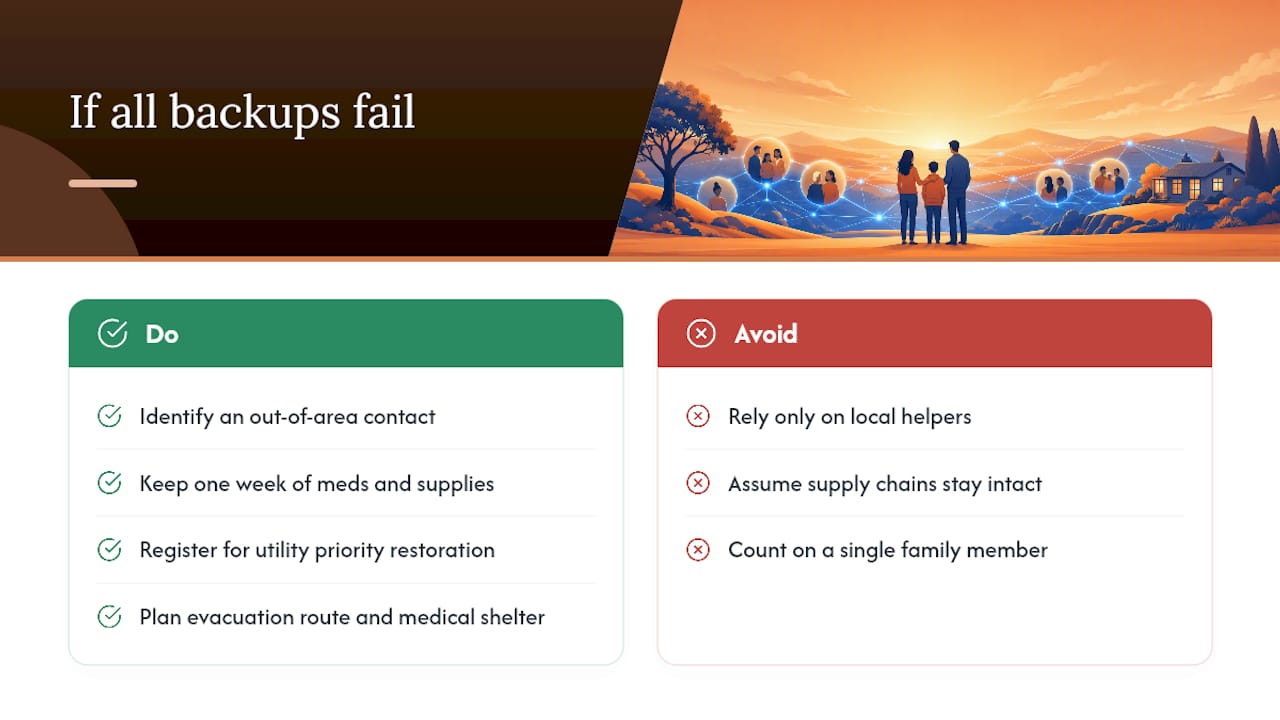
Every tier on your roster assumes at least some people are available. Pandemics, hurricanes, ice storms, and regional emergencies break that assumption completely, since everyone in your area may be dealing with the same crisis simultaneously.
Build a version of your plan that doesn’t depend on local help. Identify at least one out-of-area contact, family or a paid agency with remote coordination ability, who can help direct resources even if they can’t physically show up. Keep a week of medications and supplies on hand at all times, not just during hurricane season, since supply chains can tighten with little warning.
Register in advance with your utility for priority restoration if your loved one depends on powered medical equipment, and know your evacuation route and the nearest shelter equipped for medical needs before you need either.
Widespread emergencies are also when paid agencies matter most, since informal networks are stretched thin everywhere at once. An agency with documented backup protocols and multiple staff on call is more resilient than any single family member, no matter how devoted. Build that redundancy into your plan now, while you have the luxury of planning calmly instead of reacting.
The Uncomfortable Truth About Backup Plans Most Families Never Test
Most families have a mental backup plan. Almost none have a tested one, and that gap is where things fall apart. The conventional advice, keep a list of relatives who could help, sounds reasonable until the actual moment arrives and half the list is unreachable, untrained, or unwilling once asked directly.
What the research and the practical frameworks agree on is this: documentation and testing beat good intentions every time. A written care sheet that a stranger could follow, a roster with real commitments instead of vague willingness, and at least one trial run before an emergency, these are the things that separate families who cope from families who scramble.
Prioritize the must-do tasks first. Skip the temptation to build a perfect, exhaustive plan before doing anything. A rough plan tested once beats a detailed plan tested never.
— Opulent
Opulent Private Care: A Direct Path to Reliable Pediatric Nursing Backup
For families caring for a medically fragile child, a DIY backup roster only goes so far when the need involves tracheostomy care, ventilator support, or seizure management. A direct provider can offer in-home pediatric skilled nursing services designed to emphasize continuity, avoiding rotation among unfamiliar nurses.
Some providers use a rule that care only begins once the family, the caregiver, and the agency all agree it’s the right fit, following a trial-and-verify approach similar to recommendations in this article. The team also assists with Medicaid and GAPP paperwork, so the administrative side doesn’t become another barrier to getting reliable coverage in place.
If your child’s care plan includes a trach, vent, or G-tube, start with an intake conversation. Opulent will walk through your child’s specific needs, discuss GAPP eligibility, and explain what continuity-focused staffing looks like in practice. Reach out through Opulent Private Care to begin that conversation today.
Where to Find Ready-Made Checklists and Templates
FCA’s backup planning guide offers printable steps for identifying backups and building a critical to-do list.
Ready covers emergency kits and power priority registration.
AARP’s backup care overview explains why legal documents alone won’t cover you.
Opulent’s backup coverage guide explains continuity models specific to pediatric nursing.
This article is general information, not a substitute for advice from a qualified doctor. Consult a qualified healthcare professional about your own circumstances before acting on anything here.
Sources
Recommended
Comments