
What Backup Coverage in Home Nursing Actually Means
- Opulent Private Care Services

- Aug 24
- 10 min read
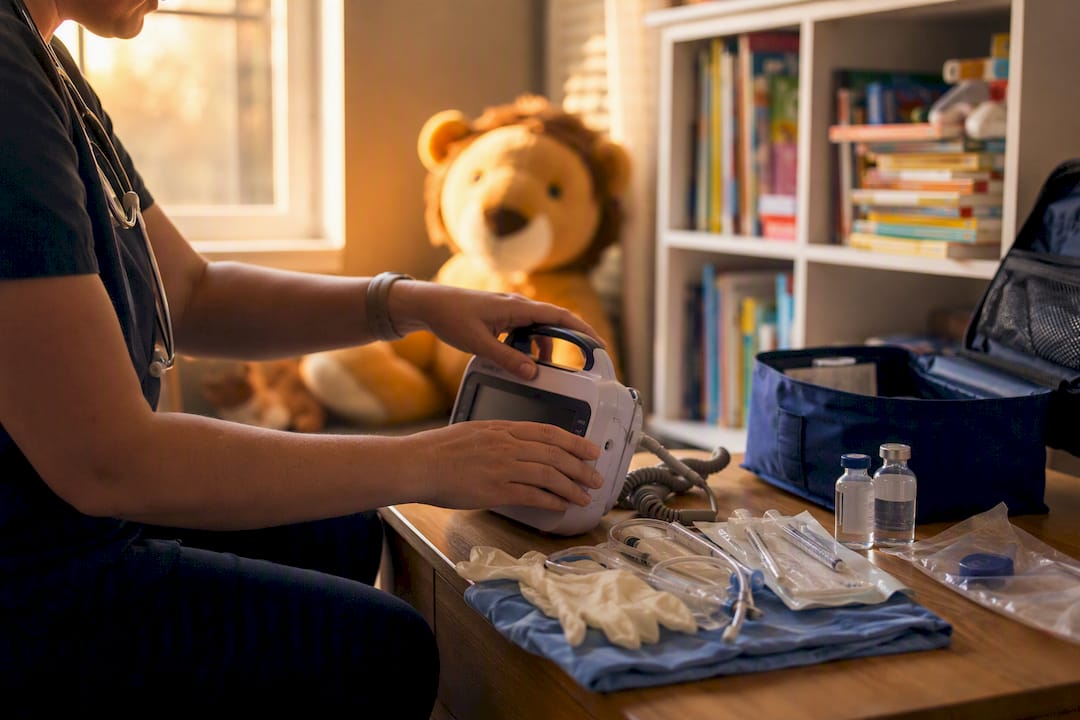
Backup coverage in home nursing is a written plan for who steps in and covers essential nursing tasks when your primary caregiver cancels, gets sick, or simply cannot make a shift. It is not a hope or a verbal promise. It is a specific arrangement, either an agency-managed substitute, a pre-screened private backup, or a medical daycare placement, that keeps care running without a gap.
If a shift falls through right now, do these three things in order:
Call the scheduling coordinator immediately and ask directly whether the fill is guaranteed or “best effort.”
Pull the written care summary (medications, dosing, transfer steps, emergency contacts) and have it ready for whoever arrives.
Line up short-term on-site coverage, a family member, neighbor, or medical daycare slot, while placement is confirmed, and note in writing who owns the search.
The rest of this guide walks through the models available, how a placement actually happens, what to ask an agency before you sign anything, and who pays for it.
Key Takeaways
Reliable backup coverage in home nursing depends on a written guaranteed-fill policy, a fast care-note handoff, and measurable provider metrics like shift fill rate and retention.
Point | Details |
Get the policy in writing | Confirm whether your agency offers a guaranteed fill or only a best-effort search, and get it documented. |
Keep a one-page care summary | Include meds, dosing, transfer steps, and emergency contacts so substitutes onboard in minutes, not hours. |
Ask for real metrics | Request shift fill rate and average nurse tenure instead of accepting general reliability claims. |
Plan for regional emergencies | Set a firm escalation threshold and confirm your agency’s staffing plan for widespread disruptions. |
Opulentprivatecare’s model | Applies its 3 Thumbs Up Rule and publishes shift fill rate and retention data for pediatric backup coverage in Georgia. |
Table of Contents
Types of Backup Coverage for Home Nursing
Not every backup model works for every family, and the wrong fit shows up fastest during a crisis.
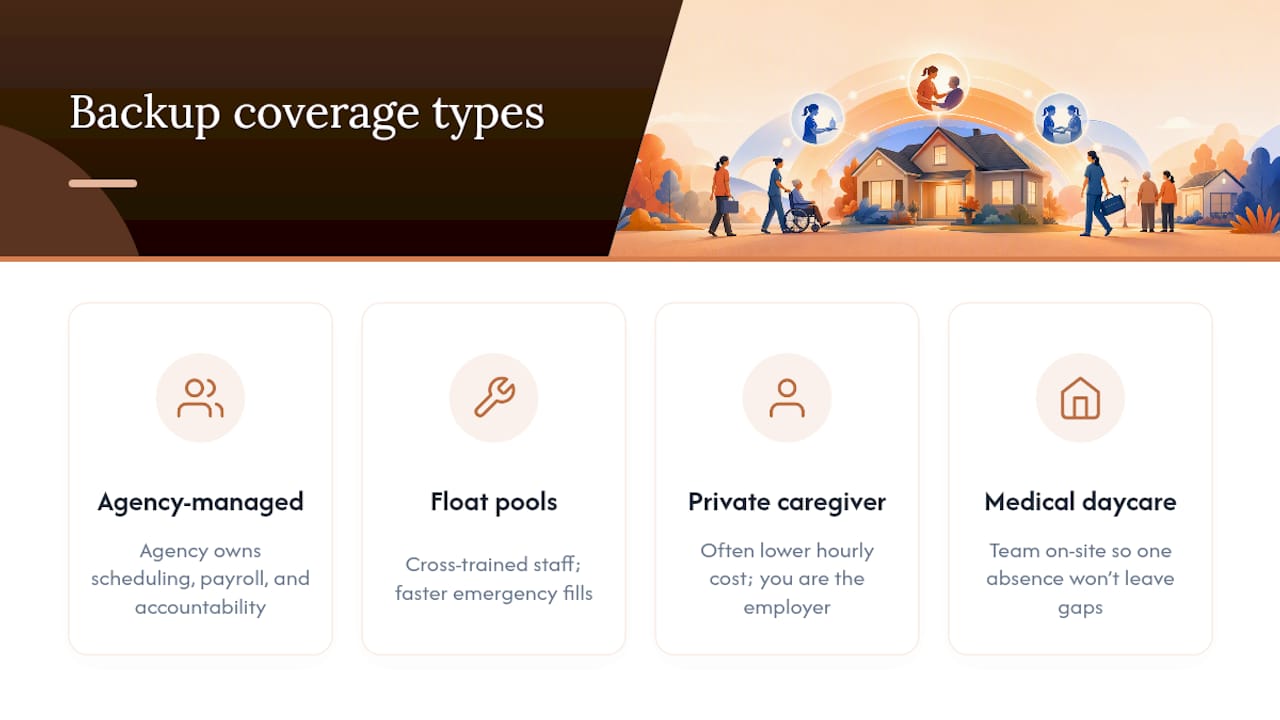
Agency-managed substitution is the most common setup for families using a licensed home health agency. The agency owns scheduling, payroll, and coverage responsibility, and it draws from its own roster when your regular nurse cannot make a shift. The strength here is accountability: one phone call, one entity responsible for the fill.
Float pools and cross-trained nurses are a subset worth asking about directly. Agencies that maintain a float pool, nurses trained across multiple conditions rather than assigned to a single client, tend to fill emergency shifts faster because more staff qualify for the placement.
Private backup caregivers, hired directly and outside an agency, often cost less per hour. But you become the employer, which means payroll, taxes, and workers’ compensation become your problem, not a scheduling office’s. If your only backup is one person you found through a private ad, you have a single point of failure, not a plan.
Medical daycare (PPEC) centers offer a team-based alternative for pediatric or high-acuity cases. Multiple clinical staff are on-site simultaneously, so one person calling in sick does not leave a child uncovered the way it can in a one-nurse home setup, according to Spark Pediatrics.
Match the model to the acuity and the calendar. A child on a ventilator needs a cross-trained nurse or PPEC backup, not a well-meaning neighbor. A short vacation gap might only need agency float coverage for three days.
Pro Tip: Never treat a single private caregiver as your entire safety net. Formalize at least one alternate option, even a part-time agency arrangement, before you rely on one person for daily coverage.
How Backup Placement Actually Works
The gap between “we’ll find someone” and a qualified nurse walking through your door involves a few concrete steps, and knowing them helps you push for real answers instead of vague reassurance.
The call goes out. A scheduler notifies available staff, often through an automated system, the moment a shift is flagged open.
Skill-matching happens. The scheduler filters for nurses trained on your loved one’s specific needs, tracheostomy care, ventilator management, G-tube feeding, or seizure protocols, before offering the shift.
Care notes transfer. A prepared substitute needs medication timing, transfer technique, behavioral triggers, and where supplies are stored, ideally on one page they can scan in under two minutes.
The nurse arrives and confirms. A capable agency has the substitute check in with the family or a supervisor before starting hands-on care.
The most important distinction in this entire process is whether your agency offers a guaranteed fill or only a best-effort search. A guaranteed fill means the agency is contractually obligated to place someone within a stated window. Best effort means they will try, with no defined timeline and no remedy if they come up short. Medicare Rights recommends families get this distinction in writing before it matters.
A single-page care summary, meds with photos of labels, transfer steps, and the top three behavioral cues, cuts onboarding time for a same-day substitute dramatically, according to CareAtHomeGuide. Families who skip this step often lose the first 20 minutes of a shift to a nurse asking questions that should already be answered on paper. If your loved one needs seizure management or complex mobility support, insist on a nurse who has handled that exact protocol before, not someone learning it on the fly.
Questions to Ask Any Agency About Backup Coverage
Ask these before you sign a contract, not after a shift falls through:
“Is your backup fill guaranteed, or is it best effort? Put the answer in writing.”
“What is your average response time from a called-out shift to a confirmed substitute?”
“Who is my dedicated point of contact when I need same-day coverage, and are they reachable after hours?”
“What is your current shift fill rate, and how is it measured?”
“How are substitute nurses briefed on my child’s or relative’s specific care plan before arrival?”
“Are your backup nurses cross-trained on trach, vent, G-tube, or seizure protocols, or only generalists?”
Vague answers are the biggest warning sign. If a scheduler cannot give you a number for response time or fill rate, that is not an oversight. It usually means the agency does not track it, which means they cannot manage it either. Refusal to put the backup policy in writing is the second red flag worth walking away from.
Pro Tip: Ask for a real example, a recent shift where a nurse called out, and how quickly the agency filled it. A specific story tells you more than any brochure language about “reliable coverage.”
If you already work with an agency that dodges these questions, it may be worth comparing options rather than waiting for the next gap to expose the problem.
Who Pays for Backup Nursing Coverage
Funding backup coverage depends heavily on which program is paying for the underlying care, and the rules differ sharply between them.
Medicare typically covers only short-term, medically necessary home health through a Medicare-certified agency, and it generally does not fund long-term, full-time skilled nursing, per Medicaid.
Medicaid waiver programs vary by state and are the most common route for ongoing pediatric or high-acuity in-home nursing, including backup staffing built into the care plan.
Long-term care insurance and VA benefits may cover some home nursing costs, but coverage depends entirely on your specific policy and its approved vendor list, according to Johns Hopkins Medicine.
Private pay covers the gap when insurance or waivers fall short, and rates vary widely by region and acuity.
How Opulent Private Care Builds Reliability Into Backup Coverage
Most agencies talk about reliability. Few publish numbers behind it. Opulentprivatecare tracks shift fill rate and nurse retention as public performance metrics, because a family cannot evaluate “we’re reliable” as a claim, but they can evaluate a fill rate.
Before any nurse starts with a family, Opulentprivatecare applies its 3 Thumbs Up Rule: the family approves, the caregiver approves, and Opulentprivatecare approves the match before care begins. That third check catches mismatches that a resume alone misses, especially for specialty cases like pediatric cardiac care or complex trach and vent management, where a nurse’s comfort level with the equipment matters as much as their certification.
Ask for measurable metrics when comparing providers, shift fill rate, average time to fill, and retention, rather than general statements of reliability.
If you are evaluating any provider, not just Opulentprivatecare, ask them directly: “What is your shift fill rate this quarter, and what is your average nurse tenure with a single family?” A provider that tracks continuity metrics as a matter of practice will have that answer ready.
The Legal Side of Backup Nursing You Cannot Skip
Backup coverage is not just a scheduling convenience. It sits inside a regulatory framework that determines who is liable if something goes wrong.
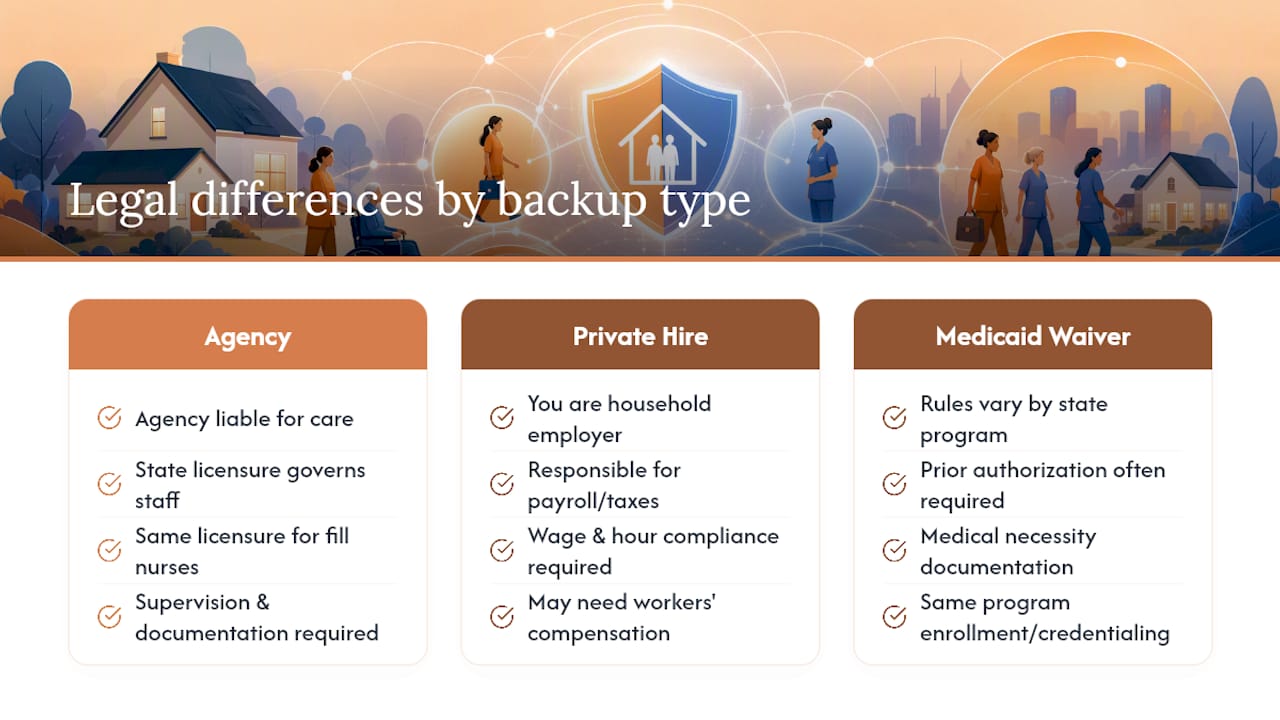
Licensed home health agencies operate under state licensure requirements that govern staff credentialing, supervision, and documentation, including for substitute or backup nurses. When an agency sends a fill nurse, that nurse must meet the same licensure and competency standards as your regular caregiver, not a lower bar because the shift was arranged last minute.
If you hire privately, the legal picture shifts entirely onto you. You become the household employer, responsible for wage and hour compliance, payroll tax withholding, and, in many states, workers’ compensation coverage for anyone working in your home, according to the IRS. Skipping this paperwork does not just risk a tax penalty. It can leave you personally liable if a caregiver is injured on the job with no coverage in place.
Medicaid waiver programs add another layer. Coverage for backup or respite nursing under a waiver typically requires prior authorization and documentation showing medical necessity, and the rules for who can bill for backup hours vary by state program. A nurse filling in for one shift under a Medicaid-funded plan generally needs to meet the same program enrollment and credentialing requirements as the primary caregiver.
Before you rely on any backup arrangement, confirm in writing whether the substitute is covered under your existing authorization or whether a separate approval is needed. Assuming coverage carries over automatically is one of the more common and costly mistakes families make.
Preparing Backup Nursing Coverage for Disasters and Public Health Emergencies
A single missed shift is disruptive. A regional emergency, a hurricane, a widespread illness outbreak, or an extended power failure, can knock out an entire agency’s local staffing pool at once. Backup planning that only accounts for one nurse calling in sick will not hold up under those conditions.
Ask your agency directly how it handles staffing during declared emergencies. Comfort Keepers recommends asking specifically about notification systems, the depth of the local caregiver pool, whether an on-call coordinator is reachable outside normal hours, and how staff are trained for location-specific risks like extreme heat or extended outages.
Build a household-level contingency alongside the agency plan. That means backup power for any equipment that depends on electricity, ventilators and feeding pumps especially, a several-day supply of medical consumables, and a secondary transportation plan if roads are impassable. Families managing tracheostomy or ventilator care should treat a power outage plan as a medical necessity, not a household chore.
Set a firm escalation threshold before a crisis, not during one: for example, if no coverage is confirmed within 30 minutes of a call-out, escalate immediately to a second source, a family member, a different agency, or a medical daycare slot, rather than waiting and hoping the first search succeeds. During a pandemic-level event, ask whether your agency has a protocol for cross-training staff across multiple households to widen the available pool when normal assignments are disrupted.
Making Backup Coverage Work With Your Primary Care Plan
Backup coverage only works when it is built into the same care plan your primary nursing team follows, not treated as a separate, disconnected arrangement. A substitute nurse who receives a different set of instructions than your regular caregiver is a setup for a medication error or a missed protocol step.
Share the same care plan documentation with every clinician involved, your child’s pediatrician or the treating physician, the primary home health agency, and any backup provider. If your loved one’s plan changes, a new medication, an adjusted feeding schedule, an updated seizure protocol, that update needs to reach the backup provider the same day it reaches the primary team. A backup plan built on outdated information is not really a backup plan.
Coordinate directly with the prescribing physician’s office about who is authorized to receive verbal orders or clarify instructions if a substitute nurse has a question mid-shift. Some families designate a single point of contact, often a case manager or the agency’s clinical supervisor, to keep primary and backup teams aligned without every provider calling the physician’s office separately.
For children with conditions like cerebral palsy who rely on very specific transfer and positioning techniques, this integration matters even more. A substitute who has never seen the physical therapy notes attached to the primary plan can unintentionally cause injury during a routine transfer. Ask your primary agency whether backup nurses receive access to the same clinical notes, not a simplified summary, before their first shift.
What Families Get Wrong About Backup Coverage
Most families treat backup coverage as an afterthought, something to figure out once a nurse actually cancels. That is backward. The families who handle a missed shift calmly are the ones who asked for the fill policy in writing months earlier and already know whether they are working with a guarantee or a hope.
The conventional advice, “just find a good agency,” undersells how much the backup question exposes about an agency’s actual operations. A provider that cannot tell you its shift fill rate is not being modest. It likely does not measure it, and what does not get measured rarely gets managed well when a shift opens at 6 a.m. on a Sunday.
Prioritize the written policy over the sales pitch. A guaranteed fill with a defined response window protects you in a way that “we always find someone” never will, because one is a contract and the other is a hope. The 3 Thumbs Up Rule approach, requiring approval from the family, the caregiver, and the agency before care starts, exists because mismatches are what create the callouts families are trying to avoid in the first place. Fix the matching problem first, and the backup problem shrinks.
— Opulent
Find Dependable Backup Nursing Coverage in Georgia
Families comparing agency substitution, private hires, and medical daycare face the same underlying question: who actually shows up when the primary plan falls through? Opulentprivatecare answers that with a documented model instead of a promise, publishing shift fill rate and nurse retention numbers and applying the 3 Thumbs Up Rule before any nurse starts with a family.
For families managing tracheostomy, ventilator, G-tube, seizure, or pediatric cardiac needs in Georgia, Opulentprivatecare matches nurses based on clinical fit and family fit, then keeps that same nurse consistent rather than rotating staff through your home. That continuity is what most families are actually looking for when they start researching backup coverage in the first place. The team also handles Medicaid and GAPP paperwork directly, reducing the administrative load that comes with either program enrollment or private hiring. If you are weighing the cost and complexity of hiring privately, a resource on caregiver access barriers lays out the systemic challenges agency-managed care is built to solve.
If your current coverage plan cannot answer a basic question, “what happens if my nurse cancels tomorrow?”, reach out to Opulentprivatecare to ask about specialty staffing and current fill rates for your area.
Sources
Recommended
Comments