
Get CHD Home Care Approved in Georgia: PPOT Checklist and Nurse Match
- Opulent Private Care Services

- 1 day ago
- 8 min read

Yes, a child with congenital heart disease can get Medicaid-covered in-home skilled nursing in Georgia, and approval hinges on medical necessity, not the diagnosis code alone. The Georgia Pediatric Program (GAPP) authorizes this kind of CHD home care once a physician documents the need in a Plan of Treatment. Your first move: get that physician order signed and call a GAPP-approved nursing agency to start the prior authorization process.
TL;DR:
Approval depends on documented medical necessity, including specific nursing tasks like medication management and post-op monitoring, not just the cardiac diagnosis.
A detailed Plan of Treatment signed by the physician, outlining nursing frequency, diagnoses, and equipment needs, is essential for timely review.
Most delays occur from incomplete paperwork or lapsed Medicaid eligibility; thorough preparation and current documentation speed up approval.
Families must actively participate in care training and have a contingency plan, as reviewer evaluations focus heavily on caregiver readiness.
Reliable nursing agencies have high shift fill rates and nurse retention, which directly impact consistent, quality care for children with CHD at home.
Table of Contents
What Does GAPP Cover, and Who Qualifies?
GAPP is Georgia’s Medicaid pathway for keeping medically fragile kids out of the hospital and at home with a nurse instead. It serves children under 21, and the Georgia Pediatric Program bases approval on documented medical necessity rather than a specific cardiac diagnosis. Two children with the same CHD defect can get very different authorizations, because reviewers look at what the child actually needs day to day, not the label on the chart.
Coverage under GAPP typically includes:
In-home skilled nursing from an RN or LPN
Personal care support for daily living tasks tied to the medical condition
A family caregiver option in some cases, where a trained relative is compensated for part of the care
Services that stop once a child is hospitalized or placed in certain residential facilities, since GAPP is specifically a home-based benefit
For CHD specifically, the needs that tend to map onto GAPP coverage include feeding support for kids who can’t take full oral nutrition, complex medication schedules involving multiple cardiac drugs, and oxygen or cardiac monitoring after a surgical repair. A newly diagnosed infant heading home from a cardiac ICU looks very different, clinically, from a school-age child years past a repair, and GAPP’s medical necessity standard is built to reflect that difference rather than force every CHD case into one bucket.
What Does Skilled Nursing for CHD Actually Involve at Home?
Skilled nursing for a child with CHD covers a wider range of tasks than most parents expect going in. Depending on the child’s stage of treatment, a nurse in the home might handle:
IV medication administration and infusions for conditions requiring ongoing cardiac support
Continuous or spot-check monitoring of heart rhythm, oxygen saturation, and vital signs
Wound monitoring and dressing changes following open-heart surgery
Feeding tube management and enteral nutrition for infants or kids who can’t feed safely by mouth
Tracheostomy or ventilator care when respiratory support is layered on top of the cardiac condition
There’s an important distinction between intermittent skilled nursing visits and continuous, or private duty, nursing. Intermittent SN might mean a nurse comes for a few hours a few times a week to manage medications and check vitals. Continuous coverage, sometimes called PDN in other state programs, covers many more hours per day for children whose condition could deteriorate quickly without near-constant observation. Texas guidance on pediatric extended care describes PDN as covering more than several hours a day for kids with the most complex, ongoing needs, which gives a useful sense of scale even though hour allocations are set case by case in Georgia.
Post-op CHD kids commonly need the higher end of that range in the weeks right after surgery, then step down as recovery stabilizes.
Pro Tip: Ask your cardiologist to spell out, in writing, exactly which tasks require a licensed nurse versus a trained caregiver. Reviewers weigh that distinction heavily, and a vague order slows everything down.
How Does the Prior Authorization Process Actually Work?
Every GAPP request runs through a documentation process that can feel bureaucratic, but it exists for a real reason: reviewers need a clear picture of what skilled care your child needs and why a trained caregiver alone wouldn’t be enough.
The Plan of Treatment, sometimes called PPOT or POC depending on which form you’re looking at, has to include:
The attending physician’s signature and the date of their last visit with the child
The intended start-of-care date for nursing services
A full list of diagnoses, not just the primary cardiac condition
Specific nursing frequency and duration (how many hours, how many days a week)
Any equipment needs, from feeding pumps to pulse oximeters
Recertification timing, since the POC isn’t a one-time document
Alliant Health Solutions Medical Review Team handles the clinical review of GAPP applications, checking them against Department standards for appropriateness. Their core question mirrors what most pediatric Medicaid reviewers look at nationally: complexity of the condition, how stable the child currently is, how often skilled interventions are needed, and what happens if that skilled care isn’t provided. Texas Children’s Health Plan guidance%20and%20Home%20Health%20Aid%20(HHA).pdf) on skilled nursing criteria lays out this same logic clearly: the task has to genuinely require a licensed nurse’s judgment, not just supervision.
Before you submit anything, run through this quick checklist:
Is the POC signed and dated by the physician within the required window?
Does it list a specific nursing frequency, not just “as needed”?
Are all diagnoses included, including anything secondary to the CHD itself?
Is the equipment list current and matched to what’s actually in use at home?
A complete, specific packet moves faster than a technically valid but vague one, every time.
How Do You Apply, and How Long Does Approval Take?
Getting a nurse into the home starts well before any paperwork touches a reviewer’s desk. Here’s the sequence most families go through:
A physician, or a hospital discharge planner working with that physician, writes the initial order and starts the PPOT
The family selects a GAPP-approved nursing agency to take on the case
The agency submits the DMA 6A form and the completed PPOT, usually through the Medicaid systems Georgia uses for these submissions, or through the relevant Care Management Organization’s prior authorization process
Alliant Health Solutions or the CMO reviews the packet for medical necessity
Hospitals and physicians frequently initiate GAPP applications directly as part of discharge planning, especially for infants coming home after cardiac surgery, according to GAPP program documentation.
Documents you’ll need on hand:
The completed DMA 6A form
The signed PPOT
Recent physician notes, not months-old records
Proof of current Medicaid eligibility
An IEP if your child is school-age and has one
Any equipment or device orders tied to the care plan
Once a complete packet lands with reviewers, expect up to a month for review(https://www.mmis.georgia.gov/portal/Portals/0/StaticContent/Public/ALL/NOTICES/GAPP Presentation Finalized June%[2026%](https://www.mmis.georgia.gov/portal/ResourceProxy.aspx?iCProxyTo=MC1FZHVjYXRpb24uYXNweD9hZj1sb2NhbCZmPVRyYWluaW5nXFJldmlldytUeXBlK1RBVC5wZGY=)2023 2 20230630141655.pdf). The DMA 6A locks in a year of eligibility information, which helps avoid re-verifying everything at every recertification. Most delays trace back to incomplete PPOTs or lapsed Medicaid status rather than the clinical picture itself, so double-checking those two things before submission saves real time.
What Should Families Prepare for at Home?
Approval is only half the equation. GAPP expects families to be active participants in the care plan, not bystanders waiting for a nurse to show up.
Your responsibilities typically include:
Participating in whatever training the agency or hospital sets up before nursing hours begin
Staying reachable during scheduled nursing shifts and emergencies
Keeping emergency contacts current and documented
Handling basic caregiving tasks that fall outside the “skilled” definition but are still part of daily life
Reviewers specifically look at caregiver comprehension and willingness to train when they weigh a case, according to GAPP in-home nursing documentation. A backup plan matters here too. If your regular nurse can’t make a shift, who’s covering, and does the agency have a documented contingency? That backup plan belongs in the POC itself, not just in a conversation you had once with the agency’s scheduler.
On the equipment side, most durable medical equipment like feeding pumps or oxygen concentrators gets ordered through the agency or a separate DME supplier coordinated with your physician. A simple home safety checklist, keeping walkways clear for equipment, having supplies organized in one dedicated space, and keeping paperwork in a single binder, makes both nursing visits and unannounced reviews go smoother.
Pro Tip: Keep a single folder, physical or digital, with your child’s most recent physician notes, the current POC, and emergency contacts. When an agency or reviewer asks for something, you want it in one place, not scattered across email threads.
For a deeper look at the hospital-to-home transition specifically, parent training for home nursing covers what to expect before that first shift begins.
What Actually Makes a Home Nursing Provider Reliable?
Most of the guidance around GAPP focuses on paperwork, and rightly so, but the paperwork isn’t where families actually feel the strain. It’s in whether the same nurse shows up week after week, or whether your child gets a new face every few shifts because the agency couldn’t fill the schedule.
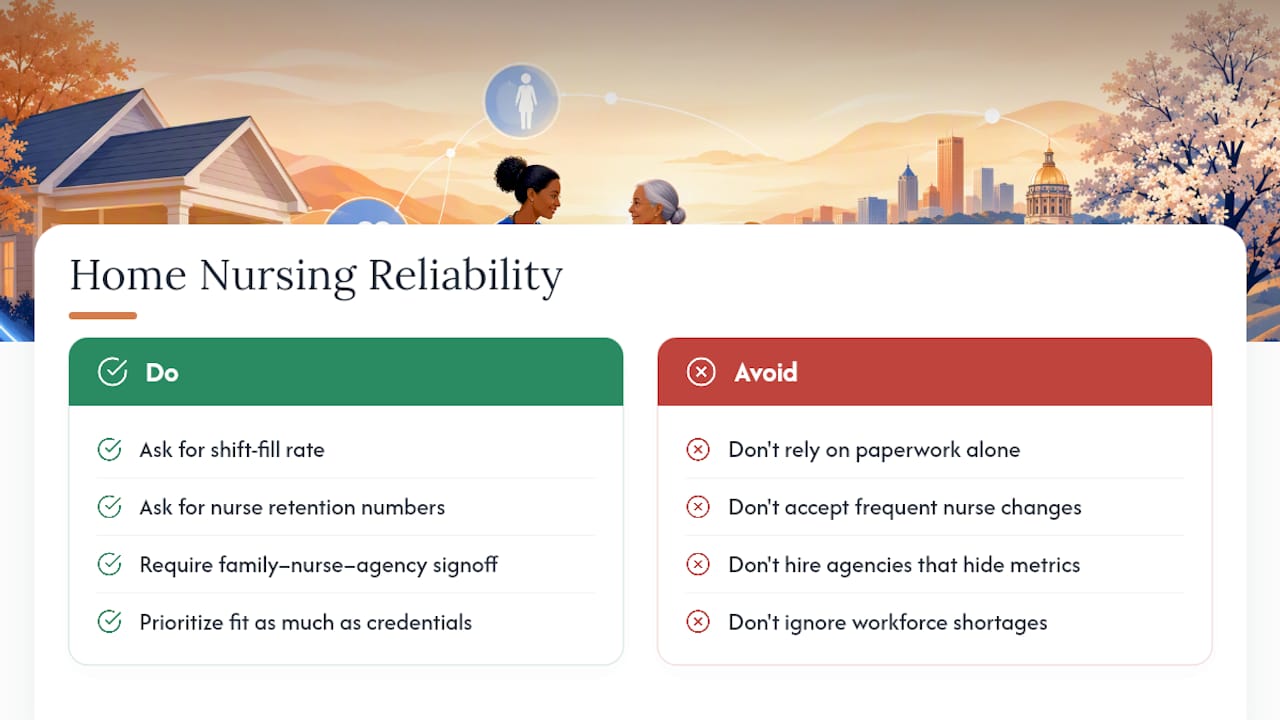
Opulentprivatecare built its “3 Thumbs Up Rule” around exactly this problem: care doesn’t start until the family, the nurse, and the agency all sign off on the match. That sounds simple, but for a child with CHD who may startle at a stranger’s touch or need a caregiver who recognizes subtle changes in color or breathing, fit matters as much as credentials.
When you’re evaluating any agency, ask directly for their shift fill rate and nurse retention numbers. Those two metrics tell you more about day-to-day reliability than a glossy brochure ever will, and workforce shortages remain a real barrier across pediatric home nursing nationally. An agency willing to publish those numbers is telling you something about how it operates.
— Opulent
How Opulent Private Care Can Help You Get Started
Opulentprivatecare provides statewide, in-home pediatric skilled nursing across Georgia, built specifically around kids managing tracheostomy, feeding, cardiac, and neurological conditions, with a nurse matching process instead of whoever happens to be available that week.
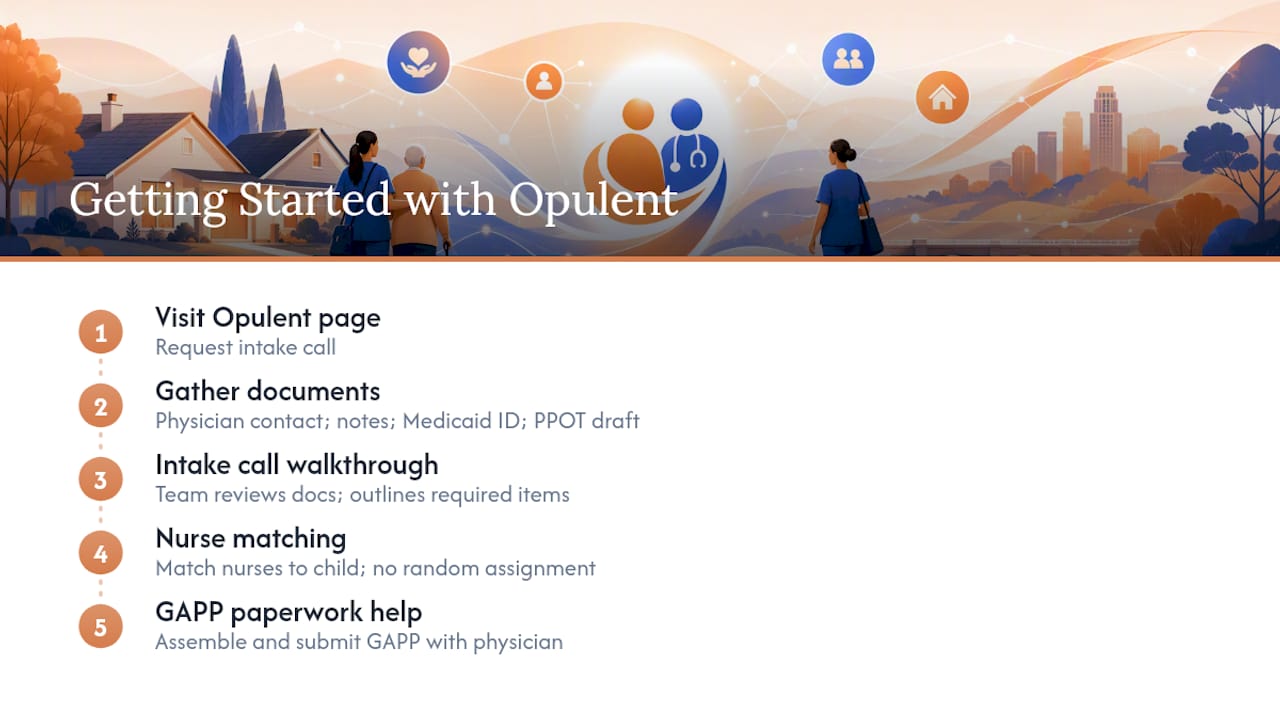
If your child has CHD and you’re trying to get skilled nursing authorized, Opulent’s team helps assemble and submit the GAPP paperwork alongside your physician, so the PPOT doesn’t stall on a missing signature or an outdated visit date. Before you reach out, have your physician’s name and contact information, recent clinical notes, your child’s Medicaid ID, and any draft PPOT you’ve already started. It speeds up the intake conversation considerably.
Opulent also assists families juggling related pediatric appointments. If your child’s care plan includes rehabilitation therapy alongside cardiac management, resources like step-by-step physical therapy for kids are worth reviewing as you coordinate multiple providers around one nursing schedule.
Start by visiting Opulent Private Care’s Georgia pediatric nursing page and requesting an intake call. A team member will walk through your child’s current documentation and outline exactly what’s needed to move the authorization forward.
This article is general information, not a substitute for advice from a qualified doctor. Consult a qualified healthcare professional about your own circumstances before acting on anything here.
Sources
Recommended
Comments