
Secure Reliable Pediatric Home Care in 30–90 Days: Medicaid Paths and Matching


When you are choosing pediatric home care, start with a physician’s order and documented medical necessity, then filter every option through four things: coordination with your child’s clinical team, caregiver competence and continuity, and confirmed payor authorization. If your child has a skilled need like a tracheostomy, ventilator, or feeding tube, skilled nursing usually takes priority over non-skilled personal care. Your first moves this week: gather medical records, call your pediatrician or discharge planner, and shortlist two or three agencies to interview.
TL;DR:
Skilled nursing is often required for children with complex needs such as tracheostomy, ventilator, or feeding tube management, and needs a physician’s documented order and medical necessity.
Consistent caregiver assignment and proper staff training are crucial to ensure safety, build trust, and reduce the risk of errors or delays in recognizing small health changes.
Families should prepare comprehensive paperwork, including physician orders and insurance information, and establish a safe, organized home environment before care begins.
The first 30 to 90 days involve intake procedures, caregiver familiarization, and ongoing assessments, with a focus on verifying reliability, communication, and continuity.
When evaluating agencies, ask about shift fill rate, nurse retention, training, coordination practices, and backup staffing to ensure reliable and ethical care.
Table of Contents
Skilled versus non-skilled care: how to decide which your child needs
Checklist: how to evaluate and choose a pediatric home care provider
Paperwork and payor steps: preparing orders, authorizations, and eligibility checks
Preparing the home and family routines for safe, effective care
Transition timeline: what to expect during the first 30 to 90 days
Legal and ethical considerations including consent and privacy
Emergency preparedness and response planning specific to home care
Cultural competence and language needs in pediatric home care
Publisher perspective: the single priority parents should never trade off
Benefits families should expect from pediatric home care
Home care lets a medically complex child recover and grow inside a familiar routine instead of a hospital room. Johns Hopkins pediatrics experts frame home health as an extension of the clinical team rather than a separate service, and when that coordination happens consistently, families see more stability at home and fewer readmissions.
Home-based services can include:
Skilled nursing for tracheostomy, ventilator, or feeding tube management.
Private duty nursing for ongoing one-on-one clinical support.
Respite care that gives family caregivers scheduled breaks.
Therapy services, including physical, occupational, and speech therapy delivered at home.
Consistency matters as much as the service itself. A child with a rotating cast of caregivers relearns trust and routine every week, which slows progress and raises the odds of a missed cue or a preventable error. A stable, familiar nurse or aide catches small changes early and reduces the stress that falls on parents managing everything else.
Skilled versus non-skilled care: how to decide which your child needs
Skilled care requires a licensed nurse and covers tasks like IV therapy, tracheostomy and ventilator management, G-tube feeding and medication titration, and wound care that needs clinical judgment. Non-skilled, or personal care, covers bathing, dressing, feeding assistance, and supervision that does not require a nursing license.
Healthychildren outlines the range of home health providers, from private duty nurses and intermittent skilled nurses to home health aides and paid family caregivers, and notes that eligibility usually starts with a referral from the pediatrician or hospital team.
Coverage for skilled nursing depends on a physician’s order and documented medical necessity. For Medicaid-enrolled children, EPSDT obligates states to furnish medically necessary services that correct or ameliorate a health condition, which is often the legal basis agencies point to when justifying skilled hours.
Before contacting agencies, confirm:
Your child has a written physician order naming the specific skilled task.
The order documents medical necessity, not just convenience.
You know whether Medicaid, GAPP, private insurance, or a military program like TRICARE will be billed.
Checklist: how to evaluate and choose a pediatric home care provider
A short, focused interview with each candidate agency will tell you more than any brochure. Work through this list before you sign anything:
Ask which credentials the assigned caregiver holds (RN, LPN, or trained personal care aide) and whether they have condition-specific training for your child’s diagnosis.
Request the agency’s shift fill rate and nurse retention figures for pediatric assignments; agencies willing to share these numbers are easier to hold accountable.
Ask how backup staffing works when a scheduled nurse calls out, and get the answer in writing.
Confirm the agency will coordinate directly with your pediatrician, hospital team, and case manager, and ask to see a sample written plan of care.
Ask about the caregiver matching process: who observes the first shift, how long the trial period lasts, and who can end the match if it is not working.
Request a background check summary and ask whether a trial shift happens with a family member present before unsupervised care begins.
Pro Tip: Schedule the first trial shift for 4 to 8 hours with a parent home and the primary clinician reachable by phone. That window reveals compatibility and gaps faster than a multi-day assumption.
End the conversation if an agency cannot name who provides backup coverage, refuses to share reliability data, or pressures you to start care before a physician’s order and authorization are in place.
Paperwork and payor steps: preparing orders, authorizations, and eligibility checks
Coverage for skilled pediatric nursing almost always starts with a physician’s order and a documented plan of care. CMS benefit policy rules require a plan of care certified by a physician or allowed practitioner, and a face-to-face encounter when the payor requires one.
The typical workflow runs from discharge planner to physician order, then agency intake, prior authorization, and finally start of care. For Medicaid-enrolled children, EPSDT is the federal backbone that often makes skilled home nursing a covered benefit rather than an optional extra.
State and program rules vary. Georgia’s GAPP program, authorized under the state’s Medicaid waiver, allows payment to legally responsible family caregivers under specific oversight rules, following CMS-approved amendments to Georgia’s Planning for Healthy Babies waiver. Military families should check TRICARE’s ECHO benefit, which covers habilitative supports and limited respite hours but usually requires prior authorization.
Before you call an agency, prepare:
The physician’s order and current plan of care.
Insurance or Medicaid ID and any prior authorization numbers.
Discharge summaries and recent hospital records.
A list of current medications, equipment, and supply vendors.
Preparing the home and family routines for safe, effective care
A few practical steps make the first weeks of care safer and less chaotic:
Set up a dedicated care area with reliable power, good lighting, clean surfaces, and accessible storage for supplies and equipment.
Organize medications, supply inventories, and daily logs, and write a one-page care summary any new staff member can read in five minutes.
Plan trial shifts and supervised handoffs so your family and the caregiver build routine together before overnight or solo coverage starts.
Line up a backup plan, whether that is a second trained family member or a respite service, so no single person carries the full load indefinitely.
Workforce shortages make short or intermittent shifts especially hard to staff, since agencies often prioritize stable, full-time assignments. Planning for a caregiver mix rather than one irreplaceable person protects your family from a single point of failure.
Transition timeline: what to expect during the first 30 to 90 days
The first days after care starts set the tone for everything that follows. Immediately, expect intake paperwork, a finalized plan of care, physician or allowed-practitioner signoff, and an orientation shift for the first caregiver.
Within the first two weeks, most agencies schedule an early monitoring call to check how the placement is going and make adjustments based on family feedback. Watch for:
A caregiver who arrives prepared and follows the written plan of care.
Clear communication when a shift needs to be covered by someone else.
Consistency in who shows up, not a different face every week.
By 30 to 90 days, expect a formal clinical review, any authorization renewals your payor requires, and a real assessment of whether continuity has held. Success looks like a stable child, a reliable caregiver schedule, and authorizations processed on time rather than in a last-minute scramble.
How Opulent approaches matching and reliability
Opulent Private Care starts every placement with what it calls the “3 Thumbs Up” rule: care begins only after the family, the caregiver, and the agency all approve the match. That three-way signoff is designed to catch mismatches before they become a disruptive mid-care change.
Opulent also publishes shift fill rate and nurse retention figures, which gives families a concrete way to judge reliability instead of relying on marketing claims. For complex conditions like tracheostomy, ventilator, or G-tube care, a consistent caregiver who already knows the child’s baseline reduces the chance of a missed cue or a documentation gap.
Whether you are evaluating Opulent or any other agency, ask:
What is your current shift fill rate for pediatric skilled cases?
What is your nurse retention rate over the past year?
Can I see a sample care plan for a condition like my child’s?
How long does the matching process take, and who can end a mismatch?
Legal and ethical considerations including consent and privacy
Parents or legal guardians give informed consent for a child’s care plan, and that consent should be documented in writing before skilled tasks begin. Ask the agency to explain, in plain language, what each caregiver is authorized to do and what requires a nurse rather than an aide.
Privacy matters as much as consent. Any agency handling your child’s medical records is bound by federal privacy rules that limit who can see or share health information, and you have the right to ask exactly who accesses your child’s chart and why. Get clear answers on how care logs, medication records, and incident reports are stored and who reviews them.
Ethical practice also means honesty about limits. A caregiver should tell you directly when a task falls outside their training or license, rather than attempting it and hoping for the best. If an agency cannot clearly separate what its aides are permitted to do from what requires a licensed nurse, treat that as a serious gap, not a minor inconsistency.
Finally, keep your own paper trail. Save copies of every signed consent form, plan of care, and authorization letter. If a dispute arises over what was agreed to or who approved a change in care, your own records are often the fastest way to resolve it.

Emergency preparedness and response planning specific to home care
Every home care plan needs a written emergency protocol specific to your child’s condition, not a generic one. For a child on a ventilator or with a tracheostomy, that means a clear step-by-step response for equipment failure, accidental decannulation, or a power outage, posted where any caregiver can see it.
Ask your agency how caregivers are trained to respond to a medical emergency in the home, and whether that training is specific to your child’s device and diagnosis. Confirm the backup power plan for essential equipment: battery duration, generator access, or a plan to relocate quickly if power fails for an extended period.
Keep an emergency folder near the care area with your child’s diagnosis summary, current medications, allergies, physician contact information, and the nearest pediatric emergency department. Share it with every new caregiver on their first shift, not after something goes wrong.
Build a communication chain before you need it: who calls 911, who calls the pediatrician, and who calls you if you are not home. Practice it once with the caregiver present, the same way you would run a fire drill, so the steps are automatic under stress rather than improvised.

Cultural competence and language needs in pediatric home care
A caregiver who understands your family’s language and cultural context can read a child’s cues more accurately and build trust faster. If your family speaks a language other than English at home, ask agencies directly whether they can match a caregiver who speaks it, or whether they provide professional interpretation for care planning conversations and daily updates.
Cultural competence goes beyond language. It includes respecting dietary practices, religious observances, and family decision-making structures, such as which relatives are involved in medical decisions. A caregiver who dismisses these preferences, even unintentionally, can create friction that undermines an otherwise clinically sound care plan.
Ask candidate agencies how they train caregivers on cultural sensitivity and whether they track language capabilities across their staff. If a mismatch is unavoidable, insist on a clear interpretation plan for medical instructions, medication changes, and emergency communication, since a misunderstood instruction in a health context carries real risk.
Publisher perspective: the single priority parents should never trade off
If you remember one thing, remember this: clinical coordination and caregiver continuity matter more than any other factor, including convenience. Systems are strained, authorizations take time, and staffing shortages are real, so advocate directly with your pediatrician and payor rather than waiting for updates to arrive on their own. If you need direct help sorting through intake or matching, Opulent’s own resources are built for exactly that conversation.
— Opulent
Opulent’s services and how to get started
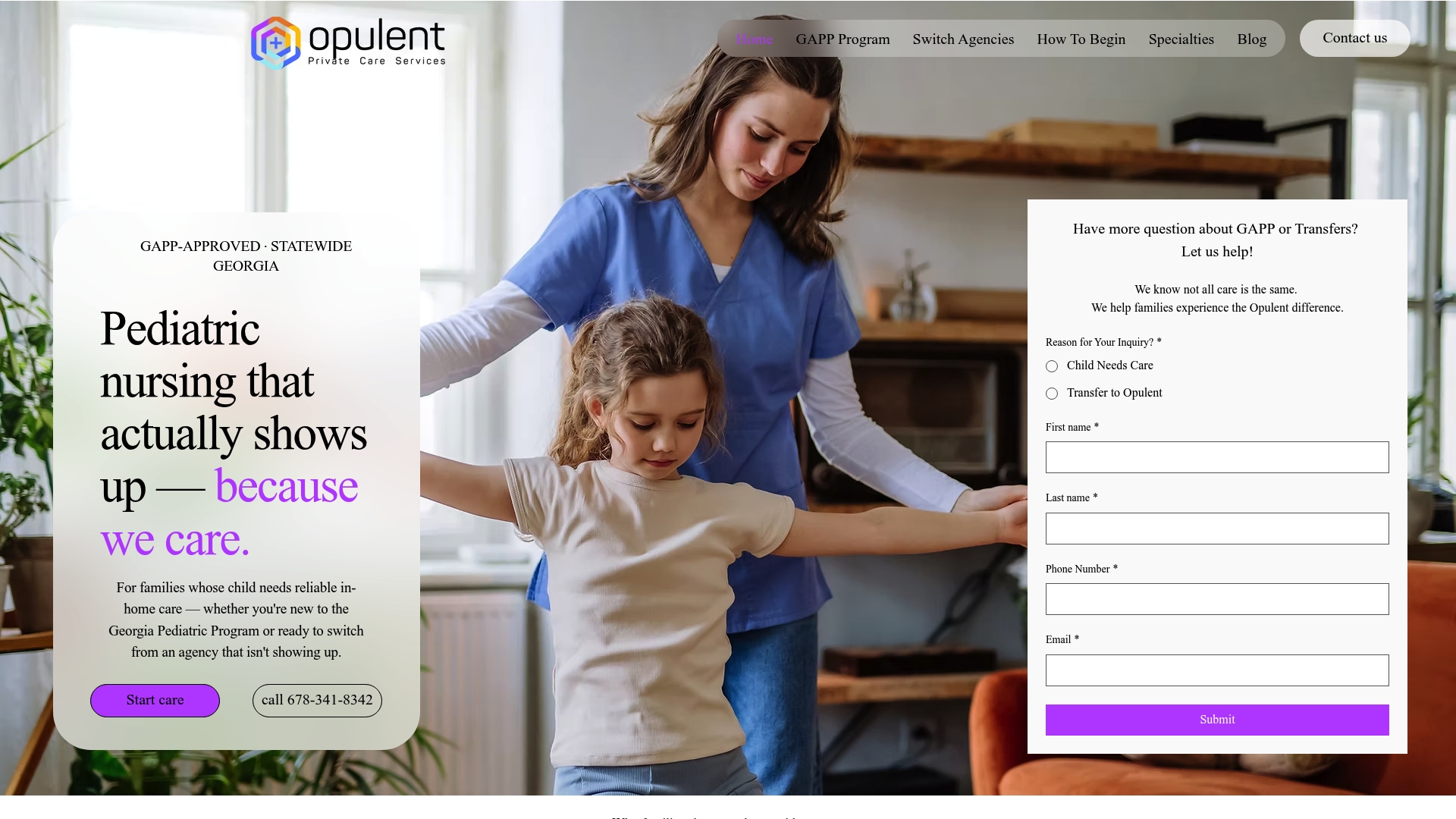
Opulent Private Care provides statewide, in-home pediatric skilled nursing for medically fragile children in Georgia, built around the same priorities this guide walks through: documented medical necessity, clinical coordination, and consistent staffing.
Services include:
Trach, ventilator, and G-tube pediatric nursing for high-acuity conditions.
A family caregiver option for eligible families under GAPP.
GAPP agency transfer support if your current agency isn’t working out.
Request an intake conversation and ask for a matching trial shift before you decide.
Sources
These references cover the rules and coordination practices behind this guide:
FAQ
What is the 80/20 rule in home care?
There is no single, universally recognized staffing priority rule for pediatric home care; definitions vary by agency and region. Some agencies use informal guidelines to allocate more hours to stable, higher-need cases, but no federal or clinical standard exists.
Is pediatric home health hard?
Pediatric home health can be demanding for families, especially early on, because it requires coordinating physician orders, insurance authorizations, and caregiver schedules while managing a child’s condition day to day. Coordination between the home health agency and the child’s pediatric clinical team tends to ease this burden over time.
What are the four types of caregivers?
HealthyChildren.org describes several home health provider types, including private duty nurses, intermittent skilled nurses, home health aides, and paid family caregivers, each suited to different levels of medical need. The right fit depends on whether your child needs skilled clinical tasks or non-skilled personal care support.
Can I get paid to watch my own kids?
In some states, Medicaid waiver programs allow a legally responsible parent to be paid as a trained caregiver under specific oversight rules. Georgia’s GAPP program, for example, permits family caregiver payment under its Medicaid waiver amendment, though eligibility and documentation requirements apply.
How do I find a reliable pediatric home care agency?
Ask any candidate agency for its shift fill rate, nurse retention figures, and a sample written plan of care, since agencies willing to share this data are easier to hold accountable. Confirm they coordinate directly with your child’s pediatrician and can explain their caregiver matching and backup staffing process in detail.
Recommended
Comments