
Continuity of Pediatric Care at Home: A Georgia Guide


Continuity of pediatric care at home means the child, family, and physician-led care team manage ongoing health together, consistently, without gaps. The American Academy of Pediatrics defines it as cooperative management of a child’s health across time and settings. The single most important step your family can take right now: confirm a named nurse match and a documented backup plan before your child leaves the hospital. Opulentprivatecare builds this into every admission, and the research from NCBI (NBK574990) confirms why it matters so much.
Table of Contents
Why does continuity matter for medically fragile children?
Consistent, relationship-based care directly reduces emergency department visits and medical errors for children with complex needs. The AAP links continuity to higher-quality outcomes and fewer unnecessary hospitalizations. When the same nurse shows up shift after shift, she already knows that your child’s oxygen saturation dips slightly before a seizure, or that he refuses his feeding tube flush unless it’s warmed first. A rotating stranger misses those signals every time.
NICE evidence is equally direct: children and parents strongly prefer seeing the same clinicians, and consistent relationships improve engagement and reduce the exhausting cycle of re-explaining your child’s history. Research on children and youth with special health care needs found that informational continuity and coordination protect against unmet needs and reduce family burden. Three types of continuity matter most: informational (shared records), management (coordinated treatment plans), and relational (the same faces, the same trust).
Family-centered home care puts parents at the center of care design, not just as observers. When parents are active co-designers of daily care plans, adherence improves and clinical changes get caught earlier.
When continuity breaks: the most vulnerable points
Continuity is most at risk during transitions, especially the move from hospital to home. Proactive information exchange and full briefings for the incoming care team reduce repeated testing and preventable errors. Common causes of continuity breakdown include:
Poor or incomplete discharge communication between hospital and home nursing teams
Frequent caregiver rotation with no documented handoff between nurses
Medicaid or GAPP authorization delays that stall care starts
Documentation gaps that trigger insurance audit failures and funding interruptions
Rural access issues that limit available qualified pediatric nurses in parts of Georgia
No named backup nurse when the primary caregiver calls out sick
Pro Tip: Before discharge, ask the home nursing agency for two things in writing: the name of your child’s assigned nurse and the name of the confirmed backup. If they cannot provide both, that is a red flag worth acting on immediately.
What should families do before and after discharge?
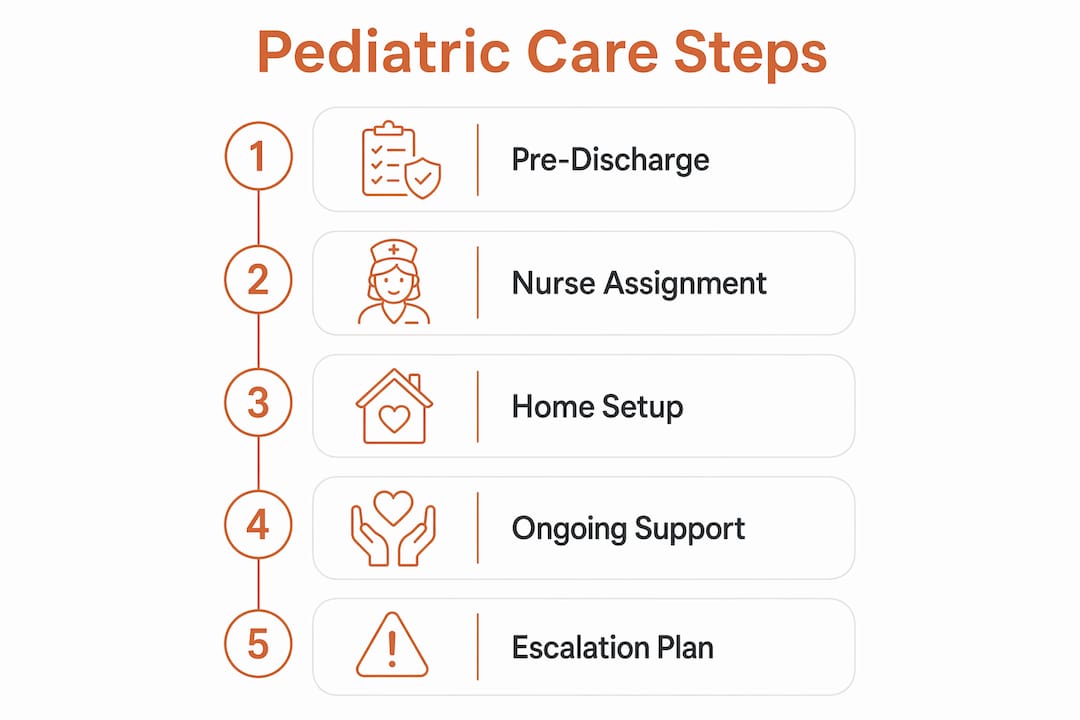
The goal is simple: the same matched caregiver and a complete, readable care plan must be in place before your child walks out of the hospital. Work through this checklist in two phases.
Documentation and records
Request a printed and digital copy of the full discharge care plan, medication list, device settings, and specialist contact list
Confirm the home nursing agency has received and reviewed all records before day one
Caregiver matching and vetting
Ask for the nurse’s name, clinical background, and experience with your child’s specific conditions (tracheostomy, ventilator, feeding tube, seizure management)
Request a meet-and-greet or nurse-fit interview before the first shift
Scheduling and shift-fill guarantees
Ask: “What is your published shift-fill rate?” and “What happens if my nurse calls out?”
Get the backup nurse’s name in writing
Insurance and Medicaid (GAPP)
Confirm authorization is active before discharge, not pending
Ask who handles GAPP paperwork on your behalf if there is a delay
Family training and integration
Complete hands-on training for every device your child uses at home
Know who to call at 2 AM and what to say
Pro Tip: Request the agency’s nurse retention metric in writing. High nurse turnover predicts caregiver rotation, which is the single fastest way continuity collapses. A provider who publishes this number is one who takes it seriously.
What should a continuity-focused provider actually demonstrate?
A continuity-focused provider publishes metrics, matches caregivers deliberately, and integrates families into care planning from day one. When vetting pediatric home care services in Georgia, verify each of the following:
Published shift-fill rate: What percentage of scheduled shifts are actually covered? Ask for the number, not a vague assurance.
Nurse retention metric: High retention means fewer strangers at your child’s bedside.
Nurse-fit interview process: Does the agency match on clinical skills and family personality, or just availability?
Role-based EHR or care plan access: Can you see your child’s care notes in real time? EVV and integrated documentation reduce the burden of repeating your child’s history to every new nurse.
Documented handoff checklist: Is there a written protocol for nurse-to-nurse transitions?
Single point of contact: One coordinator who knows your child’s case, not a rotating call center.
A provider who cannot answer the shift-fill and retention questions with actual numbers is not a continuity-focused provider, regardless of what their website says.
How do you secure continuity during the hospital-to-home transition?
The single most important task during transition is a documented handoff that names the initial caregiver and a confirmed backup. Here is a practical timeline:
72 hours before discharge: Confirm the home nursing agency has received all clinical records. Verify GAPP/Medicaid authorization is active.
48 hours before discharge: Complete nurse-fit interview. Confirm the assigned nurse’s name and first shift date.
24 hours before discharge: Complete family training on all devices. Confirm equipment and supplies will arrive before the child does.
Day of discharge: Collect printed copies of the care plan, medication list, device manuals, and a full specialist contact list. Confirm EVV is set up.
First 24–72 hours at home: The assigned nurse should complete a full home assessment and document baseline vitals and device readings. Any deviation from the hospital baseline triggers an immediate call to the pediatric specialist.
First 7 days: Schedule a follow-up call or visit with the pediatric specialist. Review the care plan with the home nurse and update as needed.
Families frequently report needing clearer instructions on who to contact and how to manage care at home. Build that contact list before you leave the building.
When should you escalate or change the care plan?
Act immediately on any of these clinical red flags: new or worsening respiratory distress, feeding intolerance that is not resolving, recurrent or prolonged seizures, or any device malfunction you are not trained to correct. Operational red flags deserve the same urgency:
Two or more missed or uncovered shifts in a single week
A nurse who is unfamiliar with your child’s devices or conditions
Care notes that are incomplete, missing, or inconsistent
No response from your coordinator within a reasonable window
When a red flag appears, follow this escalation sequence:
Step 1: Call your child’s pediatric specialist or on-call nurse line immediately for clinical issues.
Step 2: Activate the backup nurse through your agency coordinator.
Step 3: Contact your GAPP case manager if the issue involves authorization or coverage gaps.
Step 4: Document every incident with date, time, and what happened. This record protects your child and supports any insurance or Medicaid review.
If operational red flags persist after escalation, switching providers is the right call, not a last resort.
Key Takeaways

Securing continuity of pediatric care at home requires a named nurse match, a documented handoff, and verified provider metrics before your child leaves the hospital.
Point | Details |
Confirm nurse match before discharge | Get the assigned nurse’s name and backup in writing before leaving the hospital. |
Verify published metrics | Ask for shift-fill rate and nurse retention numbers; a provider who publishes them takes continuity seriously. |
Complete the discharge checklist | Collect care plan, medication list, device manuals, and specialist contacts on discharge day. |
Escalate red flags immediately | Missed shifts, unfamiliar nurses, or clinical changes require same-day action, not a wait-and-see approach. |
Opulentprivatecare for Georgia families | Offers statewide nurse matching, published reliability metrics, and GAPP paperwork support for medically fragile children. |
A continuity-first approach to home pediatric care
Most families assume that once a home nursing agency is approved and a start date is set, continuity is handled. It is not. The agency has solved the paperwork problem. The continuity problem is different, and it starts with the nurse.
At Opulentprivatecare, care does not begin until the “3 Thumbs Up Rule” is satisfied: the family approves the nurse, the nurse agrees to the placement, and Opulentprivatecare confirms the clinical fit. All three. That is not a formality. It is the mechanism that prevents the single most common continuity failure, which is a nurse who shows up once and never comes back because the fit was wrong from the start.
Publishing shift-fill rates and nurse retention metrics is not standard practice in this industry. Doing it anyway is a statement about accountability. Families deserve to know whether the agency they are trusting has a track record of actually covering shifts, not just promising to.
Opulentprivatecare: continuity-focused pediatric nursing across Georgia
For Georgia families managing tracheostomy, ventilator dependence, feeding tubes, seizure disorders, or complex neurological conditions, Opulentprivatecare offers statewide in-home pediatric nursing built around one principle: the same nurse, every shift, matched to your child before care begins.
The 3 Thumbs Up Rule means no nurse starts until your family, the caregiver, and Opulentprivatecare all agree on the fit. Published shift-fill and nurse retention metrics give you a real measure of reliability, not a promise. The team also handles GAPP paperwork and Medicaid authorization directly, so administrative delays do not interrupt your child’s care. To check eligibility, confirm coverage, or start the nurse-matching process, visit Opulentprivatecare or review GAPP program details to take the first step today.
Authoritative sources and further reading
The most reliable guidance on continuity best practices comes from peer-reviewed research and national clinical bodies.
NCBI Bookshelf: Continuity of Care (NBK574990) — Covers informational, management, and relational continuity with evidence on transition risks and handoff best practices.
NICE Evidence Review: Babies, Children and Young People’s Experience of Healthcare — Summarizes what children and families report about relational continuity and consistent clinician relationships.
Italian Journal of Pediatrics: Assessment of Continuity of Care for CYSHCN — Cross-sectional study on how informational continuity and EHR access reduce unmet needs for children with special health care needs.
JAMA/Pediatrics: Evolving Hospital-at-Home to Meet the Needs of Children — Viewpoint on pediatric hospital-at-home models, implementation challenges, and transition implications.
CareVoyant: Continuity of Care in Pediatric Home Care — Practical overview of AAP definitions, key strategies, and the role of EVV and integrated documentation in supporting continuity.
Recommended
Comments