
Family Caregiver Program Georgia: What Parents Need to Know


Under Georgia Medicaid’s family caregiver program, parents and legal guardians cannot be paid as caregivers for their own minor children through Structured Family Caregiving (SFC) or other waiver self-direction options. That exclusion is firm and applies statewide. If your child is medically fragile and needs in-home skilled nursing, the fastest realistic path is Georgia Pediatric Program (GAPP) authorization through Medicaid, paired with a licensed pediatric nursing agency.
SFC stipend context: For eligible caregivers (not parents or guardians of minors), Georgia’s SFC daily stipend typically ranges from $67 to $80 per day, with eligible caregivers receiving a percentage of the agency per-diem (usually 50–65%), while the agency retains the remainder for RN visits, coaching, and training. Under IRS Notice 2014-7, these payments are generally tax-excludable when co-residence rules are met.
Your next 7–30 days:
Confirm your child’s Medicaid eligibility and ask the case manager specifically about GAPP authorization
Ask whether CCSP or SOURCE waiver slots are open if your child is transitioning to adult services
Contact a pediatric nursing agency to start nurse matching and Medicaid paperwork simultaneously
Table of Contents
How do you actually get in-home skilled nursing through GAPP?
What families get wrong about “hiring a family member” vs. SFC
What should you ask a pediatric nursing provider before signing on?
What does in-home skilled nursing actually cost under Medicaid and GAPP?
Opulentprivatecare: pediatric nursing and GAPP support, statewide
Who qualifies for Georgia’s family caregiver programs?
Georgia Medicaid excludes spouses, parents of minor children, legal guardians, and conservators from serving as paid caregivers under SFC and other self-direction rails. This is not a gray area. SFC is designed for adult children, siblings, grandchildren, in-laws, nieces, and nephews who live with the care recipient and can pass a background check.
For SFC specifically, the care recipient must be enrolled in the CCSP or SOURCE waiver and meet a nursing-home level of care. The caregiver must live full-time with the recipient — it is a 24/7 co-residence model, not an hourly arrangement. Outside employment is effectively incompatible with the full per-diem stipend.
For parents of medically fragile children, GAPP is the correct Medicaid track. It funds skilled nursing hours for pediatric patients with complex clinical needs: tracheostomy, ventilator dependence, feeding tubes, seizure disorders, and cardiac or neurological conditions.
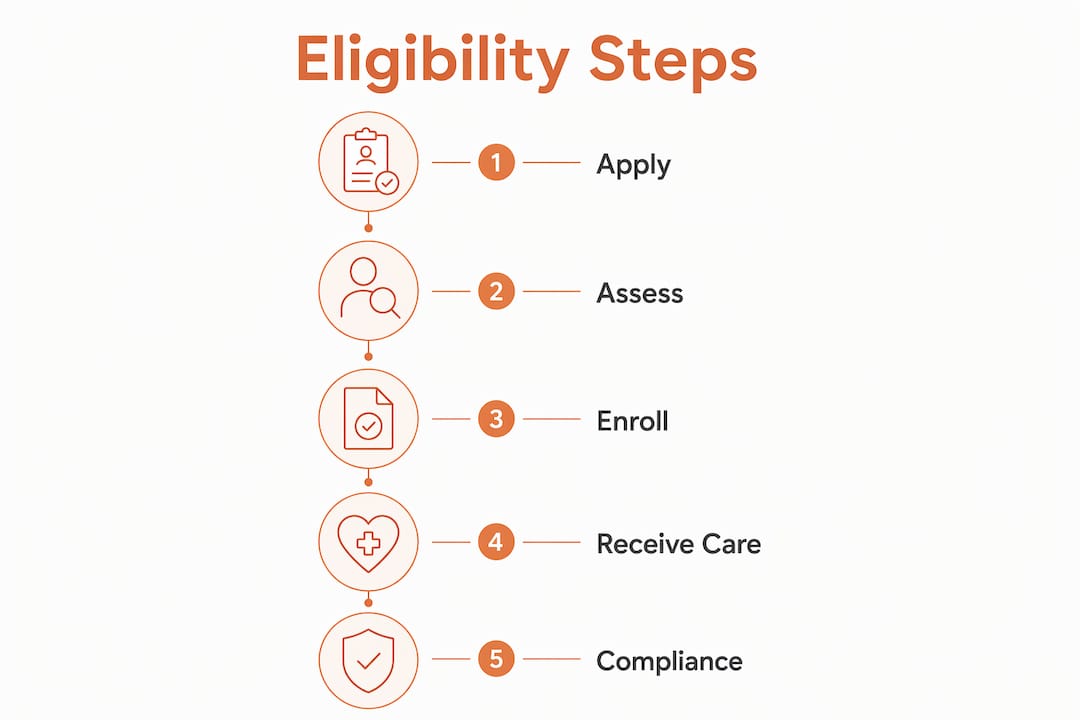
How do you actually get in-home skilled nursing through GAPP?
The process has four sequential steps, and skipping any one of them stalls authorization.
Establish Medicaid eligibility for your child, including income and categorical requirements.
Obtain a physician order documenting the skilled nursing need and specific clinical diagnoses.
Complete a level-of-care assessment conducted by a Medicaid-approved nurse; this determines authorized hours.
Select a licensed pediatric nursing agency to submit the prior authorization and begin staffing.
Paperwork errors at step 3 or 4 are the most common delay. Agencies experienced with GAPP authorization can submit complete documentation the first time, which matters when your child’s care needs are urgent.
What families get wrong about “hiring a family member” vs. SFC
The most common misconception: that SFC is simply Medicaid paying a relative informally. It is not. SFC requires documented clinical oversight — an assigned health coach, scheduled RN supervision visits, and formal training. That structure is what Medicaid authorizes payment against. Without it, no stipend is issued.
Careforth is the primary statewide SFC administrator in Georgia and manages caregiver intake, training, and payment processing. Families are typically connected to Careforth after waiver approval, not before. Attempting to arrange payment before waiver enrollment is a step families frequently take out of order, adding weeks to the process.
Pro Tip: Document every nurse visit, coaching contact, and training session from day one. Loss of documentation is the leading cause of stipend interruption under SFC.
What should you ask a pediatric nursing provider before signing on?
Four questions cut through the noise quickly:
What is your current shift fill rate? A provider unwilling to publish this number is telling you something.
What is your nurse retention rate? Rotating staff is a clinical risk for medically fragile children, not just an inconvenience.
How do you match nurses to clinical needs? Tracheostomy and ventilator care require specific competencies; generic placement is not acceptable.
Do you handle Medicaid and GAPP paperwork directly? Families should not be navigating prior authorizations alone.
Opulentprivatecare uses a 3 Thumbs Up Rule: the family, the nurse, and Opulentprivatecare must all approve the match before care begins. That standard exists because a poor fit in pediatric skilled nursing has real clinical consequences.
What does in-home skilled nursing actually cost under Medicaid and GAPP?
For families with active Medicaid and GAPP authorization, out-of-pocket cost for covered skilled nursing hours is typically zero. Medicaid pays the agency directly based on authorized hours and the applicable rate for the skill level required.
Private pay rates for pediatric skilled nursing in Georgia vary by clinical complexity and are not publicly listed by most agencies. Families without Medicaid coverage, or those awaiting authorization, sometimes bridge gaps with private pay while paperwork processes. The cost difference between Medicaid-covered and private-pay skilled nursing is substantial, which is why completing the authorization process correctly the first time matters.
How long does approval actually take?
Authorization for GAPP typically takes several weeks to a couple of months with complete documentation; incomplete documentation can cause longer delays.
Advertised timelines for SFC authorization are around two to three months, but real-world delays often extend the process further. Following up weekly with both the case manager and the SFC agency is the single most effective way to keep a file moving.
VA pathways (PCAFC, Veteran-Directed Care) are a separate administrative track and should be pursued in parallel with Medicaid, not sequentially. VA caregiver programs require a qualifying service-connected disability rating and have their own timelines.
What ongoing compliance looks like once you’re enrolled
Once GAPP nursing services begin, the agency must maintain a documented clinical plan of care, updated with any change in the child’s condition. Medicaid conducts periodic reviews, and authorized hours can be reduced if the level-of-care assessment no longer supports them.

For SFC families, compliance means consistent documentation of the caregiver’s co-residence, scheduled RN visits, and health coach contacts. Under IRS Notice 2014-7, co-residence is also the condition that keeps stipend payments tax-excludable. A change of address without proper documentation can convert payments into taxable wages retroactively.
Annual reassessments are standard across both GAPP and SFC. Missing a reassessment window is one of the fastest ways to lose authorized hours or stipend eligibility.
Opulentprivatecare: pediatric nursing and GAPP support, statewide
When a parent or guardian cannot be the paid caregiver, the practical answer is a pediatric nursing agency that handles both the clinical staffing and the Medicaid paperwork. That is exactly what Opulentprivatecare does.

Opulentprivatecare provides statewide in-home pediatric skilled nursing for medically fragile children in Georgia, covering tracheostomy, ventilator, feeding tube, seizure, cardiac, and neurological care. The intake process starts with an eligibility triage: Medicaid status, GAPP authorization readiness, and immediate clinical needs. From there, nurse matching is prioritized by clinical competency and family fit, not availability alone. Families should have their child’s Medicaid ID, recent physician orders, and current care plan ready at first contact.
Published shift fill rates and nurse retention metrics are available on request. The 3 Thumbs Up Rule means no nurse starts until the family, the nurse, and Opulentprivatecare all confirm the match. For families who have been through rotating staff, that standard is the difference between continuity and chaos.
Start the intake process today and get a clear picture of what your child qualifies for and how quickly nursing coverage can begin.
Key Takeaways
Georgia Medicaid excludes parents and legal guardians from paid caregiver roles under SFC; GAPP-funded skilled nursing through a licensed pediatric agency is the correct path for medically fragile children.
Point | Details |
Parent/guardian exclusion | Georgia Medicaid bars parents, legal guardians, spouses, and conservators from paid SFC caregiver roles. |
SFC stipend range | Eligible caregivers receive roughly $67–$80 per day, with the caregiver typically keeping 50–65% of the stipend after agency oversight costs. |
GAPP is the pediatric track | GAPP funds skilled nursing hours for children with complex needs; complete physician orders and a level-of-care assessment are required. |
Real timelines | GAPP authorization typically takes 30–60 days with clean paperwork; SFC often runs 90–180 days in practice. |
Opulentprivatecare | Provides statewide pediatric in-home nursing, GAPP paperwork support, and continuity-focused nurse matching for medically fragile children in Georgia. |
Recommended
Comments