
33–44 mg H2O/L: Home Humidification & Nurse Support for Ventilated Children

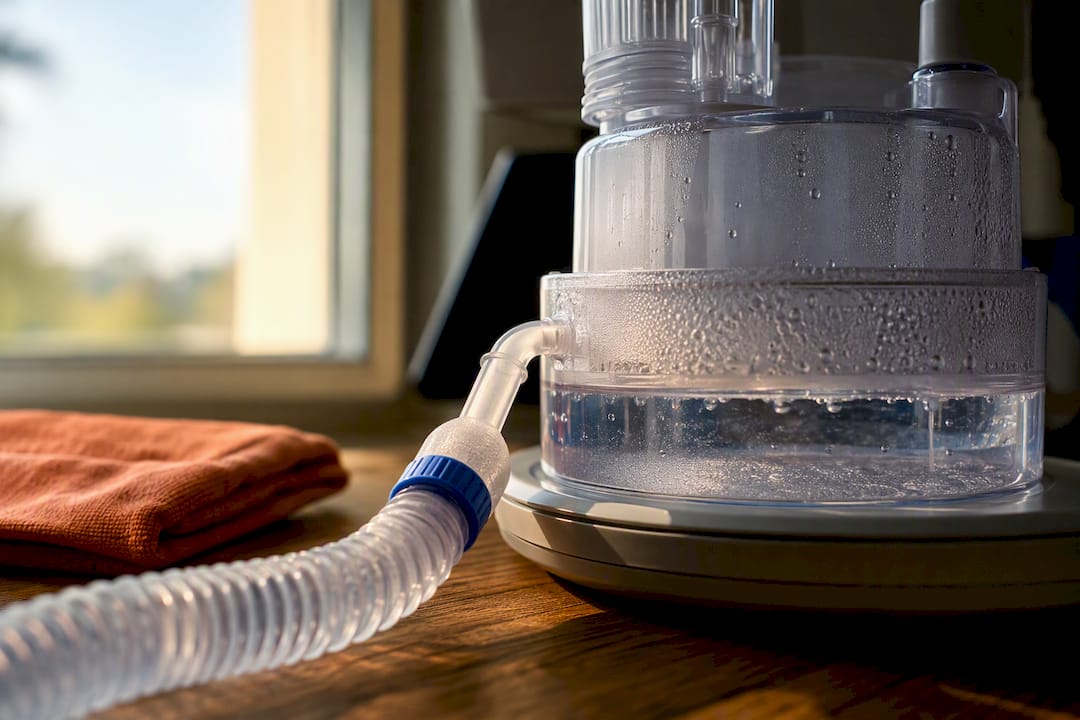
Most children on invasive mechanical ventilation do best with active heated humidification, especially infants, kids with thick secretions, or anyone on the vent long term. Heat and moisture exchangers (HMEs) work for short stretches with minimal secretions but aren’t a universal substitute. At home, three things matter every shift: know what your alarms mean, use only the water your clinician specified, and watch for harder breathing or unusual secretions right after any equipment change.
TL;DR:
Humidification is crucial for children on ventilators, especially infants and those with thick secretions, to prevent airway dryness and mucus plugging.
Heated humidifiers provide better moisture control for long-term ventilation and children with high secretion loads, while HMEs are more practical for short-term use but add dead space.
Humidifier target ranges are 33 to 44 mg of water vapor per liter of gas for active systems, and at least 30 mg for HMEs, with signs like condensate changes indicating proper function.
Proper setup involves using sterile or distilled water, correct device settings, and regular maintenance, with close observation for breathing changes after any equipment adjustments.
In-home nursing support ensures consistent, trained care and helps families navigate equipment troubleshooting, alarms, and emergency responses effectively.
Table of Contents
Why Humidification for a Ventilator Child Matters So Much
A tracheostomy or endotracheal tube bypasses the nose and throat entirely, and that’s the part of the body that normally warms and moistens every breath before it reaches the lungs. Skip that step, and the airway lining dries out fast.
Dry secretions thicken, stick to the tube walls, and slow down mucociliary clearance, the tiny hair-like cilia that sweep mucus and debris out of the lungs. When that clearance stalls, mucus plugs form. In a child, whose airway is already narrower than an adult’s, even a small plug can meaningfully block airflow.
Children carry extra risk here for a few reasons:
Smaller tidal volumes mean less margin for error when a tube partially clogs.
Limited respiratory reserve makes recovery from an obstruction event harder.
Immature thermoregulation, especially in neonates, means dry, cool gas can drop core temperature faster than in older kids or adults.
Under humidified gas doesn’t just cause discomfort. It’s tied to real complications: inadequate humidification can impair mucociliary clearance, damage the airway epithelium, and increase the risk of ventilator-associated events in children. That’s the physiologic reason clinicians take humidity settings as seriously as they take oxygen levels.
Heated Humidifiers vs. HMEs: What Fits Your Child
The two main humidification methods work in almost opposite ways, and understanding the mechanics explains why your child’s care team picked one over the other.
Heated humidifiers (HH) are active devices. Water sits in a reservoir that’s heated, and the vapor travels through the circuit, often through heated wires that keep the gas warm all the way to your child. HMEs are passive. They sit at the circuit’s Y-piece and simply capture the moisture and heat from your child’s exhaled breath, then return a portion of it on the next inhale.
Here’s how the two stack up in practice:
Moisture control. Heated humidifiers give more precise, adjustable humidity and generally outperform HMEs for kids with copious or thick secretions, long-term ventilation, or high minute ventilation.
Simplicity and portability. HMEs are disposable, need no power source, and are the practical pick for short transports or a quick trip to imaging.
Hidden costs of HMEs. They add dead space to the circuit, which matters far more in a small child than in an adult, and lab-tested performance specs don’t always match how an HME performs in real-world use.
When HMEs are off the table. Clinicians generally avoid HMEs for children with low tidal volumes, hypothermia, heavy or thick secretions, or significant circuit leaks, and passive humidification is not recommended when a noninvasive mask has a large leak.
Pro Tip: If your child’s team switches devices, ask why. A move from HH to HME (or back) is almost always driven by a specific clinical reason, like a change in secretion volume or a plan for transport, not a routine swap.
Heated humidifiers demand more upkeep, water refills, tubing checks, condensate management, but some pediatric series link them to a lower risk of tube occlusion compared to passive devices used in the wrong situation. That trade-off, more work for more protection, is exactly why the decision gets individualized rather than standardized.
The Numbers Your Respiratory Therapist Is Watching
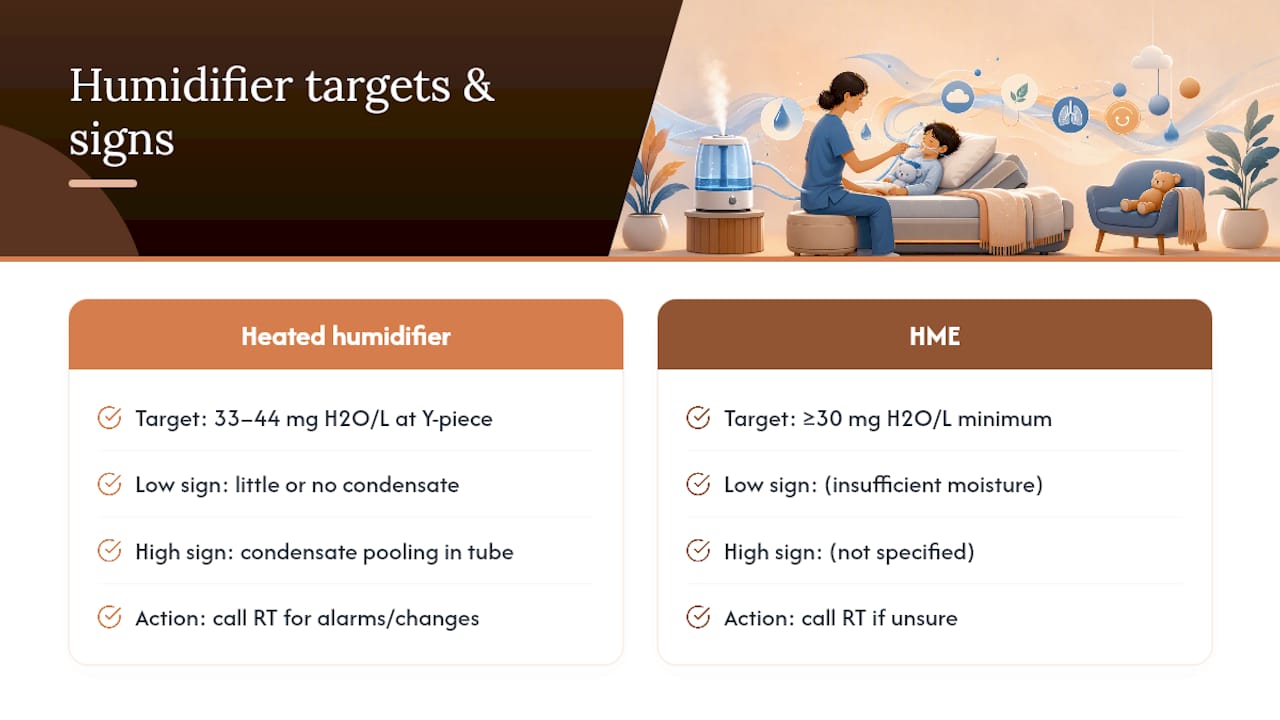
Guidelines give clinicians a specific target range, and knowing it helps you understand what your child’s device is actually doing. The American Association for Respiratory Care recommends active humidifiers deliver roughly 33 to 44 mg of water vapor per liter of gas at the circuit’s Y-piece during invasive ventilation. That same guideline sets a floor of at least 30 mg H2O/L for any HME in use.
Those numbers might look abstract, but they translate to something you can observe. If the heated humidifier’s temperature dial reads too low, you’ll often see less condensate in the tubing than usual, a sign the gas isn’t picking up enough moisture. Too much condensate pooling in the tube, on the other hand, can mean the temperature is set too high or the tubing has cooled unevenly.
You’re not expected to calculate humidity yourself. You are expected to notice when something looks different: no condensate at all after hours of use, condensate suddenly flooding the tubing, or a humidifier alarm you haven’t seen before. Any of those is worth a call to your respiratory therapist rather than a guess.
By the numbers: heated humidifiers target 33 to 44 mg H2O/L at the Y-piece; HMEs must clear a 30 mg H2O/L minimum to be considered adequate for invasive ventilation.
Setting Up and Maintaining Humidification at Home
Getting the setup right matters as much as picking the right device. Here’s how each system works day to day.
Fill the heated humidifier reservoir with sterile or distilled water, never tap water, unless your child’s device manufacturer explicitly says otherwise. Home humidifier instructions typically specify distilled or sterile water to limit biofilm growth inside the circuit.
Set the temperature exactly as prescribed and connect heated-wire tubing with a gentle downward slope from the humidifier toward your child. That slope helps condensate drain back into the chamber instead of pooling in the tube.
For HME use, confirm correct sizing at the Y-piece and replace it on the schedule your clinician set, usually before it visibly clogs or fills with secretions. A saturated or plugged HME feels heavier and may show visible moisture buildup.
Change reservoir water daily and follow the device manual for weekly deep cleaning. Empty condensate traps regularly, and never let collected fluid flow back toward your child.
Check the heater, alarms, and backup battery at the start of every shift. Keep a stocked supply of spare HMEs, tubing, and distilled water on hand.
For travel, an HME is often the practical choice for a short transfer, but reassess afterward. The added dead space that’s tolerable for twenty minutes in the car isn’t automatically fine for a full day out.
Pro Tip: After switching devices for any reason, watch your child closely for fifteen to thirty minutes. Circuit changes can alter resistance and dead space enough to change how hard the ventilator has to work to trigger a breath, so log the switch, the time, and how your child looked afterward. That note is gold for your nursing team later.
Troubleshooting: When to Fix It Yourself vs. When to Call for Help
Most humidification problems are minor and fixable on the spot. A few are not, and knowing the difference is the whole point of this section.
Common fixes you can handle:
Condensate pooling in the tubing: drain it into a container, never back toward the child, and reposition the tubing so it slopes correctly.
Heater not warming: check the power connection and confirm the alarm isn’t muted or disabled.
HME feels heavy, clogged, or wet: swap it for a fresh one immediately rather than waiting out the shift.
Some signs mean stop troubleshooting and escalate right now:
Visibly harder breathing, flaring nostrils, retractions, or a sudden change in color.
High-pressure alarms that keep sounding after you’ve checked the obvious causes.
Any sign the tube itself might be blocked, especially paired with thick, dry, or suddenly absent secretions.
For anything short of an emergency, call your home nursing team or respiratory therapist first, and have your child’s current ventilator settings, the alarm code displayed, and what changed in the last hour ready to report. For a true emergency, that’s what 911 and your child’s emergency care plan are for.
How Nurse-Led Training Backs Up What You Learn at Home
Reading about humidity targets is one thing. Watching a trained pediatric nurse walk through the same setup at your kitchen table is another. In-home nurses handle daily humidifier checks, reservoir changes, and HME swaps as part of routine care, and they also run through what an occlusion or heater alarm actually sounds like before it happens for real.
That hands-on training extends to documentation and coordination with your durable medical equipment supplier and respiratory therapist, so nobody’s guessing about what settings your child is actually running.
Continuity matters here more than most families expect. A 3 Thumbs Up Rule means a nurse only starts care once the family, the caregiver, and the agency all agree it’s a good fit, which cuts down on the rotating faces that make consistent humidification habits hard to build. If you want a trained hand walking through trach and vent care with you, or help sorting out equipment paperwork, those are important services to consider early in care.
What I Wish Someone Had Told Me Sooner
Every parent learns the same lesson eventually: condensate in the tubing isn’t a malfunction, it’s the humidifier doing its job. The panic fades fast once you know that.
The harder lesson is trusting your own eyes. If your child’s breathing looks different, don’t wait for the alarm to confirm it. Alarms catch a lot, but not everything, and a parent watching closely for years develops instincts that machines don’t have.
Ask for hands-on training before you need it in a crisis. It changes how you handle the next alarm.
— Opulent
Getting Hands-On Support From Opulentprivatecare
Reading the guidelines helps, but nothing replaces having a trained nurse in the room the first time your child’s humidifier alarm goes off. In-home pediatric nursing services can cover exactly that gap for families managing tracheostomy, ventilator, and feeding tube care, offering consistent nursing support rather than a rotating cast learning the child’s setup from scratch each shift.

Care includes in-home trach and vent nursing, caregiver training on humidification and equipment checks, emergency planning, and assistance with completing relevant Medicaid-related paperwork so you aren’t sorting through forms while also managing your child’s care. Families who prefer to stay hands-on themselves can also look into the family caregiver option, with the same training and support built in.
If you’re ready for consistent nursing support familiar with your child’s equipment, consider requesting a consultation through the GAPP program to begin conversations about paperwork and training.
Where This Guidance Comes From
The AARC clinical practice guideline sets the humidity and temperature targets clinicians use for both heated humidifiers and HMEs.
A PMC review on pediatric ICU humidification summarizes what’s known and where pediatric evidence still falls short.
A pilot randomized trial comparing HME and heated humidifier use in children found no significant difference in adverse events, though the study was small and excluded higher-risk kids.
This article is general information, not a substitute for advice from a qualified doctor. Consult a qualified healthcare professional about your own circumstances before acting on anything here.
Sources
FAQ
Can a regular humidifier be used with a ventilator?
No. Ventilator circuits require medical-grade heated humidifiers or HMEs built specifically for the device, not a room humidifier or a consumer humidification unit; those don’t integrate with the circuit or meet the AARC’s humidity targets.
Are humidifiers safe for children on ventilators?
Yes, when set up and maintained correctly. Active heated humidification is standard for most ventilated children, particularly infants and those with thick secretions, and the main safety steps are using the water type specified by your clinician and watching for changes in breathing after any setting change.
Why is humidification so important for a ventilator child?
Because the tube bypasses the nose and throat, the body’s natural humidifier, dry gas thickens secretions, slows mucociliary clearance, and raises the risk of tube occlusion and airway injury. Proper humidification keeps the airway lining functional and secretions manageable.
What are the downsides of humidified oxygen?
Humidification adds circuit dead space and can slightly change how the ventilator triggers a breath, which is why caregivers are told to watch for increased work of breathing after switching devices. Heated systems also need more daily upkeep, like water changes and condensate management, than passive HMEs.
How do in-home nursing services support families managing humidification at home?
In-home pediatric nurses can handle daily humidifier and HME checks as part of routine trach and vent care. Continuity-focused staffing models aim to have the same nurse maintain those routines shift after shift instead of rotating staff relearning the child’s setup.
Recommended
Comments