
Measuring Home Care Quality: A Georgia GAPP Family Guide


Six family-facing measures tell you whether your child’s in-home nursing is actually reliable. Track these every month, and you have real leverage with any agency:
Shift-fill rate (target: 90% or above; below 70% is a serious warning)
Missed-shift rate (target: under 5% monthly; above 5% demands a conversation)
Time-to-fill open shift (target: under 48 hours; over 72 hours is a red flag)
Percent same primary caregiver (target: 80% or more of shifts with your assigned nurse)
Nurse retention/turnover rate (target: annual turnover below 30%; 30–50% is the industry norm)
Caregiver-reported quality via CAPHONQ (target: consistently high scores on the 22-item survey)
Every one of these numbers is verifiable. You can request them from your agency, log them yourself, or cross-check them against your Medicaid/GAPP authorization records. No medical background required.
Key Takeaways
Families who track six specific metrics monthly have the clearest picture of whether their child’s in-home nursing is reliable, and the strongest position to demand improvements when it is not.
Point | Details |
Six metrics to track | Shift-fill rate, missed-shift rate, time-to-fill, primary caregiver %, nurse turnover, and CAPHONQ score cover the full picture. |
Fill rate benchmark | A fill rate above 90% is exceptional; below 70% signals serious staffing constraints per sector analysis. |
GAPP timeline context | The approval process takes 30–90 days; early fill-rate dips are common and should be evaluated after 90 days of steady-state care. |
Contract clauses matter | Require monthly written fill reports, a replacement guarantee under 48 hours, and written notice before any primary nurse change. |
Opulentprivatecare’s model | Opulentprivatecare publishes shift-fill and retention metrics and uses the 3 Thumbs Up Rule to confirm nurse-family fit before care begins. |
Table of Contents
How do you measure home care quality with the right metrics?
Each metric has a specific formula. Knowing the math lets you verify what the agency hands you rather than just accepting a summary.
Metric | Formula | Data Source | Who Reports |
Shift-fill rate | Staffed hours divided by authorized hours | Agency payroll/schedule export | Agency; family cross-checks |
Missed-shift rate | Missed shifts divided by scheduled shifts | Agency monthly fill report | Agency; family shift log |
Time-to-fill open shift | Hours from vacancy notice to confirmed replacement | Agency scheduling system | Agency |
Percent same primary caregiver | Shifts with primary nurse divided by total shifts | Nurse assignment list | Agency; family log |
Nurse retention/turnover rate | Nurses who left divided by average nurses on staff | Agency HR records | Agency |
CAPHONQ score | Average of 22 caregiver-rated items (scale varies) | Family-completed survey | Family |
Shift-fill rate is the single most important number. Sector analysis confirms that authorized-hours fill rate is the primary KPI buyers and valuation analysts use to judge pediatric home health agencies, with fill rates above 90% considered exceptional.
Percent same primary caregiver matters because continuity is not automatically delivered. Research on pediatric nursing shows that continuity is inconsistently achieved even in structured settings, and that without a formalized assignment list, families experience confusion and rotating staff. Agencies that actively manage clinical-family fit reduce turnover and improve continuity measurably.
CAPHONQ is a 22-item caregiver survey developed specifically for pediatric home nursing quality. The ICollab randomized trial registered on ClinicalTrials.gov used CAPHONQ as a primary outcome measure, making it the most validated family-facing tool available for this setting. You can complete it monthly and track your own trend line.
How can families collect and verify these numbers themselves?
You do not have to rely entirely on what the agency sends. A parallel family log takes about ten minutes a week and gives you independent data to compare.
Set up a shift log. Record the date, scheduled start/end time, actual start/end time, and nurse name for every shift. A simple spreadsheet works. Flag any no-show or late arrival immediately.
Request a monthly fill report. Ask for a time-stamped PDF showing authorized hours, staffed hours, and any missed shifts. Specify that you want it by the 5th of the following month.
Ask for the nurse assignment list. This is the agency’s internal continuity list showing which nurse is assigned as your child’s primary. Request it at intake and whenever a change is made.
Complete a CAPHONQ-style check monthly. The ICollab study protocol describes the 22-item instrument; families can adapt its core items (communication, clinical skill, reliability, responsiveness) into a simple monthly rating.
Store everything securely. Use a password-protected cloud folder (Google Drive or OneDrive) organized by month. Keep PDFs, screenshots, and email confirmations together.
Document supply gaps and out-of-pocket costs. Research on pediatric home health found that families often used personal funds to cover gaps caused by staffing shortages. Those records matter if you need to file a complaint.
Pro Tip: Capture your GAPP prior authorization (PA) approval date and your PPOT date the day you receive them. The GAPP program requires specific documentation at each stage, and those timestamps are your baseline for calculating time-to-initiate. If care starts 60 days after PA approval, that delay is measurable evidence of a staffing problem, not merely a feeling.
What benchmarks and red flags should Georgia families watch for?
Strong performance looks like this:
Shift-fill rate at or above 90%
Missed-shift rate kept low monthly to avoid impacting care
Time-to-fill an open shift promptly, ideally within a few days
Primary caregiver covering a large majority of shifts for continuity
Annual nurse turnover below 30%
On fill rates: Sector analysis of pediatric home health agencies identifies fill rates above 90% as exceptional and rates below 70% as a signal of serious staffing constraints. For a medically fragile child on a ventilator or tracheostomy, a 70% fill rate means roughly one in three authorized shifts goes uncovered.
Red flags that require immediate escalation:
Night or weekend shifts going unfilled more than once in a month
Your child’s primary nurse changing more than twice in 90 days
Agency cannot tell you the current fill rate or refuses to share it in writing
Monthly reports arrive late, incomplete, or not at all
Time-to-fill consistently exceeds 72 hours with no explanation
Pediatric home healthcare quality is rarely measured with standardized, pediatric-specific metrics, which means families who track these numbers themselves often catch problems before the agency acknowledges them. Some states have used pay-for-performance arrangements tied to missed-shift reduction and care-plan adherence to address this gap, but Georgia families cannot count on those incentives being in place at every agency.
How do you choose or hold an agency accountable using these metrics?
Questions to ask before signing
What was your average shift-fill rate for pediatric cases last quarter?
What is your average time-to-fill an open shift for a medically complex child?
What is your annual nurse turnover rate for home health nurses?
How do you document and maintain a continuity list for nurse-family matching?
Do you use CAPHONQ or any caregiver-reported quality survey?
Contract and reporting clauses to request
Monthly reporting clause: Agency delivers a written fill report by the 5th of each month, including authorized hours, staffed hours, missed shifts, and primary caregiver percentage.
Dashboard access: Family receives read access to a scheduling or reporting dashboard within 30 days of care initiation.
Replacement guarantee: Agency commits to filling any open shift within 48 hours or notifying the family with a documented corrective plan.
Nurse assignment policy: Agency maintains a written continuity list and notifies the family in writing before any primary nurse change.
Data access rights: Family may request raw scheduling data at any time with a 5-business-day turnaround.
Escalation flow when an agency falls short
Call your agency’s clinical supervisor directly. Document the call with date, time, and name.
If unresolved within 5 business days, contact your GAPP Program Specialist at the Georgia Department of Community Health.
Submit a written complaint with your shift log, missed-shift records, and any agency communications.
Under GAPP’s Freedom of Choice provision, you may transfer to a different agency. The GAPP program authorizes up to 24 hours per day of skilled nursing once approved, and that authorization follows your child, not the agency.
For high-acuity cases like tracheostomy home care, a coverage gap is a safety event, not an inconvenience. Treat it that way in your documentation.
A one-page monthly dashboard families can use
Copy this table into a spreadsheet and fill it in each month:
For a quick visual, plot your shift-fill rate month over month in a simple line chart. A downward trend over two consecutive months is enough to trigger a formal conversation with the agency.
Action plan when metrics cross red-flag thresholds:
Pull your shift log and compare it against the agency’s monthly report. Identify the specific gap.
Call the agency clinical supervisor within 24 hours of identifying the problem.
Request a written corrective action plan within 5 business days.
If the plan is not delivered or the metric does not improve within 30 days, contact your GAPP Program Specialist and begin the transfer process under Freedom of Choice.
What does a continuity-first provider actually publish?
A provider that takes measurable reliability seriously publishes these numbers monthly, without being asked:
Monthly shift-fill rate (staffed vs. authorized hours, by child)
Average time-to-fill for open shifts in the prior month
Active continuity list showing each family’s assigned primary and backup nurse
Nurse retention rate (rolling 12-month figure)
CAPHONQ average across active families
Each disclosure reduces a specific family risk. A published fill rate tells you the agency cannot hide a staffing problem behind vague reassurances. A public retention rate signals whether nurses actually want to stay, which research links directly to better continuity outcomes. A published CAPHONQ average gives you a peer benchmark: if your score is significantly below the agency’s reported average, that is a signal worth investigating.
Opulentprivatecare’s continuity-focused model is built around exactly this kind of disclosure, including nurse-match documentation and published staffing metrics that families can review before and during care.
What can these metrics not tell you?
Metrics are powerful, but they have real limits Georgia families should understand.
They do not directly measure clinical competence. A nurse who fills every shift is not automatically skilled in tracheostomy management or seizure response. Use metrics alongside clinical credential verification and your own observations during pediatric home visits.
They cannot predict sudden staffing shocks. A nurse leaving unexpectedly, a flu outbreak, or a regional workforce shortage can drop fill rates in a single week. Context matters when interpreting a one-month dip.
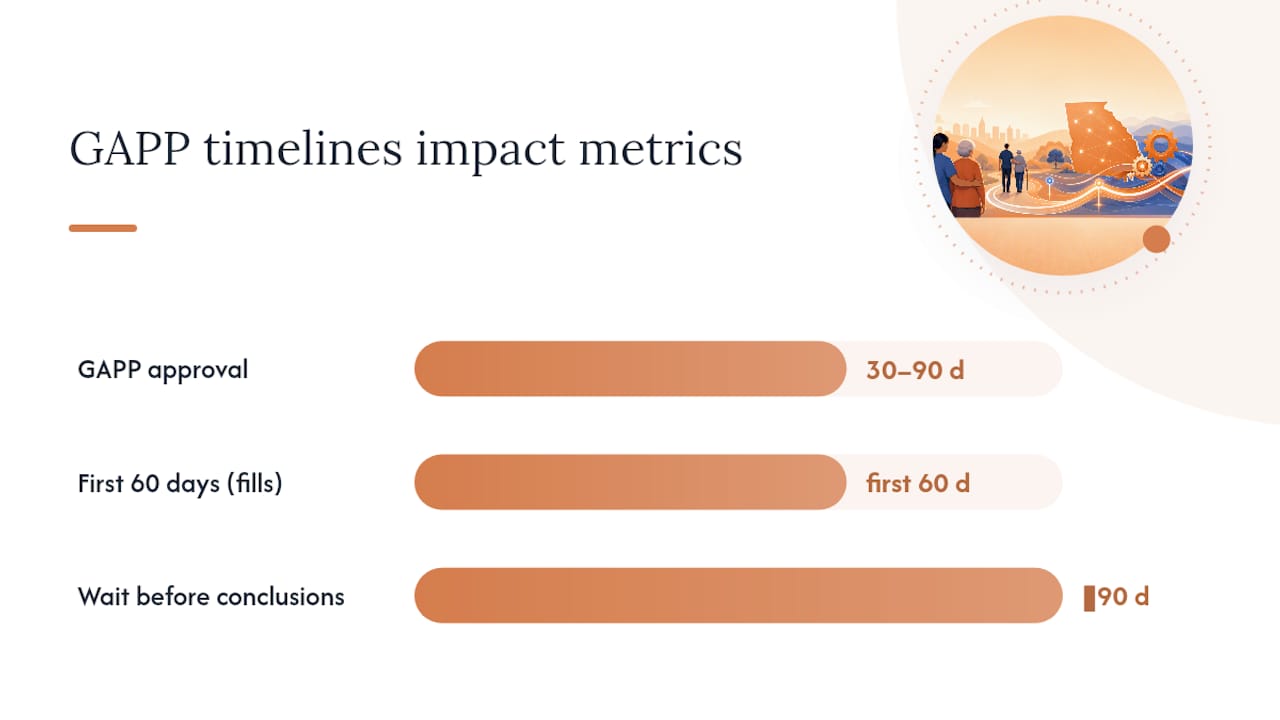
GAPP timelines affect early metrics. The GAPP approval process typically takes 30–90 days, and the GAPP program documentation requires PPOT, Appendix I, and Appendix J before care can begin. Fill rates in the first 60 days of a new authorization often look worse than steady-state performance. Give an agency at least 90 days before drawing conclusions.
Medicaid reimbursement rates affect agency behavior. Research shows Medicaid pays at lower rates than private insurance, which can push agencies to prioritize private-pay cases when staffing is tight. That structural pressure shows up in fill rates for GAPP families specifically.
When relational continuity (the same nurse, every shift) is not achievable, informational continuity — consistent, shared knowledge about your child’s needs, routines, and clinical history — becomes the practical fallback. Ask your agency how they transfer that information when a substitute nurse covers a shift.
Why publishing metrics is the right thing to do
Families of medically fragile children are already carrying an enormous load. Asking them to trust an agency on faith, without numbers, is not a partnership. Publishing shift-fill rates, retention figures, and CAPHONQ averages is not a marketing move. It is the minimum a provider owes a family whose child depends on consistent, skilled care.

Opulentprivatecare’s approach starts before care begins: the 3 Thumbs Up Rule requires sign-off from the family, the nurse, and Opulentprivatecare before a match is confirmed. That process produces better retention and higher continuity percentages because fit is verified upfront, not discovered after a bad shift. Families who request the same transparency from any provider are not being demanding. They are doing exactly what the evidence supports.
Opulentprivatecare helps Georgia GAPP families get started
For Georgia families navigating GAPP, the paperwork alone can delay care by weeks. Opulentprivatecare handles GAPP documentation from the start: PPOT completion, prior authorization support, and nurse matching based on your child’s clinical profile and your family’s preferences.

On your first call, Opulentprivatecare walks you through the nurse-match process, shares the monthly dashboard template used with current families, and explains what fill-rate and retention numbers to expect during the first 90 days under GAPP. The 3 Thumbs Up Rule means no nurse starts until your family approves the match.
Georgia families can reach Opulentprivatecare here to start the intake process, ask about current GAPP availability, or request the reporting template. If your child needs support for complex medical needs like tracheostomy, ventilator, or feeding tube care, Opulentprivatecare’s nurses are matched specifically for those conditions.
Sources
Recommended
Comments