
Medicaid Night Nursing for Children: Coverage and Access Guide
- Opulent Private Care Services

- 6 days ago
- 9 min read
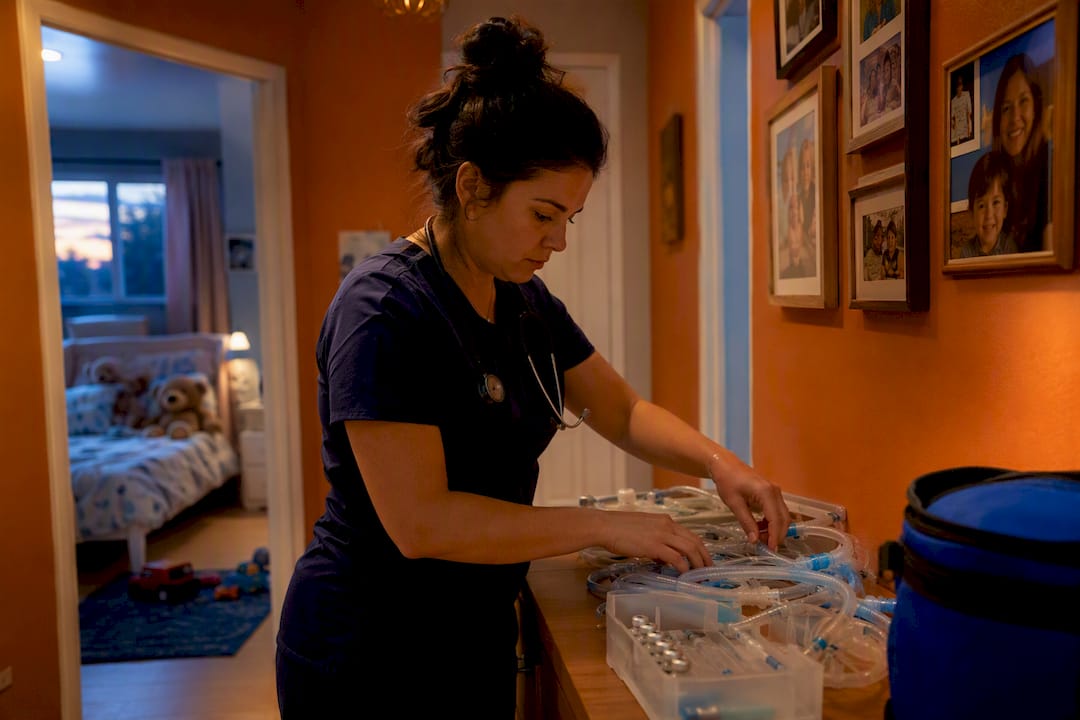
Yes: Medicaid can cover medically necessary overnight and private-duty nursing for a child under 21, but whether your family gets approved, how many hours you receive, and how fast a nurse actually shows up all depend on your state’s rules and prior authorization process. Federal law backs you up here through EPSDT, which requires Medicaid to cover services that correct or improve a child’s medical condition, including nursing in the home. That’s the legal floor. What happens next is administrative, and it moves faster when you’re organized.
Three things to do this week:
Get a physician order and plan of care naming the specific nursing tasks your child needs overnight.
Call your Medicaid case manager or MCO to ask what prior authorization forms and documentation they require.
Pull together discharge summaries, nursing notes, and any hospital records that show the pattern of care your child needs.
Pro Tip: If your child is Georgia-based and medically fragile, Opulent Private Care works with families through this exact process and can tell you within a phone call whether your child’s profile fits typical GAPP approval patterns.
TL;DR:
Medicaid coverage for overnight nursing is guaranteed under federal EPSDT law, but actual access depends on state-specific documentation and hour limits.
Proper documentation, including physician orders and discharge summaries, is critical for obtaining prior authorization and exceeding standard hour caps.
General staffing shortages mean that even approved hours may remain unfilled without a reliable provider who tracks staffing levels, retention, and on-call support.
States vary widely in their PDN policies, with some offering explicit exceptions for clinical evidence, while others use managed care programs or require direct provider contact.
Georgia families can benefit from specialized assistance in navigating paperwork, authorization, and nurse matching through Opulentprivatecare.
Table of Contents
Does your child meet Medicaid’s eligibility criteria for night nursing?
How to request pediatric night nursing and get it authorized
How Medicaid pays for night nursing and what family caregivers can expect
Your checklist to move a night nursing request forward this week
Get Medicaid night nursing started for your child in Georgia
What medicaid night nursing for a child actually covers
The legal basis for pediatric night nursing sits in one federal provision: Early and Periodic Screening, Diagnostic, and Treatment (EPSDT). Under section 1905®, Medicaid must cover medically necessary services for enrollees under 21, even services a state’s adult Medicaid plan doesn’t otherwise cover. Private-duty nursing is one of those services when a physician documents the need.
States still administer their own plans, and that’s where the friction shows up. A state can set its own prior authorization process, documentation standards, and even hour limits, as long as it doesn’t outright deny medically necessary care to a child. North Carolina’s state plan amendment on PDN is a good example: it spells out EPSDT exceptions that let a child exceed the state’s normal hour cap when clinical evidence supports it.
What this means for your family:
Federal law is the reason your child’s request can’t simply be denied for being “outside the standard plan.”
Your state’s Medicaid manual determines the paperwork trail and timeline.
An EPSDT exception argument, when properly documented, can push past a state’s usual hour ceiling.
What private-duty and overnight nursing actually involves
Private-duty nursing (PDN) is not the same thing as the intermittent home health visits many families are used to, where a nurse comes for an hour to check vitals or change a dressing. PDN is continuous, skilled nursing care, typically authorized in blocks of four or more hours at a stretch, based on how Washington’s Medicaid billing guide defines the service. Night nursing is simply PDN scheduled for the hours when your child’s clinical needs don’t stop just because the sun goes down.
Tasks that typically qualify a child for overnight skilled nursing include:
Tracheostomy and ventilator management, including monitoring, suctioning, and responding to alarms
Complex enteral nutrition, such as continuous tube feeds that require rate adjustments or troubleshooting
Multi-drug medication schedules that require precise timing through the night
Seizure monitoring and intervention, including rescue medication administration
Cardiac or respiratory monitoring for children on home oxygen or apnea monitors
Wound care or ostomy management requiring sterile technique
If your child’s nighttime needs are limited to occasional check-ins or comfort, that’s respite care, not PDN, and Medicaid won’t fund it the same way. The distinction matters because it shapes what you document and how you present the case to your caseworker. A tracheostomy that requires suctioning every hour looks very different on paper than one that’s mostly self-managing, and documenting that clinical picture accurately from day one saves you a denial and an appeal later.
Does your child meet Medicaid’s eligibility criteria for night nursing?
Medical necessity is the backbone of every PDN approval, and it has to come from a physician, not a parent’s description of a hard week. Your child’s doctor needs to write an order specifying the diagnosis, the required nursing tasks, and why those tasks require a licensed nurse rather than a trained caregiver.
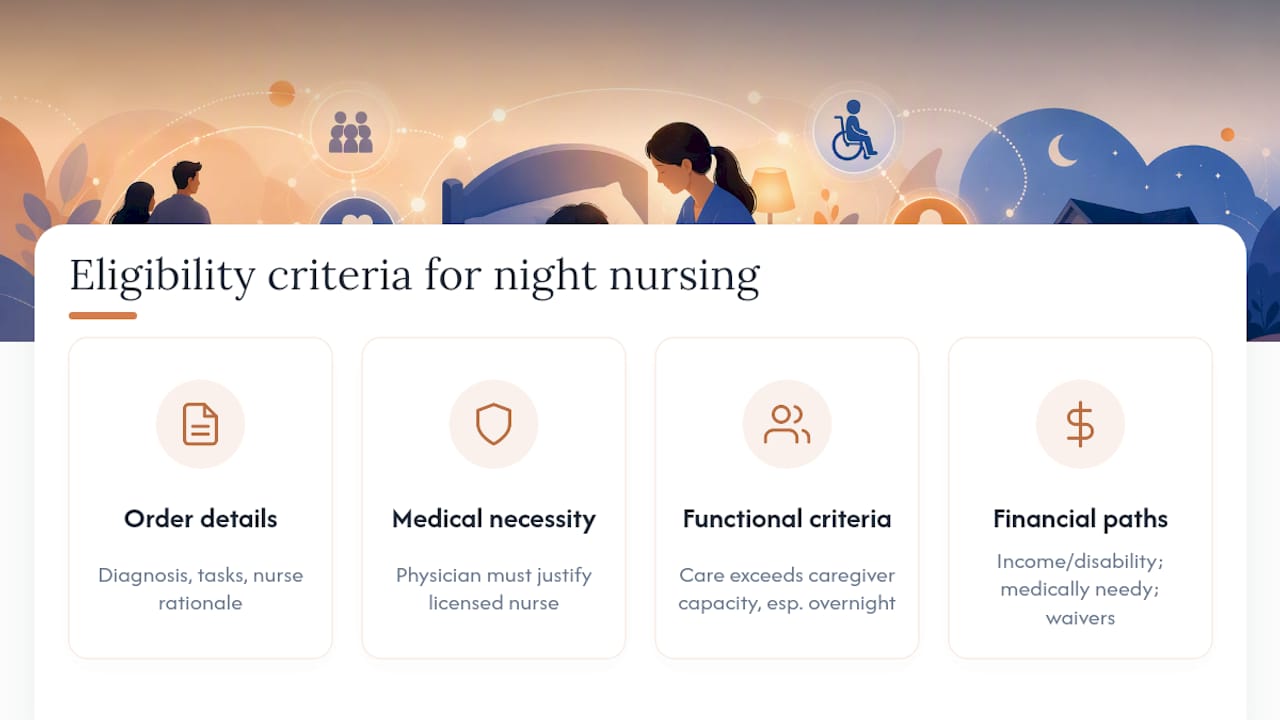
States also look at functional criteria: does the volume and complexity of care exceed what a parent can reasonably manage alone, especially overnight when sleep deprivation becomes a safety issue itself? Missouri’s Medicaid program, for instance, evaluates whether a primary caregiver’s capacity is genuinely exceeded by the clinical demands, not just strained by them.
On the financial side, your child generally qualifies through standard Medicaid income and disability pathways, though many states also offer a medically needy pathway or a waiver (like a Katie Beckett-style program) that looks at the child’s income rather than the household’s. This matters enormously for middle-income families who assume they earn “too much” for Medicaid.
Pro Tip: Ask your case manager directly whether your state has an EPSDT-based hour exception process. Many parents never hear about it because it’s not on the standard intake form.
How to request pediatric night nursing and get it authorized
Getting from “my child needs a nurse at night” to an authorized, staffed shift is a documentation exercise as much as a medical one.
Secure the physician order and plan of care first. This is the anchor document. Without it, nothing else moves. The American Academy of Pediatrics specifically recommends bringing your pediatrician into the process early, since they can act as your advocate through the prior authorization fight.
Gather discharge summaries and nursing notes. If your child is coming home from a hospital or NICU stay, that discharge paperwork is gold. It documents exactly what skilled tasks were being performed around the clock, which is the strongest evidence a reviewer can see.
Submit to your case manager or MCO with a clear clinical rationale, not just a request. Spell out the frequency of tasks across a full 24 hours, since Washington’s billing guide notes that flow sheets and nursing observation logs carry real weight in these reviews.
Prior authorization timelines vary by state and MCO, but most run several weeks. The most common denial reasons are thin documentation and a reviewer’s perception that a parent could manage the care without a nurse. That’s why the hospital-to-home window matters so much: the clinical need is freshest and best documented right at discharge, before the paper trail goes cold.
How Medicaid PDN rules and hour limits differ by state
No two states run this program the same way, and that catches a lot of families off guard when they compare notes with someone in a different state. The policy levers that vary most: hour caps per day or week, whether EPSDT exceptions are formally built into the state plan, whether alternative programs exist (some states use a Pediatric Prolonged Care Center model or a Medically Intensive Children’s Program instead of, or alongside, home PDN), and how strict provider licensing and enrollment rules are.
A few real examples show the spread:
Washington runs its Medically Intensive Children’s Program, which defines PDN in continuous four-plus-hour blocks and uses nursing consultant assessments to determine need.
North Carolina built EPSDT exception language directly into its state plan amendment, giving families a formal path past standard hour caps.
Texas routes PDN authorization through its STAR Kids managed care program, where the MCO handbook governs the process rather than the state directly.
Missouri publishes a detailed FAQ on PDN that walks through caregiver capacity standards and family-employed nurse rules.
Your fastest path to clarity is your state Medicaid website’s provider manual section on private duty nursing, plus a direct call to your case manager, since manuals lag behind actual practice more often than caseworkers do.
Why approval doesn’t always mean a nurse shows up
Here’s the part almost nobody warns families about: getting authorized hours is not the same as getting a nurse in your home tonight. Pediatric nursing has a real staffing shortage, and overnight shifts are the hardest to fill of all, because fewer nurses want them and the clinical stakes of a no-show are higher than in adult care; this is why understanding flexible nursing contract types matters when evaluating staffing availability.
When you’re evaluating a provider, ask about the numbers, not just the pitch:
Published shift-fill rates, meaning the percentage of authorized hours actually staffed
Nurse retention figures, since a revolving door of nurses undermines the whole point of continuous care
24/7 clinical on-call support for when something goes wrong at 2 a.m.
Real-time electronic documentation that keeps your child’s care team in sync
Reliable providers tend to publish these numbers because operational transparency is a genuine differentiator in this field, not a marketing checkbox.
Pro Tip: If you have authorized hours going unstaffed for weeks, document every gap. That record becomes your evidence if you ever need to appeal for a different provider or push your MCO for a solution.
How Medicaid pays for night nursing and what family caregivers can expect
Medicaid pays enrolled, state-licensed home health agencies directly for PDN hours delivered, which is why your provider’s licensing status matters as much as their bedside manner. An agency has to be properly enrolled with your state’s Medicaid program to bill for the care at all.
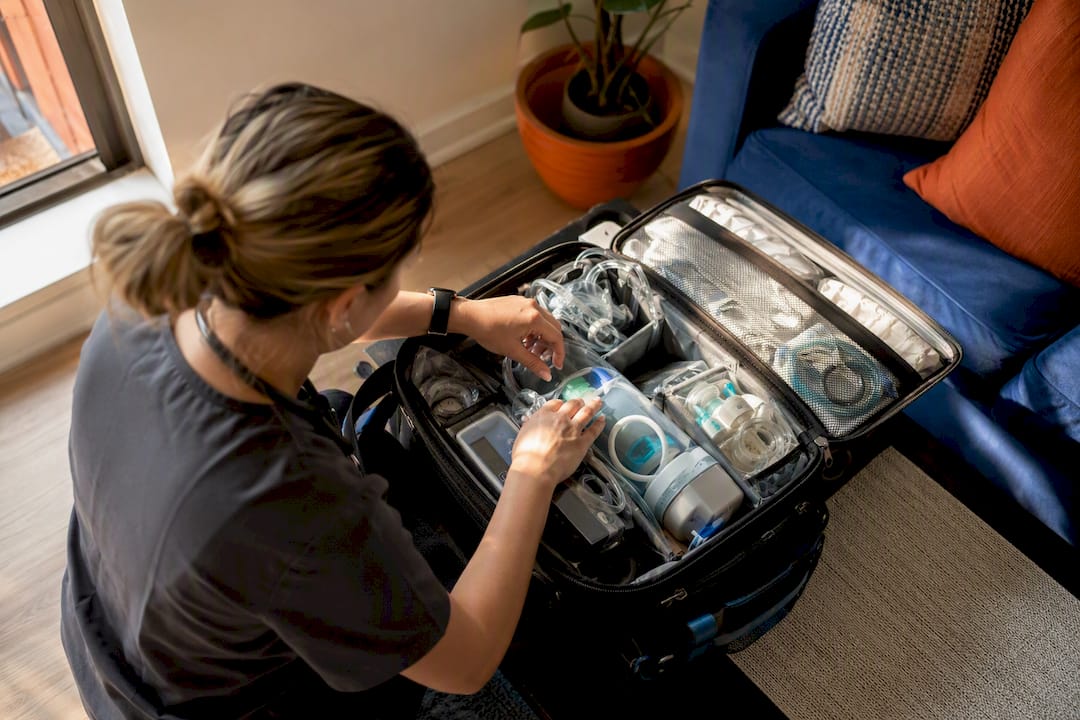
A narrower situation exists in some states: if a parent or legal guardian is a licensed RN or LPN and gets hired by a Medicaid-enrolled agency, they may be paid for a portion of PDN hours, often capped around 12 hours per day and 40 hours per week. Georgia has its own version of this pathway worth understanding if you’re a licensed parent caregiver.
When your child’s needs grow, ask your case manager about the process for requesting an hour extension, and whether coordinating PDN with a prolonged care center makes sense for partial-day coverage.
Your checklist to move a night nursing request forward this week
Call your child’s pediatrician and request a written order plus a plan of care naming specific overnight tasks.
Request your Medicaid case manager’s or MCO’s PDN prior authorization packet and ask about typical response timelines.
Pull discharge summaries and recent nursing notes if your child has had a hospital stay in the past year.
Ask what happens if hours are authorized but unstaffed, so you know your options before you’re stuck waiting.
Most families hear back on prior authorization within a few weeks, though EPSDT exception requests can take longer given the added clinical review.
What a genuinely reliable night nursing partner looks like
Families rarely get burned by the Medicaid paperwork alone. They get burned by providers who win the authorization and then can’t staff the shift. That’s why Opulentprivatecare built its “3 Thumbs Up Rule”: care doesn’t start until the family, the assigned nurse, and Opulentprivatecare all sign off on the fit. Skip that step, and you’re setting up a mismatch that shows up as a 2 a.m. call-out.
Ask any provider you’re considering for their shift-fill rate, their nurse retention numbers, and whether they offer 24/7 clinical on-call support. If they can’t answer with numbers, that’s information too.
— Opulent
Get Medicaid night nursing started for your child in Georgia
Opulentprivatecare gives Georgia families a faster path through the Medicaid maze than going it alone against a case manager’s inbox. Instead of guessing at GAPP paperwork or waiting on hold, families get hands-on help assembling physician orders, plans of care, and prior authorization documents, paired with nurses matched for your child’s specific clinical needs, whether that’s tracheostomy care, ventilator management, or G-tube feeding.

Before your intake call, have your child’s diagnosis, current physician orders, and any recent hospital discharge paperwork ready. Opulentprivatecare’s team uses that to move your authorization request forward and to start the nurse-matching process immediately, so you’re not waiting on staffing after you’re already approved. Explore the trach, vent, and G-tube nursing services Opulentprivatecare provides, or start your intake conversation to see how quickly your family can move from paperwork to a nurse at the bedside.
Key Takeaways
Medicaid must cover medically necessary overnight nursing for children under 21 under federal EPSDT law, but state-level rules on documentation, hour caps, and nurse staffing determine whether that coverage actually reaches your home.
Point | Details |
EPSDT is the legal foundation | Federal law requires Medicaid to cover medically necessary nursing for kids under 21, regardless of state plan limits. |
Documentation drives approval | A physician order, plan of care, and discharge records carry more weight than a description of caregiver exhaustion. |
Hour caps vary by state | Some states allow EPSDT exceptions to exceed standard limits when clinical evidence supports more hours. |
Approval doesn’t guarantee staffing | Nurse shortages, especially overnight, mean authorized hours can still go unfilled without a reliable provider. |
Opulentprivatecare supports Georgia families | Assists with GAPP paperwork, prior authorization, and nurse matching for tracheostomy, ventilator, and G-tube care. |
This article is general information, not a substitute for advice from a qualified doctor. Consult a qualified healthcare professional about your own circumstances before acting on anything here.
Sources
Recommended
Comments