
Secure Consistent Medicaid Private Duty Nursing for U.S. Families


Yes. Most state Medicaid programs cover private duty nursing (PDN) for medically fragile beneficiaries, and federal EPSDT rules expand that coverage for children under 21 with technology-dependent or continuous skilled nursing needs. If your child depends on a ventilator, trach, feeding tube, or needs frequent suctioning or seizure monitoring, PDN is likely worth pursuing. Start with a clinician’s order documenting the need, then contact your Medicaid plan or state Medicaid office directly.
TL;DR:
Medicaid generally covers private duty nursing for children with complex medical needs like ventilators or trachs, especially under EPSDT protections for those under 21.
Prior authorization typically requires documentation from a clinician showing continuous skilled nursing is necessary, with recertification needed before the authorization expires.
Staffing consistency and nurse retention significantly impact whether families experience the full benefit of authorized PDN hours, with frequent nurse rotation causing care disruptions.
Billing varies by state and can be through fee-for-service or managed care, with many states imposing hour caps and strict authorization procedures regardless of age.
Families should verify provider licenses, insurance, and shift-fill rates before hiring, and confirm that equipment, care plans, and backup staffing are ready before hospital discharge.
Table of Contents
What Is Medicaid Private Duty Nursing, Exactly?
Private duty nursing is a Medicaid state plan service built around continuous, shift-based skilled nursing care, not the brief, task-focused visits typical of standard home health. A PDN shift often runs more than four hours, sometimes up to 12 hours, because the nurse stays on-site to manage an ongoing medical need rather than dropping in to give a treatment and leave.
That distinction trips up a lot of families early on. Home health sends a nurse for a wound check or a medication adjustment, then leaves. Waiver-funded personal care covers nonmedical help with bathing, dressing, or mobility, but it isn’t skilled nursing at all. PDN exists for a different category of need entirely:
Ventilator or tracheostomy management requiring hands-on monitoring
Frequent or unpredictable suctioning
NG-tube or G-tube feeding administration and monitoring
Complex seizure disorders that need a trained nurse present, not just checked on
If your child’s care plan reads more like “someone qualified needs to be here constantly” than “someone needs to stop by,” PDN is the benefit category to ask about.
Who Qualifies for Medicaid PDN Coverage?
Medical necessity drives every PDN authorization decision. States and managed care organizations use level-of-care standards to determine whether a beneficiary’s condition genuinely requires continuous skilled nursing rather than intermittent visits or family caregiving alone. That standard usually looks at frequency of skilled interventions, complexity of the medical equipment involved, and the risk of an adverse event without a trained nurse present.
For children under 21, EPSDT changes the calculus significantly. Early and Periodic Screening, Diagnostic, and Treatment protections require states to cover medically necessary services for kids, even services the state’s adult benefit package doesn’t otherwise include. That’s often why a child with a trach can get authorized PDN hours in a state where an adult with a similar condition can’t.
Adult coverage looks noticeably different:
Some states cap PDN hours for adults regardless of documented need
Others restrict adult PDN to narrow categories, like ventilator-dependent beneficiaries only
Prior authorization requirements tend to be stricter, and renewal cycles shorter
The gap between pediatric and adult coverage isn’t an accident. It’s the direct result of EPSDT’s broader mandate versus the discretion states retain over adult Medicaid benefit packages.
How Does Prior Authorization Work for Medicaid PDN?
Almost every state requires prior authorization (PA) before PDN hours get approved, and the process has a fairly predictable rhythm.
The clinician submits documentation. A physician, nurse practitioner, or the home nursing agency typically files the PA request, backed by orders detailing the specific skilled tasks required and their frequency.
The payor reviews for medical necessity. If your child is enrolled through a managed care organization (MCO or CMO) rather than fee-for-service Medicaid, expect the MCO’s own utilization review team to apply its own criteria, which can differ from the state’s fee-for-service rules even for the same underlying benefit.
Approval comes with a time limit. Authorizations aren’t permanent. Most states require recertification, meaning a physician has to document the ongoing need again, often tied to a face-to-face encounter, before hours renew.
Pro Tip: Start the recertification paperwork at least two to three weeks before your current authorization expires. A missed renewal window is one of the most common reasons families experience an unplanned gap in nursing hours.
Fee-for-service Medicaid and managed care don’t always move at the same pace, so ask your care coordinator directly which system governs your case and what its specific renewal timeline looks like.
How Do You Request PDN? A Step-by-Step Checklist
Getting PDN authorized and staffed takes coordination across several parties, but the sequence is consistent across most states.
Get a clinician order. Your child’s physician needs to document, in writing, the specific continuous skilled nursing tasks required and why intermittent visits wouldn’t be sufficient.
Contact your Medicaid plan or state Medicaid office. Confirm that PDN is a covered benefit in your state, ask what the PA process requires, and get the correct forms. State guides like New York’s consumer resource walk through exactly what documentation to gather.
Choose a provider type. Decide between a licensed home health agency and an authorized independent nurse, then complete enrollment paperwork and required background checks.
Coordinate the transition. Line up equipment, schedule nurse training on your child’s specific care plan, document a formal handoff, and establish a backup staffing plan before discharge day arrives.
Families who skip step four are the ones most likely to face a coverage gap the moment they leave the hospital.
Who Can Legally Provide PDN, and What Should You Verify?
Not every caregiver with nursing credentials can bill Medicaid for PDN. States license different categories of providers, and the rules affect who your family can hire and how that care gets paid.
A home health agency operates under one licensing structure, while a Private Home Care Provider (PHCP), which Georgia specifically regulates, operates under another. An independent nurse authorized to bill directly is a third category entirely, and not every state allows it. Verification isn’t optional here. Before care starts, confirm:
Active, unencumbered RN or LPN license in your state
Current liability insurance coverage
Completed background checks appropriate to pediatric or medically complex care
The provider’s shift-fill rate and staff rotation policy
Pro Tip: Ask any prospective agency directly what percentage of authorized shifts they actually fill, and whether your child will see the same nurse consistently. A high shift-fill rate with heavy rotation still means a stream of unfamiliar faces learning your child’s care plan from scratch.
What Does PDN Billing Look Like, and How Much Coverage Can You Expect?
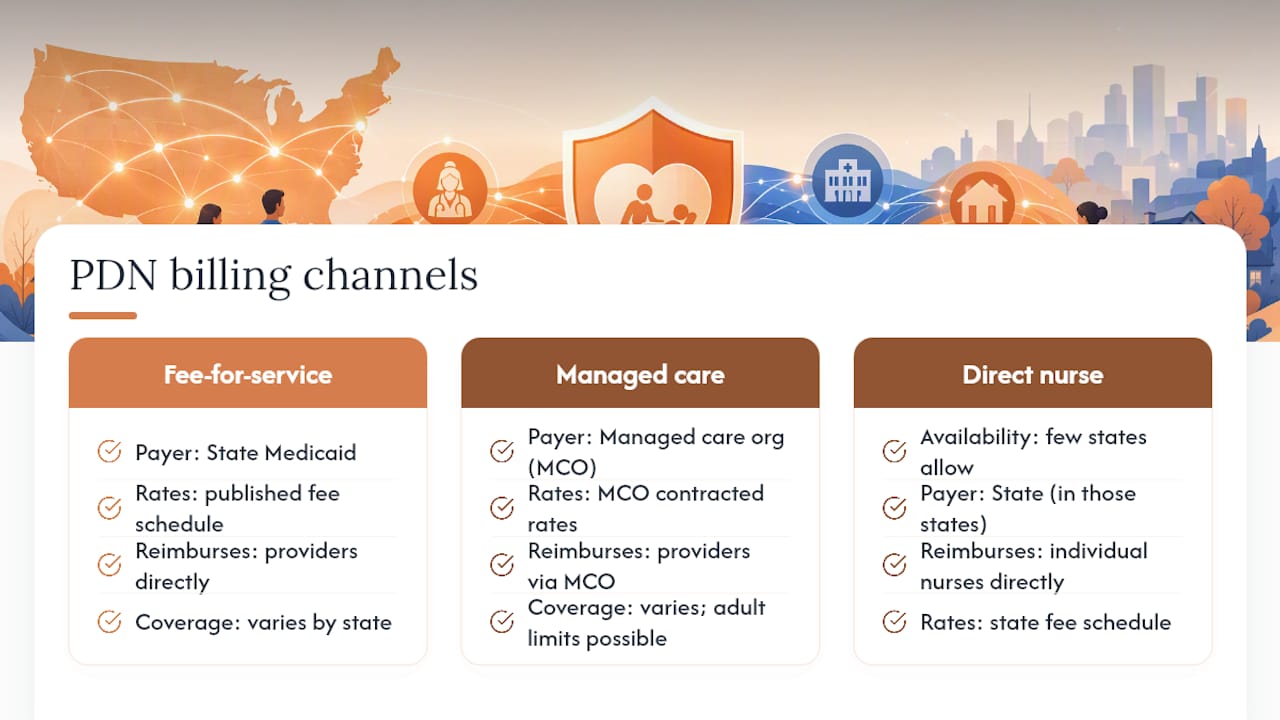
Billing runs through one of two channels: fee-for-service Medicaid, where the state pays providers directly against its published fee schedule, or managed care, where the MCO reimburses providers under its own contracted rates. A handful of states allow direct reimbursement to individual nurses rather than requiring an agency intermediary.
Authorized shift length commonly falls in the four to 12 hour range, but the total hours a family actually receives varies enormously by state.
KFF’s state-by-state data shows this isn’t a uniform national benefit: some states cover PDN broadly for both children and adults, others restrict adult coverage to narrow categories like ventilator dependency, and most impose prior authorization or hour caps regardless of age.
That variation is exactly why a printed fee schedule from your own state matters more than anything you read on a national guide. Check your state’s provider manual directly, since North Carolina and similar states publish current forms, fee schedules, and prior approval contacts that change independently of federal policy.
How Do You Coordinate a Safe Hospital Discharge to Home Nursing?
The riskiest moment in the entire PDN process is the handoff from hospital to home. Discharge planners, the home nursing agency, the family, and the Medicaid managed care organization all need to be talking to each other well before the discharge date, not on it.
Before your child leaves the hospital, confirm:
Prior authorization is fully approved, not just “submitted” or “pending”
Equipment is delivered and functioning at home
The assigned nurse has completed orientation on your child’s specific care plan
A signed care plan exists that matches what was actually authorized
A written emergency and backup staffing plan is in place
The most common pitfall is assuming coverage is active because a form was filed, when the authorization itself hasn’t cleared yet. Incomplete documentation and delayed PA approval account for most of the gap-in-care stories families report. Push for written confirmation of PA status before you sign discharge paperwork, not after.
A Continuity-First Take on Pediatric PDN
Most of the friction families describe with PDN isn’t really about eligibility. It’s about staffing consistency once coverage is approved. A state can authorize 12 hours of daily nursing and it still fails a family if four different nurses rotate through that shift in a single month, each one relearning a child’s trach care or feeding schedule from scratch.
That’s the piece the policy conversation tends to skip. Shift-fill rate and nurse retention aren’t soft metrics. They predict whether a family actually experiences the benefit they were approved for. Opulent tracks both publicly, and applies a “3 Thumbs Up Rule,” meaning care only starts once the family, the assigned nurse, and Opulent itself all confirm the fit is right, because a nurse who’s clinically qualified but a poor match for a specific child’s routine creates its own kind of instability.
Authorization gets families through the door. Retention is what determines whether the care behind that door actually holds together.
— Opulent
Getting Started With Medicaid-Funded PDN in Georgia
Opulent Private Care is the alternative to piecing together PDN coverage on your own. Instead of navigating Medicaid and GAPP paperwork solo while also vetting nurses, Opulent handles the Medicaid and GAPP authorization paperwork directly, matches your child with a nurse based on clinical fit and family compatibility, and tracks its own shift-fill and retention rates publicly so you’re not guessing whether coverage will actually translate into a consistent caregiver.
For children who are ventilator-dependent, have a tracheostomy, or need G-tube feeding support, Opulent’s trach, vent, and G-tube nursing team specializes specifically in that level of medical complexity. Families who prefer a relative or trusted caregiver to provide paid care can look into the family caregiver option, and families already receiving PDN through another agency but experiencing rotating staff or unfilled shifts can start a GAPP agency transfer without losing their existing authorization. If your family is navigating multiple Medicaid benefits at once, resources like this ABA therapy coverage guide can help you understand how separate authorizations interact. Reach out to Opulent to start the intake conversation and find out what your child qualifies for.
Where to Find Official PDN Rules and Forms
Your state’s own Medicaid provider manual is the most reliable source for current forms, fee schedules, and PA contacts. North Carolina’s PDN page and Alabama’s PDN materials are useful examples of what to look for. For a fast state-by-state comparison of coverage and limits, KFF’s State Health Facts table remains the clearest single reference, and the federal EPSDT rules governing children’s coverage sit in 42 CFR Part 440.
This article is general information, not a substitute for advice from a qualified doctor. Consult a qualified healthcare professional about your own circumstances before acting on anything here.
Sources
FAQ
Does Medicaid Pay for a Private Duty Nurse?
Yes, in most states, when a physician documents medical necessity for continuous skilled nursing rather than intermittent visits. Coverage details, hour limits, and prior authorization rules vary significantly by state, so checking your specific state’s Medicaid program is essential before assuming a denial or approval.
Did Recent Federal Changes Cut Medicaid Coverage for Nursing Care?
Medicaid policy at the federal and state level shifts periodically, and specific program cuts vary by state and year. Rather than relying on general news coverage, confirm your current PDN authorization status and benefit limits directly with your state Medicaid office or MCO, since state-level rules govern your actual coverage.
What Determines the Medicaid Rate for Private Duty Nursing?
Reimbursement rates are set individually by each state and published in that state’s Medicaid fee schedule, so there’s no single national rate. Check your own state’s provider manual, such as North Carolina’s published PDN fee schedule, for the figure that actually applies to your case.
Will Medicare Pay for Private Duty Nursing?
Medicare does not typically cover private duty nursing the way Medicaid does. Medicare’s home health benefit covers intermittent skilled visits for specific medical needs, not the continuous, shift-based nursing that PDN provides, which is why families with technology-dependent children generally pursue PDN through Medicaid or EPSDT instead.
How Do I Know if My Child Qualifies for Medicaid PDN in Georgia?
If your child has a documented need for continuous skilled nursing, such as ventilator support, tracheostomy care, or complex feeding needs, EPSDT protections generally support coverage for beneficiaries under 21. Opulent Private Care can help confirm eligibility and manage the GAPP paperwork required to get authorization started.
Recommended
Comments