
30 Minute Backup: Family Plan for Missed Pediatric Nursing Shifts
- Opulent Private Care Services

- 5 days ago
- 10 min read
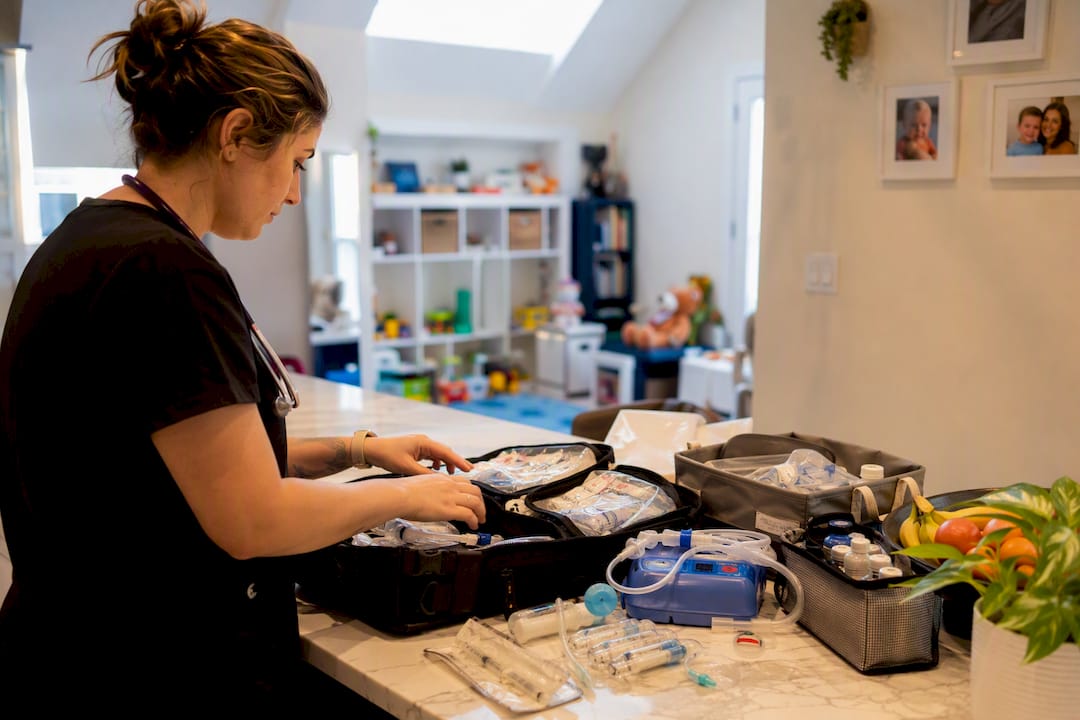
If your child’s scheduled nurse doesn’t show up, check airway, breathing, and medication timing first, then call the agency’s backup line and document exactly when you called. Look for red flags like labored breathing, a malfunctioning vent alarm, or a missed seizure medication window that would justify calling 911. Providers like Opulent Private Care publish shift fill rates and retention numbers precisely so families have a benchmark before a crisis hits.
TL;DR:
More than half of pediatric nurses miss at least one required care activity during their last shift, which can lead to overlooked small problems.
Staffing shortages, high workloads, and high turnover cause missed shifts, especially affecting soft care tasks like emotional support and teaching.
Verifying a provider’s shift fill rate, retention, and contingency plans before contracting can reduce the risk of caregiver cancellations.
Building a safety net through team-based care, cross-trained family members, and telehealth triage decreases dependency on single nurses.
Repeated missed shifts impact a child’s health by increasing risks of secretion buildup, skin breakdown, medication missed windows, and unnoticed subtle health changes.
Table of Contents
What Should You Do First When a Pediatric Nurse Misses a Shift?
How Do You Evaluate a Home Nursing Provider Before You Commit?
How Do Missed Shifts Affect a Child’s and Family’s Emotional Well-Being?
What Are the Legal Responsibilities When a Nursing Shift Is Missed?
What Happens to a Child’s Health When Nursing Shifts Are Missed Repeatedly?
How Opulentprivatecare Helps Families Avoid the Missed Shift Cycle
What Should You Do First When a Pediatric Nurse Misses a Shift?
The first ten minutes matter more than anything else you’ll do that day. Before you dial a single phone number, put eyes and hands on your child.
Check the equipment that keeps your child stable: ventilator settings and alarms, tracheostomy tie tightness and secretions, feeding pump flow rate, and pulse oximeter readings if your child uses one. Confirm the last medication given and when the next dose is due. A missed seizure medication or a stalled feeding schedule turns a staffing problem into a medical one fast, and that’s the line that determines whether you handle this yourself or call 911.
Immediate action checklist:
Assess and stabilize. Confirm your child is breathing normally, devices are functioning, and no medication or treatment window has been missed.
Call the assigned nurse directly. Ask plainly: “Are you on your way, or has something come up?” Get a real answer, not a guess.
Call the agency’s clinical director or on call line. Say: “My scheduled nurse for [child’s name] has not arrived and it’s [time]. I need a backup nurse or confirmation of the plan in the next 30 minutes.”
Activate short term coverage. This might mean a trained family member stepping in, a backup nurse from the agency’s roster, or, where available, a same day slot at a pediatric medical daycare or PPEC center.
Consider telehealth triage if you have a clinical question but the situation doesn’t clearly require an ambulance.
Document everything. Timestamp the missed shift, every call you made, who you spoke with, and what was promised.
Documentation isn’t paperwork for its own sake. Case managers and Medicaid payors use these records to authorize extra hours, approve a provider switch, or justify PPEC placement later. A text message time stamp is evidence; a vague memory of “sometime last week” is not.
Pro Tip: Keep a laminated card near your child’s care station listing the agency’s after hours number, your case manager’s direct line, and your backup nurse’s contact info. When you’re managing a vent alarm with one hand, you don’t want to be scrolling through a phone.
Why Do Pediatric Nursing Shifts Get Missed So Often?
Missed shifts rarely come from carelessness. They come from a nursing workforce stretched thinner than most families realize, and from care tasks that are easier to skip than others when time runs short.
A survey of more than 2,000 pediatric nurses found that over half missed at least one required care activity during their last shift. The tasks most often left undone weren’t emergency procedures. They were care planning, comforting or talking with the patient, and teaching or counseling the family. Pain management and urgent interventions got done almost every time. Emotional support and forward planning were what fell through the cracks.
That pattern holds real meaning for home care. It suggests a nurse under pressure will always keep your child breathing and medicated, but the softer, relationship-building parts of care, the parts that catch small problems before they become big ones, are what disappear first when staffing is tight.
The organizational causes behind this are well documented:
Chronic staffing shortages that leave agencies scrambling to cover open shifts
High individual nurse workload, which research links to a sharply higher rate of missed care
Weak institutional support and burnout driving experienced nurses out of pediatric work entirely
High turnover, which breaks the continuity a medically complex child depends on
Better staffed, better supported work environments show up in the data too. Studies tie stronger nurse work environments to roughly 40% lower odds of missed care compared with poorly supported ones.
In a hospital, a missed task gets caught by the next nurse on rounds. In a home, your child often has one nurse and no built in backup, which is exactly why an agency’s staffing depth and its written contingency plan matter more in home care than almost anywhere else in pediatric nursing.
How Do You Evaluate a Home Nursing Provider Before You Commit?
Ask the right questions before you sign, and you’ll spend far less time scrambling after a missed shift later. Reliability in pediatric home nursing isn’t a feeling an agency projects in a sales call. It’s a set of numbers and written procedures you can request and verify.
Questions to ask every provider:
What is your average shift fill rate over the last quarter?
What is your nurse retention rate over the past 12 months?
Walk me through your backup staffing process, step by step, and how fast does it activate?
How do you match a nurse to a specific child and family before care starts?
Can you give me a reference from a family with a similar diagnosis?
Documentation worth requesting:
Recent shift fill statistics, not vague reassurances about being “reliable”
A written backup or contingency staffing plan, not a verbal promise
A description of the nurse matching process, including any family approval step
At least one reference contact from an existing client family
When you get to the contract stage, negotiate specifics. Ask for guaranteed backup coverage within a defined window, a notification timeline for any cancellation, minimum qualifications for a replacement nurse, and a written remedy, like priority scheduling or reduced billing, if misses repeat. An agency that hesitates to put any of this in writing is telling you something important before you’ve spent a single week with them.
Pro Tip: Ask specifically for a named escalation contact, not just a general office number. “Who do I call at 2 a.m. if my nurse doesn’t show?” is a fair question, and a confident answer tells you a lot about how the agency actually operates.
Resources like Opulentprivatecare’s guide to evaluating pediatric nursing providers walk through this comparison process in more depth if you’re weighing multiple agencies at once.
What Long-Term Strategies Reduce Missed Nursing Shifts?
No single arrangement eliminates missed shifts entirely, but combining approaches gets you much closer to real continuity than relying on one nurse and hoping.
Pediatric medical daycare, often called PPEC (Prescribed Pediatric Extended Care), staffs with a team rather than a single assigned nurse. That team model builds in backup automatically, so one nurse calling in sick doesn’t leave your child uncovered the way it can in a one-to-one home assignment. It isn’t a fit for every family or every diagnosis, but where it’s available, it’s a genuine reliability upgrade.
Families who build the strongest safety nets tend to combine several strategies rather than depending on just one:
Weekday PPEC attendance paired with evening or overnight home nursing
Cross-training a family member or trusted caregiver as a certified backup for basic tasks
Building a small, known pool of two or three substitute nurses the family has already met
Keeping a telehealth triage line saved for quick clinical questions that don’t require an ER visit
Building this network takes coordination with your case manager well before you need it. Eligibility for PPEC, transportation logistics, age limits, and Medicaid or GAPP authorization timing all need to be sorted out in advance, not during a crisis. Start that conversation the same week you finalize home nursing, not after the third missed shift.
How Do You Escalate Recurring Missed Shifts?
One missed shift is a problem to solve. Three in a month is a pattern that needs a paper trail and a clear escalation path.
Log every incident. Record the date, scheduled time, actual outcome, who covered (if anyone), and any clinical notes.
Notify the agency in writing. Start with the scheduling manager, then the clinical director if the pattern continues.
Loop in your case manager or payor. Missed shift logs support requests for additional authorized hours or a provider change.
Contact your state’s licensing board if an agency ignores repeated documented misses or fails to provide a functioning backup plan.
A clean log turns “this keeps happening” into evidence a payor can act on.
How Do Missed Shifts Affect a Child’s and Family’s Emotional Well-Being?
The toll of a missed shift rarely shows up on a chart, but it’s real and it compounds. For a child who depends on a consistent nurse, a stranger, or no one, in that chair changes the day. Kids with complex medical needs often build trust slowly with a caregiver who understands their specific cues, and a disrupted routine can trigger anxiety that has nothing to do with their underlying diagnosis.

Parents absorb the sharper edge of it. Research on families after pediatric ICU discharge links missed home nursing shifts to increased caregiver burden and disrupted family routines. That’s a clinical way of describing what it actually feels like: canceling a work shift with two hours’ notice, skipping a sibling’s school event, or lying awake because you’re covering the overnight watch yourself for the third time this month.
Repeated cancellations also erode trust in the care plan itself. Parents start second guessing every scheduled shift, wondering if this is the day it falls through again. That low grade vigilance is exhausting in a way that’s hard to explain to anyone who hasn’t lived it, and it’s part of why continuity, the same nurse, reliably, week after week, matters as much for a family’s mental health as it does for a child’s clinical stability.
None of this means you’re overreacting when a missed shift rattles you. It means the stakes of provider reliability extend well past the clinical checklist.
What Are the Legal Responsibilities When a Nursing Shift Is Missed?
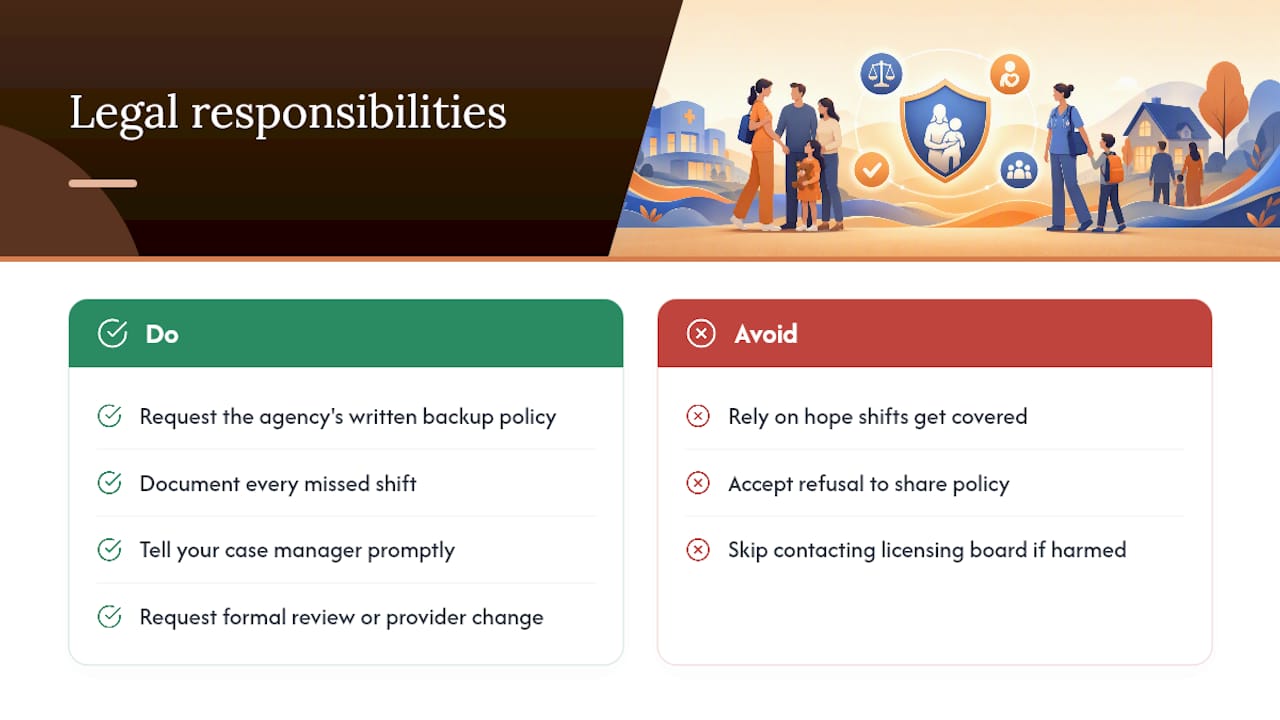
Home nursing agencies carry a duty of care once they accept a case, and a missed shift without a documented backup plan can raise real liability questions depending on what happens as a result. Agencies licensed to provide skilled pediatric nursing are generally expected to maintain adequate staffing and a functioning contingency system, not simply hope every shift gets covered.
For Medicaid funded care through Georgia’s GAPP program, authorized hours represent a commitment the agency has agreed to fulfill. Chronic failure to deliver authorized hours can affect a family’s case with their payor and may be grounds for requesting a formal review or a change in provider. Parents have the right to request the agency’s written contingency and backup staffing policy, and a provider’s refusal to share one is itself worth flagging to a case manager.
Parents also carry a role here, though it isn’t a legal burden so much as a practical one: documenting missed shifts protects your ability to request additional hours, pursue a provider change, or support an appeal if a payor questions your need for continued authorization.
None of this is a substitute for legal advice specific to your situation and your state’s regulations. If you believe an agency’s staffing failures have caused harm or violated the terms of your care agreement, a conversation with your case manager and, if needed, your state’s licensing board is the appropriate next step, not a general internet search for what your rights might be.
What Happens to a Child’s Health When Nursing Shifts Are Missed Repeatedly?
An occasional missed shift is a stressful inconvenience. A pattern of missed shifts is a clinical risk that compounds over months.
Children with tracheostomies depend on consistent suctioning and tie checks; skip that consistently and secretion buildup or skin breakdown becomes more likely. Kids on ventilators need someone trained to catch a subtle alarm pattern before it becomes an emergency, and a rotating cast of unfamiliar or absent caregivers makes that harder. Feeding tube complications, aspiration risk, and missed medication windows for seizure disorders all share the same underlying problem: these risks are managed by consistency, and consistency is exactly what a missed shift takes away.
There’s a slower cost too. Nurses who see a child regularly notice gradual changes, a shift in muscle tone, a subtle change in respiratory effort, that a rotating or absent caregiver would miss entirely. Care planning and teaching, the very tasks most often skipped when nurses are stretched thin, are what catch problems early. Skip them chronically and small issues have more room to become bigger ones before anyone notices.
This is the strongest argument for prioritizing continuity over convenience when you choose a provider. A nurse who’s covered your child’s shifts for a year notices things a replacement nurse simply can’t, not because of skill, but because of history.
Opulent’s Approach to Preventing Missed Shifts
Opulentprivatecare built its model around the belief that reliability should be measurable, not promised. We publish our shift fill rates and nurse retention numbers because families deserve a real number to evaluate, not a reassurance. We also limit rotating staff wherever possible, because a child recovering from a rough night shouldn’t have to reintroduce themselves to a new nurse the next morning.
Our ‘3 Thumbs Up Rule’ means a nurse starts care only after the family, the nurse, and Opulentprivatecare all agree it’s the right fit. That matching process is what reduces last minute cancellations in the first place: a nurse who feels genuinely matched to a family is far more likely to stay committed to the schedule. Ask any provider you’re considering for the same proof.
— Opulent
How Opulentprivatecare Helps Families Avoid the Missed Shift Cycle
Opulentprivatecare provides in-home pediatric skilled nursing across Georgia for children managing tracheostomy, ventilator, feeding tube, seizure, cardiac, and neurological conditions, with published shift fill rates, tracked nurse retention, and the ‘3 Thumbs Up Rule’ matching process built into every placement. We also help families navigate Medicaid and GAPP paperwork, so getting authorized care started doesn’t add another layer of stress to an already demanding situation.

If you’re tired of wondering whether tomorrow’s shift will actually be covered, request an intake call and ask to see our current fill rate and retention numbers directly. You can also explore our approach to trach, vent, and G-tube care if your child’s needs fall into one of those categories, or start with a visit to our main site to see what continuity focused pediatric nursing actually looks like in practice.
Selected Research and Partner Resources
Key sources behind this guide include the pediatric missed care survey and its linked workload analysis, the Experts@Minnesota study on missed shifts and family outcomes, and Spark Pediatrics on PPEC reliability. For operational strategies, see Klyr Media’s patient engagement playbook.
Sources
Recommended
Comments