
Yes, Georgia Will Pay Parents and Family Members as Caregivers
- Opulent Private Care Services

- Aug 18
- 8 min read

Yes, a parent or family member can get paid to provide care in Georgia, most commonly through Structured Family Caregiving (SFC), a service delivered inside the CCSP and SOURCE Medicaid waivers. Georgia Medicaid usually excludes spouses from these caregiver roles, though the VA can pay a spouse under separate federal programs. Here’s the fastest map:
SFC via CCSP or SOURCE: a daily stipend for a live-in caregiver.
CCSP/SOURCE participant direction: hourly consumer-directed pay instead of a stipend.
Family Hire under NOW/COMP or ICWP: payroll-based pay for family caregivers of people with intellectual or developmental disabilities.
VA caregiver programs: the routine path when a spouse is the one providing care.
Call Georgia Aging Access at 1-866-552-4464 or start an application through Georgia Gateway to find out which route fits your family.
Pro Tip: Ask your case manager specifically for “SFC” by name when requesting a waiver assessment. It’s a service line item, not a standalone program, and case managers sometimes need the exact term to code the request correctly.
Key Takeaways
Structured Family Caregiving lets most non-spouse relatives get paid a daily stipend through Georgia’s CCSP and SOURCE waivers, provided the caregiver lives with the recipient and completes Fiscal Intermediary or agency intake.
Point | Details |
SFC is the primary route | Available inside CCSP and SOURCE waivers, paying roughly $67 to $80 per day to a live-in caregiver. |
Spouses are usually excluded | Most waiver rails bar spouses, guardians, and parents of minor recipients from paid caregiver roles. |
Start with two calls | Contact Georgia Aging Access at 1-866-552-4464 and apply through Georgia Gateway. |
Expect real processing time | Waiver enrollment and SFC intake combined often take several months depending on waitlists. |
Opulent handles the paperwork | Opulent Private Care assists Georgia families with Medicaid and GAPP paperwork and nurse matching for medically fragile children. |
Table of Contents
Which Georgia caregiver programs actually pay family members?
How do you get started as a paid parent caregiver in Georgia?
What does the Fiscal Intermediary handle, and what paperwork do you need?
What do families get wrong about getting paid to care for a relative?
Why families lean toward SFC agencies or Family Hire instead of going it alone
Get Help With the Paperwork That Actually Slows Families Down
Which Georgia caregiver programs actually pay family members?
Three main rails cover most families asking about paid parent caregiver options in Georgia, and they work differently enough that picking the wrong one wastes months.
Structured Family Caregiving pays a live-in caregiver a daily stipend rather than an hourly wage. It’s offered as a service inside CCSP and SOURCE, meaning the care recipient has to already be enrolled in one of those waivers before SFC becomes available. You cannot apply for SFC on its own.
CCSP and SOURCE participant direction works more like a traditional job. The care recipient (or their representative) hires and directs a personal care worker, who gets paid hourly, on a timesheet basis, through the state’s payment system.
Family Hire under NOW/COMP or ICWP applies mainly to families caring for a person with an intellectual or developmental disability. Georgia’s participant-directed waivers let the recipient’s family hire a relative as a paid support worker, subject to Fiscal Intermediary rules.
SFC: daily stipend, live-in requirement, agency-managed.
CCSP/SOURCE self-direction: hourly wages, more scheduling flexibility.
NOW/COMP or ICWP Family Hire: payroll-based, tied to an approved support plan.
Who qualifies as a paid family caregiver in Georgia?
Eligibility runs on two tracks at once: the care recipient’s Medicaid status and the caregiver’s relationship to them.

The care recipient needs active Georgia Medicaid enrollment and a documented nursing-facility level of care, confirmed through an assessment. Income and resource limits apply to the recipient (not the caregiver), and residency in Georgia is required, which is why every pathway routes back through Georgia Gateway.
On the caregiver side, most adult relatives qualify: adult children, siblings, in-laws, and grandchildren caring for a grandparent. The exclusions matter more than the eligible list. Georgia’s waiver rules generally bar a spouse, a legal guardian, or the parent of a minor-child recipient from serving as the paid caregiver under SFC or standard self-direction.
Caregiver must be 18 or older.
Background checks are standard across SFC and Family Hire programs.
Proof of relationship and residency documentation is typically required at intake.
SFC specifically requires the caregiver to live with the care recipient.
A significant portion of family caregivers nationally provide extensive unpaid care weekly, which these waiver pathways aim to address for Georgia families who qualify.
How much do paid family caregivers earn in Georgia?
Structured Family Caregiving typically pays a live-in caregiver around $67 to $80 per day, which works out to roughly $1,987 to $2,400 a month, depending on the care recipient’s acuity level and how much the contracted agency retains for oversight and case management.
Hourly self-direction pay through CCSP or SOURCE varies by role and region, and it’s set through the state’s approved wage schedule rather than a flat stipend.
Payments run through a contracted SFC agency or a Fiscal Intermediary, not directly from the state.
Most caregivers are treated as W-2 employees for payroll purposes.
Under IRS Notice 2014-7, some Medicaid waiver payments to a live-in caregiver may be excludable from federal gross income when co-residence and difficulty-of-care conditions are met. FICA treatment can still get complicated, so talk to a tax professional before you file.
How do you get started as a paid parent caregiver in Georgia?
Confirm Medicaid eligibility. Apply or verify status through Georgia Gateway, and gather proof of income, assets, and residency ahead of time.
Call Georgia Aging Access at 1-866-552-4464, or reach out to your local Area Agency on Aging or existing case manager, and request a waiver assessment for CCSP or SOURCE.
Complete the level-of-care assessment. If your family member qualifies, ask the case manager to add SFC as a service line in the approved care plan.
Work with the contracted SFC agency or Fiscal Intermediary to finish caregiver intake: background check, required training, and the new-hire packet.
Confirm payroll setup and training completion, then get your first pay date in writing. Keep every document. If a request is denied, you’ll need that paper trail for an appeal.
Pro Tip: Start Step 1 even before you’re sure which waiver fits. Georgia Gateway processing and level-of-care assessments run on their own timelines, so parallel-tracking the paperwork saves weeks later.
What does the Fiscal Intermediary handle, and what paperwork do you need?
A Fiscal Intermediary (FI) acts as the employer of record for Family Hire and some self-directed arrangements, handling payroll, tax withholding, and compliance so the family doesn’t have to run its own mini payroll department. SFC works a little differently, with the contracted agency itself managing pay and oversight.
Either way, expect to submit:
Government-issued ID and proof of the caregiver’s relationship to the recipient.
Signed background check consent.
Federal and state tax withholding forms.
Timesheets tied to the approved individual service plan (ISP) or plan of care.
The FI issues what’s often called a “Good to Go” letter once the packet clears, and payroll can only start from that approved hire date, not the date care actually began. Submitting an incomplete packet is the single most common reason families lose weeks of otherwise-payable time.
How long does approval take, and what causes delays?
Timelines vary by pathway. Medicaid eligibility and waiver enrollment generally take 30 to 180 days depending on waitlist status. SFC intake after that adds another 60 to 180 days. VA pathways can move faster, often 30 to 120 days, but vary case by case.
Incomplete financial documentation is the top cause of stalled applications.
CCSP sometimes carries a waitlist; SOURCE often has faster openings.
Missing training modules or unresolved background check flags can hold up an otherwise-approved Family Hire packet.
Stay in regular contact with your case manager, and escalate through your Area Agency on Aging if a request sits untouched for more than a few weeks.
What do families get wrong about getting paid to care for a relative?
The biggest misconception is assuming there’s one universal “caregiver salary” that applies across Georgia. There isn’t. Payment depends entirely on the care recipient’s assessed level of care and which specific waiver applies, which is why two families with seemingly similar situations can end up on very different pay structures.
While a waiver application processes, Georgia’s Division of Aging Services and Area Agencies on Aging still offer respite care, caregiver training, and dementia-specific REACH supports at no cost tied to Medicaid approval. Families dealing with autism-related waiver waitlists can also check state-by-state waitlist data to gauge realistic timing.
Call ADRC at 1-866-552-4464 for an intake screening.
Request a CCSP or SOURCE assessment directly through your case manager.
If the care recipient is a veteran, ask about VA caregiver programs separately, since they run on entirely different rules.
Pro Tip: Don’t wait for waiver approval to start using respite and training services. They’re often available immediately and can meaningfully reduce burnout during a 60 to 180 day SFC intake window.
Why families lean toward SFC agencies or Family Hire instead of going it alone
Families gravitate toward SFC or Family Hire because the paperwork burden is real, and getting one form wrong can push a payment start date back by weeks. The tax treatment questions alone (difficulty-of-care exclusions, FICA nuances) trip up capable people regularly.
At Opulent Private Care, this is where we spend a lot of our time: helping families thread Medicaid and GAPP paperwork correctly the first time, matching a caregiver to a child’s actual clinical needs, and keeping continuity so a medically complex child isn’t cycling through new faces. If a request gets denied, ask your case manager about the appeals process. It exists for a reason.
Get Help With the Paperwork That Actually Slows Families Down
Opulent Private Care exists for the exact moment where Medicaid rules meet a child who needs skilled, consistent care, and the paperwork between those two things feels like its own full-time job.

We help Georgia families navigate GAPP and Medicaid paperwork, match a child with a nurse based on clinical needs and family fit, and coordinate the Fiscal Intermediary steps that determine when payments actually start. For medically fragile children managing tracheostomy care, feeding support, or neurological conditions, our “3 Thumbs Up Rule” means care doesn’t start until the family, the caregiver, and Opulent all agree it’s the right match, and we track nurse retention so your child isn’t relearning a new caregiver every few months.
If you’re trying to figure out whether Structured Family Caregiving, GAPP, or in-home skilled nursing fits your situation, request an intake consultation and we’ll walk through your options together.
Frequently Asked Questions
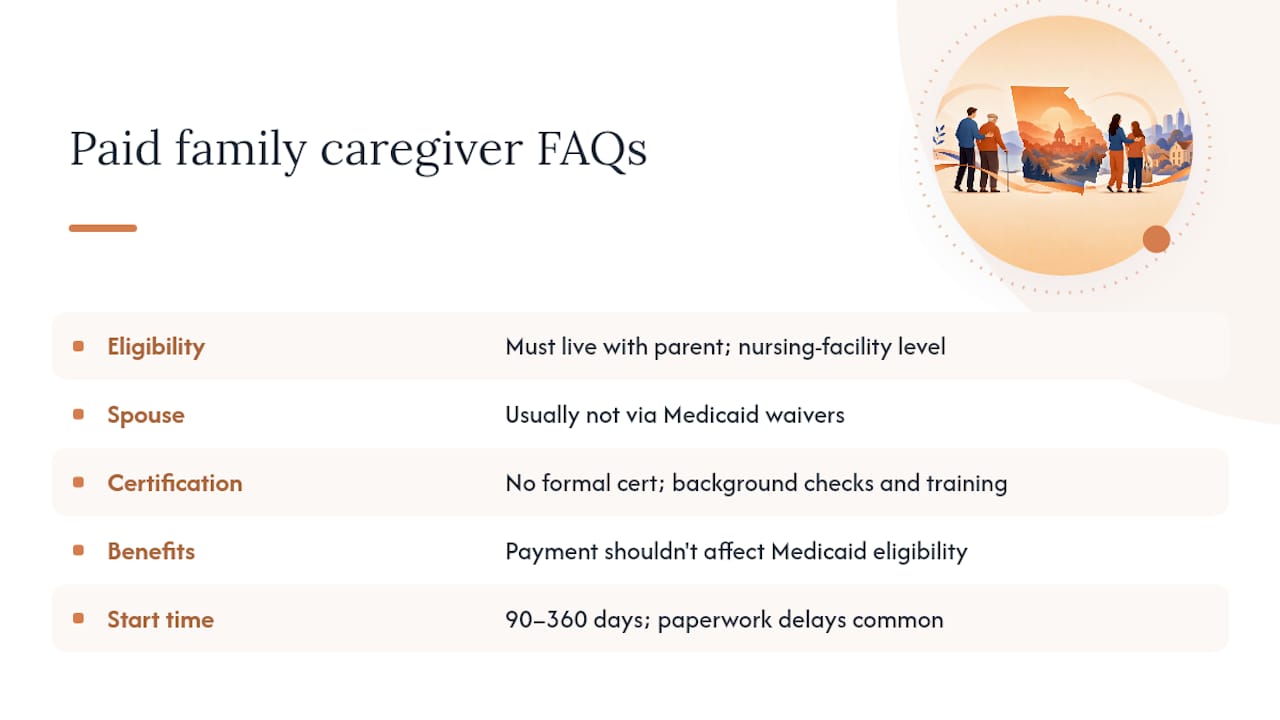
Can I get paid to take care of my elderly parent in Georgia? Yes, generally through Structured Family Caregiving inside the CCSP or SOURCE waiver, provided you live with your parent and they meet nursing-facility level of care requirements.
Can a spouse be a paid caregiver in Georgia? Usually not through standard Medicaid waivers. Spousal pay typically runs through separate VA caregiver programs instead.
Do I need to be certified to become a paid family caregiver? Formal certification usually isn’t required, but SFC agencies and Fiscal Intermediaries require background checks and completion of specific training modules before payroll begins.
Will getting paid as a caregiver affect my parent’s other benefits? It shouldn’t affect the care recipient’s Medicaid eligibility since the payment goes to the caregiver, not the recipient, but confirm details with your case manager given individual circumstances vary.
How long does it take to start getting paid as a family caregiver in Georgia? Combined waiver enrollment and SFC intake often take 90 to 360 days total, though incomplete paperwork is the most common cause of delay beyond that range.
This article is general information, not a substitute for advice from a qualified financial advisor. Consult a qualified financial professional about your own circumstances before acting on anything here.
Sources
Recommended
Comments