
Georgia Medicaid Pediatric Nursing (GAPP): A Parent's Guide

Yes, your medically fragile child can receive in-home skilled nursing through Georgia Medicaid if they are under 20 years and 11 months old, have an active Georgia Medicaid ID, and meet medical necessity criteria. Your first move: confirm that Medicaid is active (not pending), then call a GAPP-approved nursing agency. The agency submits the prior authorization on your behalf. You do not file it yourself.
Eligibility checklist:
Child is under 20 years, 11 months old
Active Georgia Medicaid (not pending status)
Physician documents medical necessity for in-home skilled nursing
Child requires RN, LPN, or personal care support at home
Documents to have ready:
Physician order (PPOT / Appendix Y), signed with explicit medical necessity language
DMA-6A or DMA-80 (submitted by the agency, not the family)
Appendix J (Letter of Understanding) and Appendix G (Freedom of Choice)
Recent discharge summary or hospital notes
Timing: Once a complete packet is submitted, prior authorization review typically takes 2–6 weeks, with the full process from first call to first nurse visit often spanning 30–90 days. DMA-6A authorizations are valid for a year. Renew well before expiration to avoid a gap in service.
Key contacts: GAPP program specialist at Georgia DCH; Alliant Health Solutions (prior auth review); local DFCS office (Medicaid eligibility); Georgia Medicaid Member Services: 1-800-869-1150.
Key Takeaways
Georgia’s GAPP program covers in-home skilled nursing for medically fragile children under 21 through Medicaid, but the agency submits all prior authorization and the physician order must document medical necessity explicitly to avoid denial.
Point | Details |
Confirm Medicaid first | Active Georgia Medicaid ID is required before any agency can submit prior authorization. |
Agency submits the PA | Families never file prior authorization directly; a GAPP-approved agency handles all submissions. |
Physician order specificity | Orders must name the nurse type, hours, diagnosis, and why home care is medically necessary. |
Renewal window | DMA-6A is valid one year; renew 30–60 days before expiration to prevent a service gap. |
Opulentprivatecare | Provides statewide GAPP paperwork assistance, nurse matching via the 3 Thumbs Up Rule, and trach/vent/feeding care with published continuity metrics. |
Table of Contents
How GAPP agencies and families coordinate ongoing care
Once prior authorization is approved, the agency schedules an initial planning meeting with your family. At that meeting, you sign the PPOT (Appendix Y) and the Letter of Understanding (Appendix J), which outlines everyone’s responsibilities. The agency then matches a nurse to your child considering clinical skills and family fit.
Day-to-day, the agency manages scheduling, shift coverage, and nurse competency verification. Your role as a caregiver is to be present or reachable during shifts, communicate changes in your child’s condition to the nurse and physician, and sign off on care plan updates. If a nurse cannot make a shift, the agency is responsible for finding a replacement. Families with children on tracheostomy, ventilator, or feeding tube support should confirm upfront that the agency has nurses credentialed for those specific skills. A useful starting point for checking agency credentialing practices is NurseFlex agency reviews.

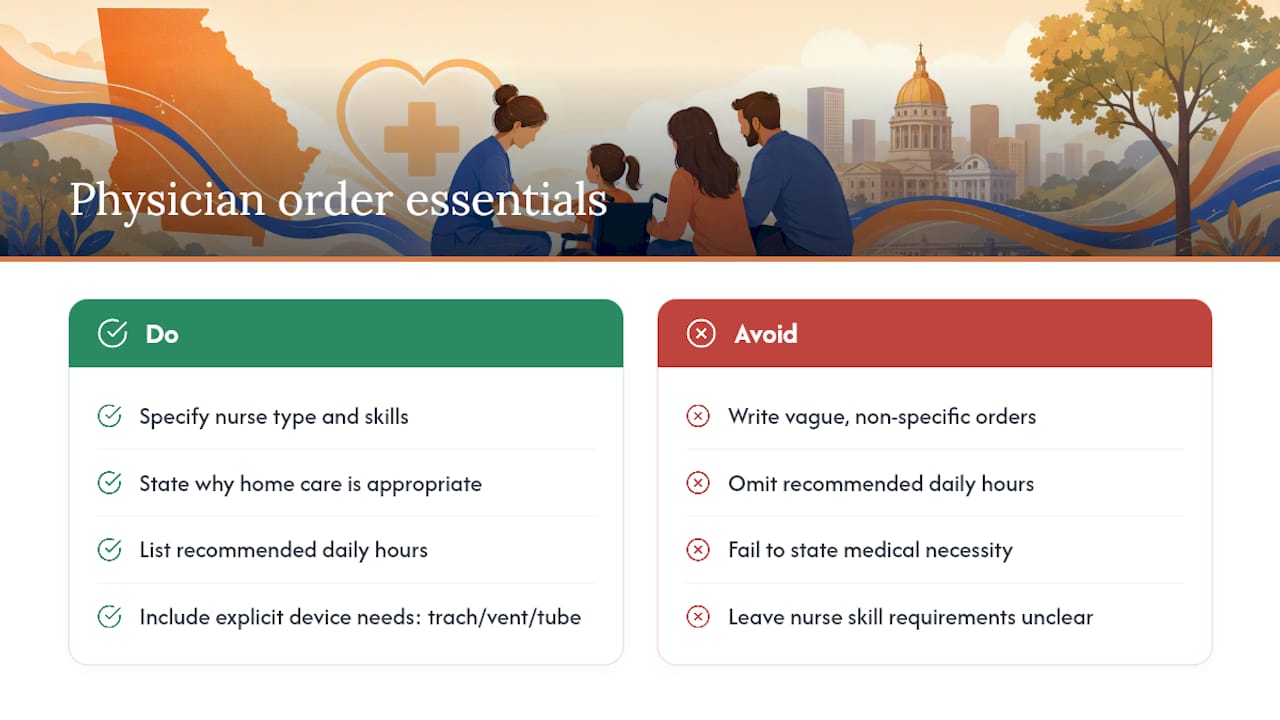
Georgia pediatricians play a key role too: their orders must specify the type of nurse needed, the reason home care is medically appropriate over a facility, and the recommended daily hours. Vague orders are the single most common reason applications stall at the physician order stage.
How to handle urgent or emergency situations under GAPP
GAPP is not a substitute for emergency medical services. If your child has a medical emergency, call 911 first. The GAPP nurse on duty follows your child’s established care plan and physician orders, but acute deterioration goes to emergency services, not the agency.
For urgent but non-emergency situations, such as a nurse calling out on a complex-care shift, contact your agency’s on-call line immediately. Agencies are required to make reasonable efforts to fill critical shifts. If your agency repeatedly fails to cover shifts for a child on a ventilator or with a tracheostomy, you have the right to transfer to a different GAPP-approved agency under the Freedom of Choice provision (Appendix G). The GAPP program presentation confirms that families retain this right annually.
For authorization disputes or denials, contact Alliant Health Solutions directly. DCH administers the program and can escalate unresolved issues.
What Opulentprivatecare sees families get wrong about GAPP
Most families spend weeks trying to navigate GAPP paperwork before realizing the agency was supposed to lead that process from day one. The program is genuinely designed so the agency carries the documentation burden, but only if you pick the right agency early.
The other consistent gap: physician orders written too vaguely to survive Alliant’s review. “Child needs nursing care at home” gets denied. “Child requires LPN 12 hours daily for tracheostomy suctioning and ventilator management due to [diagnosis], home care medically necessary to prevent repeated hospitalization” gets approved. That specificity is not the physician’s default. A good GAPP agency hands the physician the correct template.
Continuity is the piece families underestimate most. Rotating nurses on a child with a trach and a vent is not just inconvenient. It is a safety issue. Opulentprivatecare’s 3 Thumbs Up Rule requires sign-off from the family, the nurse, and Opulent before any nurse starts, which filters out mismatches before they become disruptions. Published shift-fill and nurse retention metrics make that commitment verifiable, not just a talking point.
Opulentprivatecare gets your child from approval to a matched nurse faster
Families navigating GAPP for the first time face a real gap between “approved” and “care actually starting.” Opulentprivatecare closes that gap with hands-on support at every step: confirming your child’s Medicaid status, providing physicians with the correct order template, handling DMA-6A and Appendix Y submission, and scheduling your intake visit within days of approval.
Specializing in tracheostomy, ventilator, feeding tube, seizure, and neurological care statewide across Georgia, Opulentprivatecare matches each child to a nurse based on clinical fit and family preference. The 3 Thumbs Up Rule means no nurse starts until everyone agrees it is the right match. Most families see their first assigned shift within 1–2 weeks of authorization, depending on nurse availability. For appeals, letters of medical necessity, or urgent escalation to Alliant or DCH, Opulentprivatecare’s team handles it alongside you. Start with a free intake call to confirm eligibility and get your paperwork moving today.
Sources
Key forms and who submits them:
Program contacts:
What speeds up review: Submit a recent hospital discharge summary or inpatient notes alongside the physician order. Hospitals and discharge planners can also initiate the GAPP application directly through a nursing agency, which often shortens the timeline for children transitioning from inpatient care. For a detailed walkthrough of securing the right skilled nursing hours, Opulentprivatecare’s step-by-step guide covers documentation and appeals in full.
Recommended
Comments