
Pediatric Staffing Guidelines for Georgia Families


Safe in-home pediatric staffing for medically fragile children in Georgia is acuity-driven, not ratio-driven. The Society of Pediatric Nurses states plainly that no single published ratio applies across all pediatric settings. What actually determines safe staffing is an evidence-based acuity assessment matched to your child’s specific clinical needs, combined with a nurse whose competencies cover trach care, ventilator management, G-tube feeding, seizure protocols, or whatever your child requires daily. For Georgia families, the starting point is the Georgia Pediatric Program (GAPP), a Medicaid-funded pathway through the Department of Community Health that can authorize in-home skilled nursing (RN or LPN) for children under 21 with qualifying medical needs.
Immediate next steps:
Confirm GAPP eligibility through your child’s Medicaid managed care organization (MCO)
Request a formal acuity assessment from the clinical team before any staffing plan is finalized
Verify that your assigned nurse holds documented competencies for your child’s specific equipment and conditions
Ask the agency for its shift fill rate, nurse retention rate, and written backup coverage plan
Get paperwork assistance early — GAPP authorization requires clinical documentation that takes time to assemble
Red flags to watch for:
Rotating unfamiliar nurses with no continuity plan
No written backup coverage when a shift goes unfilled
Missing pediatric-specific certifications or competency records
A staffing plan built on a fixed ratio rather than an acuity tool
Pro Tip: Before you sign any staffing agreement, ask the agency to show you its shift fill rate and nurse retention numbers in writing. Agencies that publish these metrics are telling you something real about how they operate.
The AACN’s pediatric critical care standards reinforce this: assignments like 1:1 or 1:2 nurse-to-patient ratios for high-acuity children can serve as minimum references (as recommended by SPN), but must ultimately be determined by objective workload measures, patient needs, and available support—not a blanket rule. For a child on a home ventilator, that often means a dedicated nurse for every shift. SPN also recommends that staffing plans include frequent re-evaluation and measurable nurse-sensitive outcomes, such as infection rates and medication errors, to judge whether the plan is still adequate as your child’s condition changes.
Who must be involved in building the plan: you as the family, your child’s primary clinician, the direct-care nurse, and your GAPP or MCO care coordinator. The Children’s Hospital Association workforce blueprint documents real national shortages in pediatric nursing, which is why nurse retention and caregiver burnout prevention matter as much as the initial hire. A staffing plan should be reviewed at minimum whenever your child’s medical status changes, and at least annually.

Table of Contents
How Opulentprivatecare Handles Pediatric Staffing in Georgia
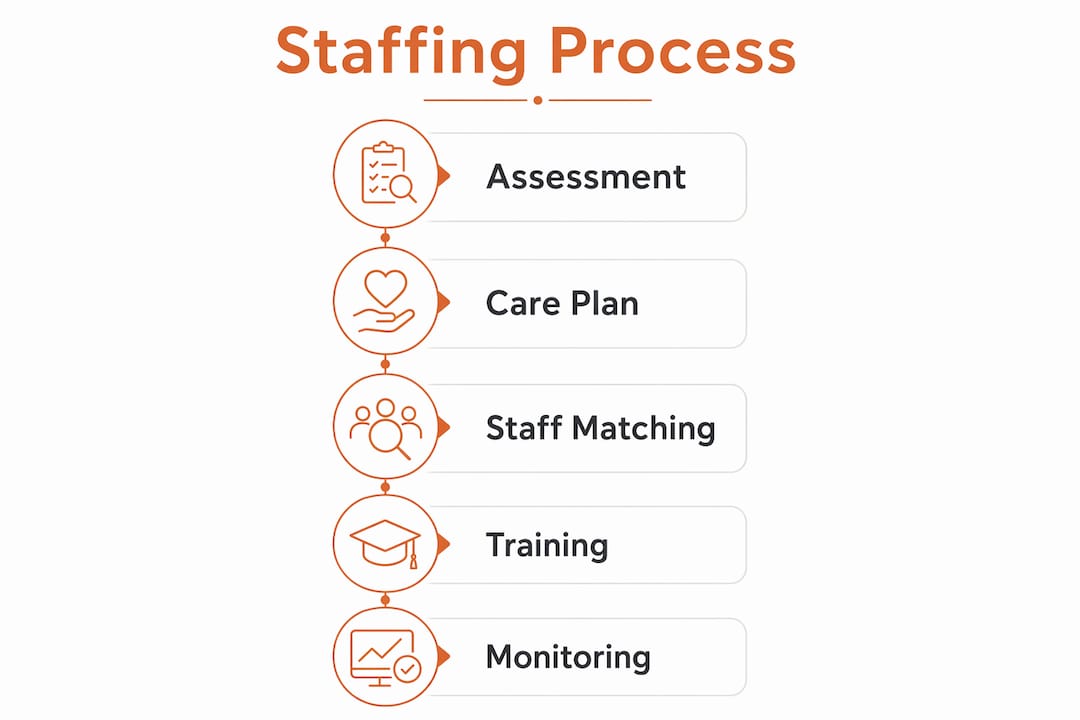
Opulentprivatecare works exclusively with medically fragile children across Georgia, and the process starts before a nurse ever walks through your door. Intake begins with a clinical acuity assessment, then nurse matching based on both clinical competency and family fit. That second part matters more than most families expect. A nurse who is technically qualified but not the right fit for your household creates friction that affects care quality over time.
The agency’s 3 Thumbs Up Rule formalizes this: the family, the caregiver, and Opulentprivatecare all explicitly agree before care begins. No one starts until all three are aligned.
Opulentprivatecare publishes shift fill rates and nurse retention metrics so families can evaluate reliability before committing. The staffing agreement covers scope of care, documented nurse competencies, shift schedule, contingency coverage, review cadence, and sign-off from all parties. For GAPP and Medicaid paperwork, the team provides direct assistance with clinical documentation, authorization requests, and appeals navigation.
To get started, visit Opulentprivatecare’s Georgia pediatric nursing page or explore the GAPP application process to understand what documentation you will need before your first intake call.
Key Takeaways
Safe pediatric in-home staffing in Georgia requires an acuity-based plan, verified nurse competencies, GAPP Medicaid authorization, and a continuity-focused agency that publishes its reliability metrics.
Point | Details |
No universal ratio exists | SPN confirms staffing must be individualized using evidence-based acuity tools, not a fixed nurse-to-patient number. SPN offers minimum guidelines as a reference—such as 1 RN to 4 patients in pediatric med/surg and 1 RN to 2 patients in pediatric intensive care—but emphasizes these are context-dependent and not universal rules. |
GAPP is the funding pathway | Georgia DCH’s GAPP program authorizes Medicaid-funded in-home skilled nursing for children under 21 with qualifying needs. |
Competencies must match conditions | Nurses caring for children with trachs, vents, or G-tubes need documented, condition-specific clinical competencies. |
Plans require ongoing review | SPN recommends frequent re-evaluation using measurable outcomes; review whenever your child’s condition changes. |
Opulentprivatecare | Offers acuity-based nurse matching, published shift fill and retention metrics, and full GAPP paperwork assistance across Georgia. |
Recommended
Comments