
Seizure Management Home Care: A Caregiver's Guide


What to do right now when a seizure starts
The single most protective thing you can do during a seizure is keep the person safe from the environment around them, not from the seizure itself. Ease them to the ground, cushion their head with something soft, and clear away any hard or sharp objects nearby. Once convulsions stop, gently roll them onto their side so their airway stays open. That’s the core of seizure first aid at home, and it works for most episodes.
What to do:
Stay calm and stay with the person throughout
Cushion the head with a folded jacket, pillow, or your hands
Loosen anything tight around the neck, like a collar
Time the seizure from the moment it starts
Turn them onto their side once convulsions end
Check for a medical alert bracelet for emergency contacts
What never to do:
Do not restrain them or try to stop the movements
Do not put anything in their mouth, including your fingers. Swallowing the tongue is a myth, and objects in the mouth cause choking and injury
Do not give food or water until they are fully alert
Call 911 immediately if the seizure lasts longer than 5 minutes, the person does not regain consciousness, another seizure follows quickly, the seizure happens in water, or this is their first-ever episode.
How to make your home safer for someone with seizures
Every room carries a different risk. The bathroom is the most dangerous: replace baths with showers, because a seizure in a filled tub can cause drowning. Keep bathroom and bedroom doors unlocked so help can reach the person quickly. In the kitchen, turn pot handles toward the back of the stove and fill plates near the stove rather than carrying hot food across the room.
Living areas need attention too; a thorough ear health assessment can help occupational therapy professionals evaluate risks and tailor home safety improvements for those with epilepsy. Secure heavy furniture to walls, replace glass-topped tables with safer materials, and add protective foam covers to sharp furniture edges. Non-slip mats belong in the bathroom and any area with hard flooring. Remove loose rugs that could cause a fall.
“Professional home safety evaluations by occupational therapists reveal subtle hazards and provide tailored adaptive solutions beyond generic advice.” A home safety evaluation from a visiting nurse or occupational therapist catches risks that a checklist misses entirely.
Consider seizure monitoring devices and wearable alert systems for times when the person is alone. Keep a phone or emergency call button accessible in every room. These practical home modifications, drawn from Epilepsy Foundation guidance, reduce injury risk without turning the home into a clinical space.

Post-seizure care: what to watch for after it ends
Recovery looks different for every person. Some are alert within minutes; others remain confused, exhausted, or disoriented for an hour or more. Stay with them through all of it.
Monitor these things closely:
Breathing: confirm it resumes normally and stays steady
Consciousness: speak to them calmly and watch for a response
Injuries: check for cuts, bruises, or head impact from the fall
Confusion duration: note how long disorientation lasts and whether it worsens
Keep them in the recovery position (on their side) until they are fully awake and aware of their surroundings. Do not offer food or water until they can swallow safely. If they vomit, the side position prevents aspiration.
Contact a doctor if the post-seizure confusion lasts unusually long, if the person’s behavior seems different from past episodes, or if any new physical symptoms appear. Call 911 again if breathing does not resume or if a second seizure begins before full recovery.
Ongoing home care: medication, documentation, and caregiver education
Medication adherence is the foundation of epilepsy home care. Missing even one dose can destabilize seizure control that took months to establish. Keep refills stocked before running out, store medications away from children, and never stop a seizure medication without a doctor’s guidance.
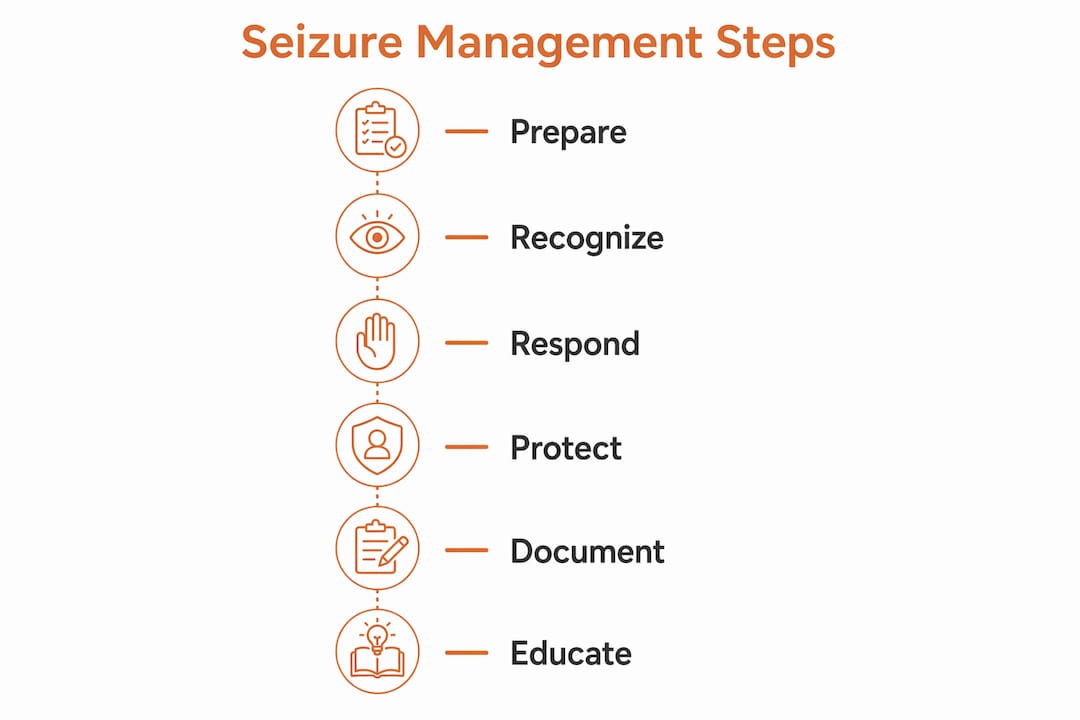
Rescue medications, such as rectal diazepam or intranasal midazolam, require a separate level of preparation. Caregivers must receive formal training from a clinician before administering these medications, covering correct dosing, contraindications, and when to call 911 regardless of the medication’s effect. Administering rescue medication without that training creates serious risk.
A seizure diary transforms scattered observations into medical evidence. Record the time, duration, seizure type, possible triggers, medications given, and recovery details after every episode. Neurologists use this data to adjust treatment far more effectively than memory alone allows.

A Seizure Action Plan, developed collaboratively with the medical team, gives every caregiver in the household a clear, printed reference. It should list seizure types, triggers, rescue medication instructions, and the exact threshold for calling 911. Keep it visible, updated annually, and shared with every adult who spends time with the person.
Pro Tip: Train more than one household member on rescue medication use and the Seizure Action Plan. If the primary caregiver is unavailable during an episode, a second trained adult can respond correctly without delay.
How specialized home nursing supports complex seizure care
For medically fragile children whose seizures are frequent, severe, or tied to other neurological conditions, family caregivers often carry more than any one person can safely manage alone. Specialized in-home pediatric nursing brings clinical expertise directly into the home, covering seizure monitoring, rescue medication administration, and real-time coordination with the child’s medical team.
Continuity of care matters as much as clinical skill. A nurse who knows a child’s specific seizure patterns, baseline behavior, and individual triggers responds faster and more accurately than a rotating staff member encountering the child for the first time.
Opulentprivatecare provides this level of pediatric home nursing in Georgia, with a matching process that requires approval from the family, the nurse, and Opulentprivatecare before care begins. That structure, the “3 Thumbs Up Rule,” means families get a consistent caregiver who fits their child clinically and personally. For families navigating Medicaid through Georgia’s GAPP program, Opulentprivatecare also handles the paperwork and tracks nurse retention so families are not left managing staffing gaps on top of medical care.
Recognizing different types of seizures
Not every seizure looks like a convulsion. Tonic-clonic seizures (formerly called grand mal) involve loss of consciousness and full-body muscle contractions. Absence seizures appear as a brief blank stare, sometimes with subtle lip movements or blinking, lasting only seconds. Focal seizures may cause jerking in one limb, unusual sensations, or repetitive automatic movements like chewing or hand rubbing, with the person remaining partially aware.
Recognizing the type matters because the first aid response and the emergency threshold can differ. An absence seizure rarely requires 911. A tonic-clonic seizure lasting more than 5 minutes always does. Some people experience an aura before a seizure begins, giving a brief window to sit down and alert someone nearby.
What your emergency response plan should include
A written emergency plan removes the guesswork in a high-stress moment. At minimum, it should specify who calls 911, who administers rescue medication and when, and where the Seizure Action Plan is kept. Post it somewhere visible, like the refrigerator or a kitchen cabinet.
Every adult caregiver should know the 911 criteria: seizure over 5 minutes, no return to consciousness, repeated seizures, injury, seizure in water, or a first-time episode. The Epilepsy Foundation recommends reviewing and updating the plan with the treating neurologist at least once a year. Include the neurologist’s contact number and the nearest emergency room address in the plan itself.
Supporting yourself as a caregiver
Caregiver burnout is real and it directly affects the quality of care. Watching someone you love have a seizure is frightening, and doing it repeatedly without support takes a toll. The Epilepsy Foundation offers online support communities and local resource referrals specifically for caregivers and family members.
Seek professional counseling if anxiety about seizures is affecting your sleep, relationships, or daily functioning. Share the caregiving load by training other family members or trusted friends on seizure response. Connecting with other epilepsy caregivers, whether through local groups or online forums, provides practical advice and the kind of understanding that comes only from shared experience.
Key Takeaways
Effective seizure management at home requires immediate protective first aid, a safe home environment, consistent medication adherence, and a written Seizure Action Plan shared with every caregiver in the household.
Point | Details |
Call 911 promptly if a seizure lasts longer than 5 minutes, the person does not regain consciousness between seizures, another seizure follows quickly, the seizure happens in water, or this is their first-ever episode. | |
Never put anything in the mouth | Objects in the mouth cause choking and injury; the recovery position protects the airway. |
Train every caregiver | Rescue medication use requires formal clinical training before any administration attempt. |
Keep a seizure diary | Documenting time, type, triggers, and recovery helps neurologists adjust treatment effectively. |
Modify the home by room | Showers over baths, locked-free doors, and secured furniture reduce seizure injury risk. |
Recommended
Comments