
Assistance with Applying for Medicaid: 2026 Guide


Assistance with applying for Medicaid is defined as free, expert support from navigators, Certified Application Counselors, state agencies, and community health centers that guides families through every step of obtaining healthcare coverage. The process does not require a lawyer or a fee. Federal programs like HealthCare.gov and resources such as Federally Qualified Health Centers (FQHCs) exist specifically to remove barriers for families who need Medicaid but do not know where to start. For families with medically fragile children in Georgia, securing this coverage is often the first step toward accessing specialized care through programs like the Georgia Pediatric Program (GAPP). This guide covers every method of getting help, what documents you need, and how to handle denials.
What types of free assistance are available for Medicaid applications?
Free Medicaid application support comes from several distinct sources, and knowing which one fits your situation saves time.
Federal Marketplace navigators and Certified Application Counselors (CACs) are trained, certified helpers who work independently of insurance companies. Navigators and CACs receive no financial incentives from insurers, which means their advice is unbiased. You can find them at localhelp.healthcare.gov by entering your zip code.

Federally Qualified Health Centers (FQHCs) offer application help alongside medical services. The Health Resources and Services Administration (HRSA) maintains a searchable directory at findahealthcenter.hrsa.gov. These centers serve low-income families and often have staff dedicated to enrollment support.
State and local social services offices process Medicaid applications directly and can answer eligibility questions on the spot. Most states also offer a dedicated Medicaid phone line where a counselor walks you through the application in real time.
Hospital social workers and financial counselors are a less obvious but highly effective resource. They specialize in helping uninsured patients apply for coverage, including retroactive coverage for bills already incurred.
The format of help matters too. Phone and online assistance work well for straightforward cases. In-person assistance is more efficient for complex household situations, especially when multiple family members have different eligibility categories or when documents need to be reviewed on the spot.
Pro Tip: Search localhelp.healthcare.gov before calling your state Medicaid office. Navigators often have shorter wait times and can handle the full application with you during a single appointment.
What do you need before applying for Medicaid?
Eligibility for Medicaid depends on four core factors: household income, household size, age, and disability or immigration status. States set income limits as a percentage of the Federal Poverty Level (FPL), and those thresholds vary by state and household composition. Children, pregnant individuals, and people with disabilities often qualify at higher income levels than non-disabled adults.
The documents you need fall into predictable categories. Gathering them before you contact an assister cuts the application time significantly.
Document category | Examples |
Proof of identity | Driver’s license, state ID, passport |
Proof of income | Pay stubs, tax returns, employer letter |
Proof of citizenship or immigration status | Birth certificate, Social Security card, immigration documents |
Proof of residency | Utility bill, lease agreement |
Medical documentation (if applying for disability) | Physician letters, diagnosis records, treatment history |
One critical fact that most families do not know: states must allow applicants to submit missing documents after the initial application. That legal requirement means you should apply as soon as possible, even if your paperwork is incomplete. Your coverage start date is tied to your application date, not the date your documents arrive.
Pro Tip: Create a single folder, physical or digital, with copies of every document listed above. Assisters can review your folder in one sitting and flag anything missing before you submit.
How to apply for Medicaid with assistance: a step-by-step process
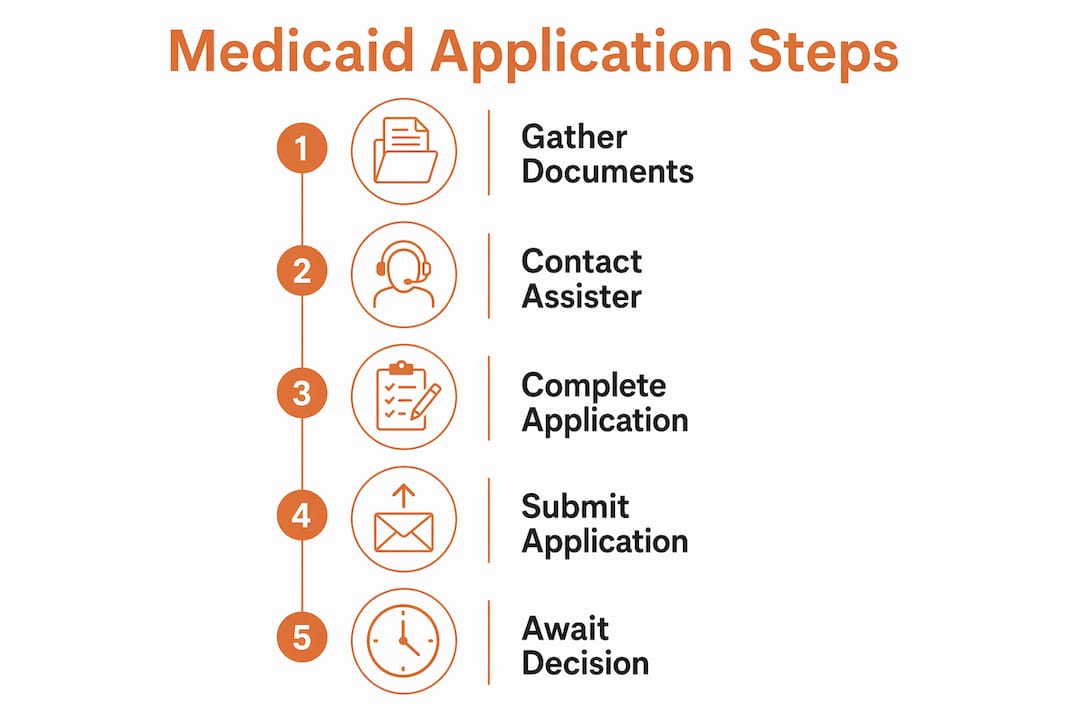
Applying with help is faster and more accurate than applying alone. Follow these steps in order.
Check eligibility first. Use your state’s Medicaid eligibility screener or visit a navigator. Knowing your likely eligibility category before you apply prevents the most common denial reason: being processed under the wrong group.
Choose your application method. Online applications through your state’s Medicaid portal or HealthCare.gov are generally 2–4 weeks faster than mail or in-person paper submissions. Standard processing takes 7–45 days for most applicants, and up to 90 days for disability cases.
Contact a free assister. Call your state Medicaid office, visit an FQHC, or search localhelp.healthcare.gov for a navigator near you. Schedule an appointment rather than walking in, especially for complex cases involving children with disabilities.
Complete and submit the application with guidance. Your assister reviews every field before submission. This step catches errors in income reporting, household composition, and eligibility category that would otherwise trigger a denial or delay.
Track your application status. Most states provide an online portal where you can check status in real time. If you applied by mail or in person, call the Medicaid office after 10 business days to confirm receipt.
The table below compares application methods so you can choose the right one for your situation.
Method | Processing speed | Best for | Assistance integration |
Online portal | Fastest (2–4 weeks shorter) | Most applicants | Navigators can co-complete remotely |
Phone | Moderate | Simple cases, no complex documents | State counselor guides you live |
In-person at office | Moderate | Complex households | Direct document review on the spot |
Slowest | Rural applicants without internet | Limited; assister can review before mailing |
For families applying for Medicaid nursing for children with complex medical needs, in-person assistance at an FQHC or state office is the strongest choice. The assister can flag specialty program eligibility, such as GAPP, that an online portal may not surface automatically.
Pro Tip: Apply online and schedule a navigator appointment for the same day. The navigator reviews your online draft before you hit submit, combining speed with accuracy.
How do you handle common challenges and denials?
Denials are common, and most are correctable. The key is acting fast and reading the denial letter carefully.
The most frequent reasons for denial include:
Missing documents: The application was submitted without required proof of income or identity.
Category errors: The state processed your application under the wrong eligibility group, such as adult Medicaid instead of a children’s program.
Income calculation mistakes: Gross income was reported instead of net, or a household member was incorrectly included or excluded.
Missed deadlines: The applicant did not respond to a request for additional information within the required window.
Denial letters sometimes contain category errors that are straightforward to correct on appeal. Reading the letter word by word, not just the headline decision, reveals the specific reason and the path to fix it.
“Many eligible people never apply because the process seems daunting, but formal appeal rights make denials reversible if acted upon quickly. You have the right to a fair hearing, typically within 90 days of the denial notice.”
If you receive a denial, request a fair hearing in writing before the deadline stated in your letter. Legal aid organizations, available in most states at no cost, can represent you at the hearing. Advocacy groups focused on disability rights are especially effective for families applying for children with complex medical needs. A second application with corrected documents is also an option, though an appeal preserves your original application date, which protects your coverage start date.
How hospital social workers assist with Medicaid for medical bills
Hospital social workers are one of the most underused resources in the entire Medicaid system. They sit inside the hospital, they know the system, and they work for you at no charge.
Hospital financial assistance offices help uninsured patients apply for Medicaid retroactively to cover past medical bills. That retroactive coverage can reach back up to three months before the application date. For a family facing a large hospital bill, this single fact can eliminate thousands of dollars in debt.
Key situations where hospital social workers provide the most value:
You received emergency care without insurance and now face a large bill.
Your child was hospitalized and you did not know Medicaid was an option at the time.
You need to apply for Medicaid quickly because a planned procedure is coming up.
You are transitioning from employer coverage and need a bridge before Medicaid activates.
Ask for the social work or financial counseling department at any hospital’s front desk or patient services office. You do not need to be a current inpatient to request this help. Many hospitals extend this service to recent patients for up to 90 days after discharge.
Key Takeaways
Securing Medicaid coverage is fastest when you apply early, use a free assister, and appeal any denial before the deadline.
Point | Details |
Apply before paperwork is complete | States must allow missing documents after submission, so your start date is protected. |
Use free assisters | Navigators and CACs are independent, unbiased, and available at no cost through localhelp.healthcare.gov. |
Online is fastest | Online applications process 2–4 weeks faster than mail; pair them with a navigator review. |
Appeal every denial | Category errors and missing documents are correctable; you have up to 90 days to request a hearing. |
Ask hospital social workers | They can apply retroactively for up to 3 months of coverage to offset existing medical bills. |
What families often get wrong about Medicaid application help
The families I work with most closely are not failing because they lack information. They are failing because they wait. They wait until the paperwork is perfect. They wait until they are sure they qualify. They wait until the medical bill becomes a crisis. Every one of those delays costs them money and coverage time.
The single most effective thing you can do is contact a navigator or FQHC this week, not after you have gathered every document. Assisters are trained to work with incomplete files. They have seen every document combination imaginable, and they know exactly what your state will accept as a substitute when the original is unavailable.
For families with children who have complex medical needs, the stakes are even higher. Programs like GAPP in Georgia layer specialized pediatric nursing hours on top of base Medicaid coverage. Missing the application window or getting denied without appealing can delay access to those nursing hours by months. That is not an abstract inconvenience. For a child who depends on tracheostomy care or feeding support, it is a direct health risk.
My strongest advice: treat the denial letter as the beginning of the process, not the end. Read it line by line. Find the specific reason. Then call a legal aid organization or return to your navigator the same day. The appeal window is short, and the success rate for corrected appeals is meaningful.
— Opulent
Opulentprivatecare: supporting families after Medicaid approval
Securing Medicaid is the foundation. What comes next, especially for families with medically fragile children, is finding care that actually shows up and stays.
Opulentprivatecare provides in-home pediatric nursing in Georgia for children with complex needs including tracheostomy care, feeding support, and neurological conditions. Every placement follows the “3 Thumbs Up Rule,” requiring approval from the family, the nurse, and Opulentprivatecare before care begins. Opulentprivatecare publishes shift fill rates and nurse retention metrics so families can evaluate reliability before committing. For families who have just secured Medicaid coverage and need specialized pediatric care, Opulentprivatecare is built to be a long-term partner, not a rotating roster of strangers.
FAQ
What is assistance with applying for Medicaid?
Assistance with applying for Medicaid is free support from trained navigators, Certified Application Counselors, FQHCs, and state agencies that helps you complete and submit your Medicaid application accurately.
How long does a Medicaid application take to process?
Standard Medicaid applications take 7–45 days to process. Disability-based applications can take up to 90 days, and online submissions process faster than paper or mail applications.
Can I apply for Medicaid for a child with a disability?
Yes. Children with disabilities often qualify at higher income thresholds than adults, and programs like GAPP in Georgia provide additional pediatric nursing program benefits on top of base Medicaid coverage.
What happens if my Medicaid application is denied?
You have the right to request a fair hearing, typically within 90 days of the denial notice. Reviewing the denial letter for category errors is the first step, and legal aid organizations can represent you at no cost.
Can Medicaid cover medical bills I already have?
Yes. Medicaid coverage can apply retroactively for up to 3 months before your application date. Hospital social workers can help you apply specifically to cover existing bills.
Recommended
Comments