
Hospital Discharge to Home Nursing: Family Caregiver Steps


Before you leave the hospital, confirm three things: a signed physician order for home nursing, a named home health agency or private-duty nursing provider, and a first visit scheduled within 24–48 hours of discharge. Everything else in this guide builds on those three checkpoints.
Your immediate action list:
Ask the discharge planner: “Has a signed physician order for home health been placed and faxed to our chosen agency?”
Give the planner your chosen agency’s name and intake fax number.
Get written confirmation of the first-visit date and time before you leave the building.
Quick contact card to keep with the patient:
Discharge planner: name + direct phone
Treating physician: office number + after-hours line
Home nursing agency: intake desk number + on-call number
Primary care physician: office + after-hours
Emergency contacts: two family members + 911
Statistic to know: CMS data shows nearly 1 in 5 Medicare patients is readmitted within 30 days of discharge. That window starts the moment the patient leaves the building.
Table of Contents
How does the IDEAL framework help you lead the discharge conversation?
What do home health agency, private-duty nursing, and personal care aides actually mean?
How do you get from a physician order to a first home nursing visit?
What happens in the first 72 hours, and when should you call for help?
What does the evidence say about nurse-led transitional care?
Opulentprivatecare: specialized pediatric in-home nursing in Georgia
Why is the hospital-to-home window so dangerous?
The first 72 hours after discharge carry more clinical risk than most families expect. CMS reports that approximately 20% of Medicare patients are readmitted within 30 days, costing the U.S. health system over $26 billion annually in largely preventable readmissions. Those numbers reflect a specific, repeatable failure pattern.
The “discharge gap” typically looks like this:
A physician order is sent late on a Friday, and the home nursing agency cannot schedule a first visit until Monday.
The patient goes home with a new medication regimen nobody has walked through with the family.
A follow-up appointment was scheduled but nobody confirmed the patient has transportation.
Durable medical equipment (DME) was ordered but not delivered before discharge.
Any one of these gaps can trigger a return to the emergency department. Together, they almost guarantee it.
Families who treat the first home nursing visit as an urgent medical safety step, not a scheduling formality, close most of these gaps before they open. The signed order and confirmed first-visit time are not paperwork. They are the clinical handoff.
How does the IDEAL framework help you lead the discharge conversation?
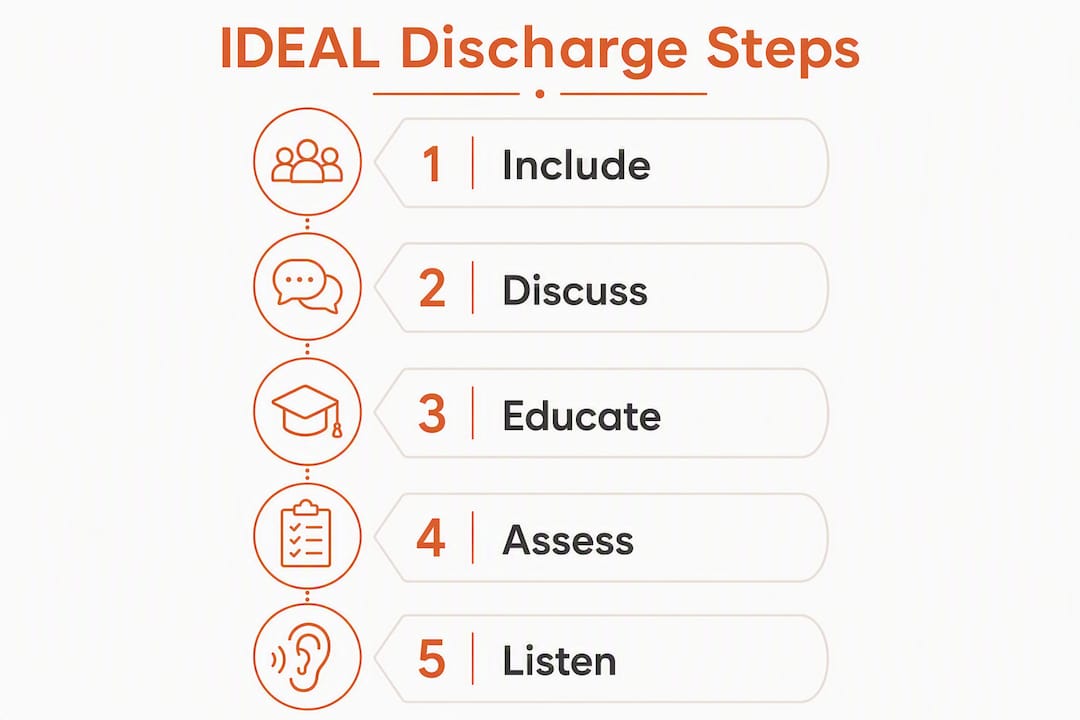
AHRQ’s IDEAL discharge planning framework converts the discharge process into a five-step checklist you can lead, rather than a clinical event that happens to you. Each letter is a caregiver action.
I — Include: Ask to be present at every care conference and discharge planning meeting. Say: “We want to be included in all discharge planning discussions.”
D — Discuss: Ask the team to walk through the diagnosis, medications, and what to watch for at home. Say: “Can you explain what changed with the medications and what symptoms should concern us?”
E — Educate: Request written instructions in plain language. Say: “Can we get written instructions for every medication change and wound care step?”
A — Assess: Confirm the home environment is ready. Say: “What equipment needs to be in place before we get home, and who is arranging delivery?”
L — Listen: Ask the team to listen to your concerns before discharge is finalized. Say: “We have a few questions about the first few days. Can we go through them before we sign anything?”
Hospitals are required by federal Conditions of Participation to begin discharge planning on admission for patients who may need post-discharge services. That means you have a right to this conversation early, not just on the day of discharge.
Pro Tip: Close the loop on every verbal confirmation. After the discharge planner says the order has been faxed, ask for the fax confirmation number or a timestamp. If discharge falls on a Friday, ask the planner to send the order by Thursday afternoon. A late-week order commonly delays the first home visit by 48–72 hours.
What do home health agency, private-duty nursing, and personal care aides actually mean?
These are different services with different clinical scopes and payment rules. Choosing the wrong category means either paying out of pocket for services insurance would cover, or expecting a personal care aide to perform clinical tasks they are not licensed to do.
Short definitions:
Medicare-covered home health (skilled, intermittent): Requires a physician order, homebound status, and a documented medical necessity. Covers skilled nursing visits, physical therapy, occupational therapy, and speech therapy. Visits are intermittent (typically a few hours, a few times per week), not continuous. Medicare Part A or Part B pays when three conditions are met: the patient is homebound, a physician certifies the need, and a Medicare-certified agency provides the care.
Private-duty nursing (PDN): Hourly or live-in skilled nursing, often used when a patient needs continuous clinical supervision. Paid privately or through Medicaid programs. For medically fragile children in Georgia, the Georgia Pediatric Program (GAPP) is a Medicaid pathway that may cover private-duty nursing when eligibility requirements are met.
Personal care / custodial aides: Non-skilled support for activities of daily living (ADLs) such as bathing, dressing, and meal preparation. Not covered by Medicare for home care. May be covered by some Medicaid programs or private pay.
Task | Medicare Home Health | Private-Duty Nursing | Personal Care Aide |
Wound care | Yes | Yes | No |
Ventilator / trach care | Yes (intermittent) | Yes (continuous) | No |
Medication administration | Yes | Yes | No |
24-hour supervision | No | Yes | No |
ADL help (bathing, dressing) | Limited | Yes | Yes |
Tube feeding management | Yes | Yes | No |
When to choose which:
A patient recovering from surgery who needs wound checks twice a week: Medicare home health.
A child on a ventilator who needs continuous skilled nursing overnight: private-duty nursing through Medicaid/GAPP.
A patient who is medically stable but needs help with bathing and meals: personal care aide.
Red flags that require skilled nursing, not just a personal care aide: active wound care orders, tracheostomy or ventilator management, IV medications, tube feeding, seizure protocols, or any condition where a clinical assessment is needed at each visit.
What should you confirm before leaving the hospital?
Work through this list before the patient is discharged. Print it and bring it to the discharge planning meeting.
Immediate action items (non-negotiable before discharge):
Physician-signed order for home nursing is in the chart and has been faxed to your named agency.
Agency name, intake contact, and on-call number are written down.
First-visit date and time are confirmed in writing.
Homebound status is documented in the chart (if Medicare is the payer).
Clinical documentation to collect:
Discharge summary (ask for a printed copy)
Reconciled medication list with doses, timing, and purpose of each drug
Wound care orders with specific dressing instructions
DME prescriptions and confirmed delivery dates
Lab orders and follow-up appointment confirmations
Any specialist referrals with contact information
Questions to ask the discharge planner:
“Has the physician signed the home health order, and has it been sent to [agency name]?”
“What is the agency’s intake contact number, and who do we call if the nurse doesn’t arrive?”
“Is there a written transition plan we can take home?”
“What symptoms should send us back to the ED?”
Questions to ask the treating physician:
“Are there any medication changes I need to understand before we leave?”
“What are the top three things to watch for in the first 72 hours?”
“Who do we call after hours if something changes?”
Friday/holiday timing: If discharge is scheduled for a Friday or the day before a holiday, ask the planner to transmit the order by Thursday. An order sent late in the week commonly delays the first visit by two to three days. If that is unavoidable, ask the hospital social worker to arrange a bridge visit or confirm the agency has weekend coverage before you leave.
How do you get from a physician order to a first home nursing visit?
Three operational checkpoints must happen before discharge: a signed order, completed agency intake, and a confirmed first-visit time. Here is the exact sequence.
Step-by-step:
Physician signs the order. The treating physician or attending writes and signs the home health or private-duty nursing order. This is the clinical authorization everything else depends on.
Discharge planner transmits the order. The planner faxes or electronically sends the order to your named agency. Confirm the fax number and ask for a transmission confirmation.
Family names the agency. You have the right to choose your home health provider. Give the planner the agency name and intake number in writing.
Agency completes intake and insurance verification. The agency confirms eligibility, obtains any required pre-authorization from the insurer, and assigns a nurse.
Agency schedules the first visit and confirms an arrival window. Get this in writing: date, time window, and nurse name if possible.
Family confirms DME delivery before discharge. If oxygen, a hospital bed, or a suction machine is needed, it must arrive before or on the same day as the first nursing visit.
What to expect during the first visit:
Medication reconciliation (comparing what was prescribed at discharge to what is in the home)
Clinical assessment (vitals, wound check, respiratory status)
Equipment check (oxygen levels, feeding pump settings, suction function)
OASIS assessment if the agency is Medicare-certified (a standardized intake tool)
Confirmation of follow-up appointments and physician contact information
Call scripts:
To the discharge planner: “Can you confirm the order has been signed and faxed to [agency name] at [fax number]? Can I get the fax confirmation number before we leave?”

To the agency intake desk: “We are discharging [patient name] on [date]. Can you confirm you received the order, that intake is complete, and that a nurse is scheduled for [date/time]?”
Who pays for home nursing after discharge?
Coverage depends on service category. Medicare covers intermittent skilled home health for homebound patients. Medicaid and programs like Georgia’s GAPP may cover private-duty nursing for eligible children. Private insurance varies by plan.
Payer | Home Health (Skilled, Intermittent) | Private-Duty Nursing | Personal Care Aide |
Medicare | Covered when homebound + physician order + medical necessity | Not covered | Not covered |
Georgia Medicaid / GAPP | Covered (skilled visits) | Covered for eligible children under GAPP | May be covered under separate waiver |
Private insurance | Varies by plan; pre-auth often required | Varies; often limited | Rarely covered |
Private pay | Out of pocket | Out of pocket | Out of pocket |
“Homebound” is not the same as bed-bound. CMS defines homebound functionally: leaving home requires a considerable and taxing effort. Patients who use oxygen, a walker, or need assistance from another person to leave the house typically qualify. Documenting that effort in the chart is what unlocks Medicare home health coverage.
Quick coverage checks to run before discharge:
Ask the discharge planner: “Is homebound status documented in the chart?”
Ask the insurer: “Does this service require pre-authorization, and has the agency submitted it?”
Ask the agency: “Have you verified our insurance and confirmed coverage for the first visit?”
For Georgia families with medically fragile children, Georgia Medicaid’s GAPP program is a specific pathway to private-duty nursing under Medicaid. Families should proactively ask the hospital social worker about GAPP enrollment rather than waiting for hospital staff to raise it. Opulentprivatecare assists families with GAPP paperwork as part of its intake process.
For Medicare eligibility details and home health coverage criteria, Medicare.gov and CMS publish current eligibility rules and the home health benefit explanation.
How should you prepare the home before the nurse arrives?
Small preparation steps reduce errors and speed clinical assessments on the first visit. A nurse who walks into a clear, organized space can focus on the patient, not on locating supplies or navigating clutter.
Equipment checklist:
Confirm DME delivery and setup (hospital bed, oxygen concentrator or tanks, suction machine, feeding pump, mobility aids)
Verify all equipment is plugged in, charged, or has a backup power source
Place suction supplies, feeding supplies, and wound care materials in one labeled location near the patient
Confirm oxygen tubing length allows the patient to move to the bathroom
Post emergency numbers (physician, agency on-call, 911) on the refrigerator or near the patient’s bed
Home safety steps:
Clear pathways from the front door to the patient’s room and bathroom (minimum 36 inches wide)
Remove throw rugs and loose cords from walking areas
Install grab bars in the bathroom if not already in place, or arrange a shower chair
Secure pets in a separate room during nursing visits
Store all medications in one location with labels visible; keep the reconciled medication list next to them
Caregiver setup:
Designate one primary caregiver who will be present for the first visit
Gather the patient’s ID, insurance card, and medication bottles in one folder
Prepare a quiet, well-lit area where the nurse can document and assess
Have the discharge summary and medication list printed and ready
Pro Tip: If the patient uses a tracheostomy or ventilator at home, review the tracheostomy home care guide before the first nursing visit. Knowing the basic steps helps you ask better questions and catch setup errors early.
What happens in the first 72 hours, and when should you call for help?
The first 72 hours are the most clinically vulnerable period after discharge. Expect the first nurse to perform a full assessment, reconcile medications, check equipment, and confirm follow-up plans. That visit is not a courtesy call.
72-hour checklist:
Day 1 (first visit): Vitals, medication reconciliation, wound check, equipment verification, confirmation of follow-up appointment dates.
Day 2: Observe for any new symptoms; confirm the patient is taking medications correctly; check wound or surgical site for changes.
Day 3: Confirm the next nursing visit is scheduled; contact the physician’s office to verify the follow-up appointment is on the calendar.
Red flags that require immediate action:
Worsening shortness of breath or oxygen saturation dropping below the physician’s stated threshold
Fever above 101°F (or whatever threshold the physician specified at discharge)
Uncontrolled bleeding or wound drainage that soaks through dressings
Sudden confusion, dizziness, or loss of consciousness
Inability to keep medications down due to vomiting
For any of these: call the physician’s after-hours line first. If you cannot reach them within 10 minutes or the patient is deteriorating, call 911.
If a scheduled nursing visit is missed:
Call the agency’s on-call number immediately.
If no response within 30 minutes, call the discharge planner or hospital social worker.
Contact the primary care physician’s office to document the missed visit.
Write down the date, time, and name of every person you spoke with. That record matters if you need to escalate or dispute a billing gap.
A first home visit within 24–48 hours is consistently recommended in post-discharge care guidelines to reduce preventable complications. A missed first visit is not a minor scheduling issue.
How do caregivers get trained, and what is teach-back?
Caregivers should insist on teach-back for any clinical task they are expected to perform between nursing visits. Teach-back is not a quiz. It is a method where the nurse asks the caregiver to demonstrate or explain a skill back, confirming understanding before the nurse leaves.
Training competencies to request and verify:
Medication administration: correct dose, timing, and what to do if a dose is missed
Wound care: dressing change steps, signs of infection, when to call
Tube feeding: setup, rate, flushing, and troubleshooting
Suctioning (if applicable): technique, frequency, and when to escalate
Tracheostomy care: cleaning, inner cannula changes, emergency steps
How teach-back works in practice:
The nurse demonstrates the skill. Then the nurse asks: “Can you show me how you would do this?” The caregiver performs the skill while the nurse observes. If the caregiver misses a step, the nurse demonstrates again and repeats. This continues until the caregiver can complete the task correctly and independently.
Ask the nurse to document completed training in the patient record. A written or visual instruction sheet for each skill should stay in the home.
Sample script: “Before you leave today, can we do a teach-back on the wound dressing change? I want to make sure I can do it correctly when you’re not here.”
For families managing complex pediatric conditions, the pediatric caregiver guide for complex medical needs covers long-term training expectations and how to build a sustainable care routine at home.
Respite and support resources: The Family Caregiver Alliance (caregiver.org) maintains a national database of respite programs and caregiver support services by state. Georgia families can also ask the hospital social worker about state-funded respite programs or contact the agency directly about relief coverage options.
Pro Tip: Request written instructions for every clinical task before the nurse leaves the first visit. A laminated one-page reference card for suctioning or tube feeding, posted near the patient’s bed, reduces errors during overnight hours when you are tired and the nurse is not there.
What does the evidence say about nurse-led transitional care?
Multiple studies and government data show that early home nursing and structured transitional care reduce preventable readmissions and improve safety outcomes. The evidence is consistent enough that securing a first visit within 24–48 hours is not just a guideline recommendation. It is the single most protective step a family can take.
Key finding: A JAMA Internal Medicine cohort study of more than 17 million hospitalizations found that patients discharged to home with home health care had a 5.6-percentage-point higher 30-day readmission rate compared with those discharged to a skilled nursing facility, alongside lower Medicare payments. The tradeoff is real: home discharge costs less but requires more active management to prevent readmission.
Peer-reviewed research on nurse-led transitional care consistently shows that nurse-led interventions with explicit written transition plans reduce emergency department visits and improve quality of life. The key components that drive those outcomes are medication reconciliation, a clinical assessment within 48 hours, and a written plan naming the home provider and specific clinical tasks.
What this means for families:
Secure a signed order and a confirmed first-visit time before discharge. Not after.
Request a written transition plan that names the home nursing agency, lists clinical tasks, and includes physician contact information.
Ask specifically for nurse-led transitional care if the hospital offers a care transitions program.
The Care Navigator resource from ltcfeds.gov provides practical guidance on the hospital-to-home transition and is worth bookmarking before discharge day.
A documented plan and a first visit within 24–48 hours is consistently associated with fewer preventable complications across the transitional care literature.
Key Takeaways
Securing a signed physician order, naming a home nursing provider, and confirming a first visit within 24–48 hours before discharge are the three steps that most directly reduce preventable readmissions and complications at home.
Point | Details |
Confirm order before discharge | Verify the physician-signed order has been faxed to your named agency before leaving the hospital. |
First visit within 24–48 hours | A confirmed first nursing visit within this window is consistently linked to fewer preventable complications. |
Collect all clinical documents | Take the discharge summary, reconciled medication list, wound care orders, and DME prescriptions with you. |
Verify payer coverage early | Confirm homebound status, medical necessity, and pre-authorization with the insurer before discharge day. |
Opulentprivatecare for pediatric cases | Georgia families with medically fragile children can contact Opulentprivatecare for GAPP paperwork assistance and continuity-focused nurse matching. |
What providers actually see on day one at home
The first home nursing visit rarely goes exactly as families picture it. Most families expect a brief check-in. What actually happens is closer to a full clinical intake: vitals, a head-to-toe assessment, medication reconciliation against the discharge list, equipment checks, and a review of every follow-up order. For a medically fragile child, that first visit can take two hours or more.
The most common family question on day one is about nurse consistency: “Will we have the same nurse every time?” It is a fair question, and the honest answer is that it depends entirely on the agency’s staffing model. Rotating nurses create real clinical risk for complex patients because each new clinician needs time to learn the patient’s baseline. A nurse who has never seen a child’s normal trach secretions cannot reliably identify when something has changed.
The second most common question is what happens when a nurse cannot make a shift. The answer should never be “we’ll try to find someone.” A reliable agency has a documented fill process and publishes its shift fill rate. If an agency cannot tell you its fill rate, that is a signal worth taking seriously.
Opulentprivatecare’s “3 Thumbs Up Rule” reflects a specific philosophy: care does not start until the family, the nurse, and Opulentprivatecare all approve the match. That process takes slightly longer upfront, but it eliminates the rotating-staff problem that undermines continuity for medically fragile children. Families transitioning from hospital to home nursing should ask every agency they consider: “What is your nurse retention rate, and how do you handle a missed shift?” The answers tell you more than any brochure.
Opulentprivatecare: specialized pediatric in-home nursing in Georgia
For families of medically fragile children in Georgia, the transition from hospital to home nursing carries clinical stakes that standard home health agencies are not always equipped to meet. Opulentprivatecare provides statewide, in-home pediatric skilled nursing specifically for children with complex medical needs, and handles Medicaid/GAPP paperwork as part of the intake process so families are not navigating that alone.

Core services relevant at discharge:
Tracheostomy and ventilator management
Feeding tube (G-tube/NG-tube) care and monitoring
Seizure and neurological condition support
Cardiac monitoring
Continuity-focused staffing with no rotating nurses
GAPP and Medicaid authorization assistance
Opulentprivatecare publishes its shift fill rates and nurse retention metrics so families can verify reliability before committing. The “3 Thumbs Up Rule” means every nurse placement is approved by the family, the nurse, and Opulentprivatecare before care begins.
If your child is preparing for discharge and you need Georgia pediatric in-home nursing with GAPP support, contact Opulentprivatecare to begin the intake process. You can also learn more about GAPP program eligibility and next steps on the Opulentprivatecare site.
Useful sources and authoritative resources
Keep this list in your discharge folder alongside your clinical documents.
Resource | Why it’s useful |
Official framework with scripts and checklists for families to lead discharge planning conversations | |
Eligibility criteria, homebound status definition, and Medicare home health benefit explanation | |
Practical step-by-step transition guidance from a federal resource | |
Evidence on home health vs. SNF outcomes across 17 million hospitalizations | |
Georgia Medicaid / GAPP | Georgia-specific Medicaid program information and GAPP eligibility for pediatric private-duty nursing |
Statewide Georgia pediatric in-home nursing, GAPP paperwork assistance, and nurse matching | |
Clinical overview of discharge planning requirements and best practices | |
National database of caregiver support and respite programs by state |
One final note: Keep every discharge document, physician order, medication list, and agency contact in a single labeled folder at home. The first time a nurse asks for the discharge summary at 7 AM, you will be glad it is not buried in a hospital bag.
Recommended
Comments