
Cap, Solidify, Document: Clinician Suction Canister Disposal Checklist

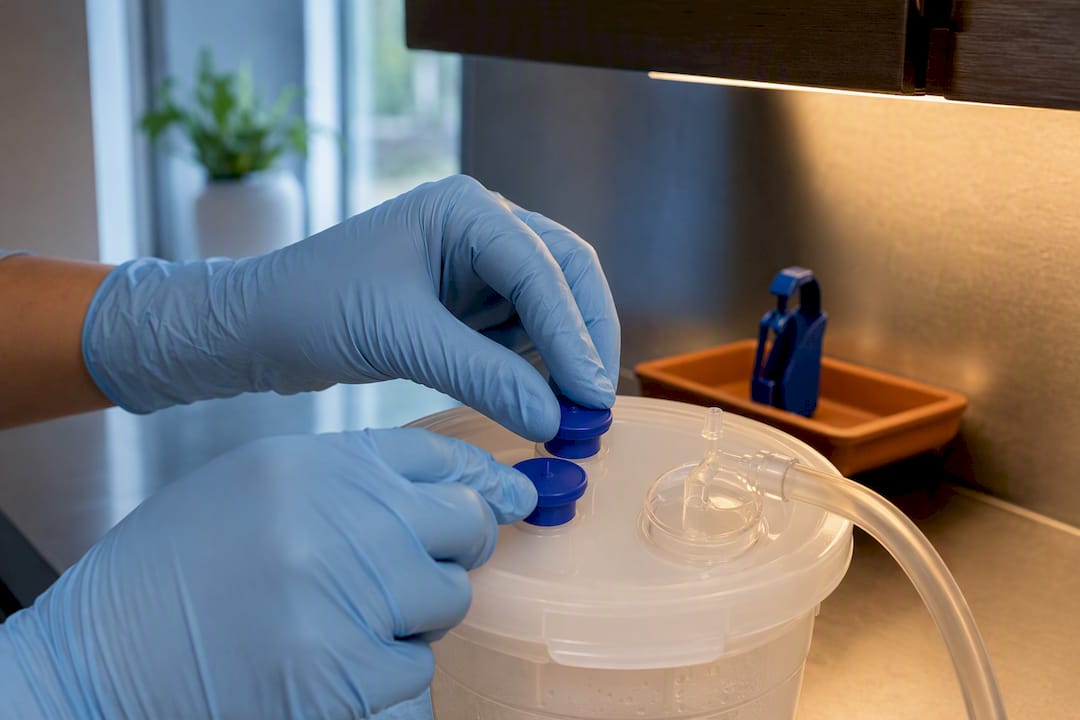
Cap every port, add solidifier or drop the liquid into a sealed disposable liner, then route the closed canister into your facility’s regulated medical waste stream. Sewer disposal is only acceptable through a documented closed-drain system your facility has approved for that purpose. Disposable suction canisters are single-patient, single-use devices, and treating them any other way puts staff and patients at risk.
TL;DR:
Proper disposal requires sealing all ports, adding solidifier or liner contents, then placing the canister in regulated medical waste or a validated closed-drain system.
Using disposable liners or closed-drain systems significantly reduces manual handling and splash risks, with closed systems cutting handling by up to 91 percent.
Disposal decisions must be documented and approved by infection prevention and facilities engineering based on local plumbing codes and environmental policies.
Routine cleaning of reusable canisters must follow manufacturer instructions, including high-level disinfection, and damaged or unclear canisters should be retired.
In home care, proper designation of disposal areas is essential, and staff should be trained on protocols to prevent variable practices and ensure safety.
Table of Contents
What Is Proper Suction Canister Disposal?
Proper suction canister disposal means capping all ports, neutralizing the liquid contents with a solidifier or containment liner, and placing the sealed unit into regulated medical waste (RMW) unless your facility has a validated closed-drain system in place. Manufacturers build this sequence into their Instructions for Use for a reason: canister contents are potentially infectious, and disposable canisters are not designed to be reopened, emptied, and reused.
That single rule covers most bedside scenarios. But the real work is in the sequence, and getting the order wrong is how spills happen.
Step-by-step disposal at the bedside
Perform disposal in a non-patient care area whenever possible, such as a soiled utility room or designated disposal station. If the canister is full mid-procedure and a spill risk exists, wait for a second staff member or engineering assistance rather than attempting a one-person transfer of an overfilled unit.
Stop suction and disconnect patient tubing at the canister lid.
Cap all ports securely, including the patient port and vacuum port.
Add a solidifying agent if the canister’s IFU calls for one, or confirm the liner is pre-gelled.
Remove the canister from its bracket, keeping it upright.
Seal the lid, checking that tethered caps are fully engaged.
Place the sealed canister into the RMW container, or transfer it to an approved closed-drain dock if your facility uses one.
Document the patient identifier, time of disposal, and staff initials in the chart or waste log your facility requires. If any splash or exposure occurs during the process, file an incident report immediately, not at the end of shift.
Pro Tip: Never force open a canister lid that looks sealed shut. Many disposable models use a nonremovable lid specifically to prevent tampering and splash exposure — if it won’t open with normal pressure, it isn’t supposed to.
What PPE Do You Need for Canister Disposal?
Standard precautions apply the moment you touch a used canister, not just when you suspect infection. The minimum gear for routine disposal includes:
Disposable gloves, changed if torn or visibly contaminated
Eye protection or a face shield if there’s any splash risk
A fluid-resistant gown for canisters that are full or awkward to handle
An N95 or equivalent respirator when aerosolization risk is elevated, such as with active respiratory infections
Work over a sink or in a designated disposal room with absorbent pads or a splash tray underneath. If a spill happens anyway, contain it immediately, disinfect the surface with an EPA-registered hospital-grade disinfectant, and report any skin or mucous membrane exposure through your facility’s occupational health process without delay.
Should You Use a Solidifier or a Closed System?
Solidifiers turn liquid canister contents into a gel, which is why so many facilities build them into standard practice. Products like Sanisorb solidifying packets work by absorbing free liquid, cutting spill risk during transport and often reclassifying the waste under facility policy once it’s no longer free-flowing. Disposable liners with tethered lids go a step further, letting staff remove the entire liquid load in one motion without touching the fluid directly.
Closed drain systems sit at the top of the safety hierarchy. A peer-reviewed evaluation comparing closed systems against traditional canisters found they cut manual handling events by 91% and eliminated lifting in 70% of procedures, a meaningful drop in the exposure moments that cause splashes and back injuries.
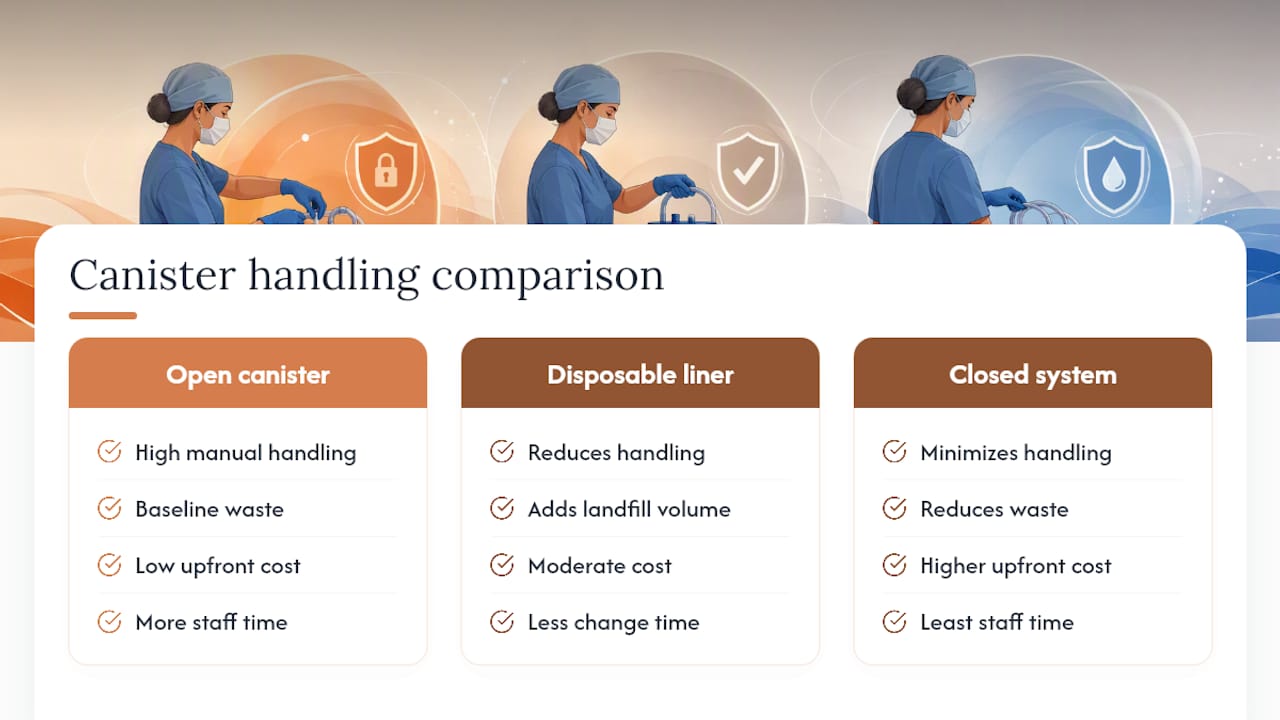
Solidifiers: low cost, easy to stock, best for standard-volume disposable canisters.
Disposable liners: faster removal, fewer touchpoints, higher per-unit cost.
Closed drain or rover systems: highest upfront investment, but the strongest reduction in staff handling.
Before switching systems, loop in facilities engineering and infection control. A closed system that isn’t plumbed or maintained correctly creates new risks instead of removing old ones.
How Do You Decide Between Sewer and Regulated Medical Waste?
OSHA’s bloodborne pathogens standard sets the federal floor: treat suction fluid as potentially infectious and handle it with standard precautions. But the standard doesn’t tell you whether a given canister goes down the drain or into a red bag. That call comes down to state and local RMW definitions and plumbing codes, which vary more than most clinicians expect.
The decision tree in most facilities looks like this: a solidified or sealed disposable canister goes to RMW pickup as biohazard waste. A closed-drain or rover system routes fluid to the sanitary sewer, but only when the system is properly plumbed, maintained, and specifically authorized under your facility’s environmental compliance program.
Getting authorization right takes more than one department:
Infection prevention confirms the disposal method meets standard precautions for the patient population.
Environmental services manages RMW pickup schedules and container supply.
Facilities engineering verifies plumbing and backflow protection for any closed-drain installation.
Risk and compliance documents the approval and keeps records for surveyors.
Keep that approval on file. If a state inspector or accrediting body asks why fluid is going to the sewer instead of RMW, “we have a documented, engineering-verified closed system” is the answer that holds up. “We’ve always done it that way” is not.
How Do You Clean and Disinfect Reusable Canisters?
Reusable canisters exist, but they carry more labor and exposure risk than disposables, and reuse is only appropriate when the device’s IFU explicitly permits it. High-level disinfection, or sterilization for certain patient populations, is not optional when reuse is indicated.
Transport the canister in a closed container to the reprocessing area.
Don full PPE before emptying, and empty contents only in a designated disposal area.
Clean manually or via automated washer per the device’s IFU.
Apply disinfectant and observe the exact contact time specified in the IFU, not an estimate.
Dry, inspect for cracks or clouding, and log the cycle for your facility’s records.
Retire any canister with a damaged seal, persistent clouding after cleaning, or a failed disinfection verification test. A canister that won’t come clean isn’t worth the risk of keeping in rotation.
Smarter Workflow: Reducing Exposure and Waste Together
Disposable liners and closed systems both cut down on manual handling, and that’s the biggest lever you have for reducing staff injury risk. Where budget allows, prioritize them over traditional open canisters for high-turnover units.
For heavy or full canisters, use docking stations or carts instead of carrying them by hand, and plan disposal timing around shift changes so no one attempts a solo lift of an overfilled unit. Sustainability and infection control don’t always agree. Solidifiers add landfill volume; closed systems cut waste but cost more upfront. Loop in both your infection prevention and sustainability teams before standardizing on one approach facility-wide.
Pro Tip: If your unit handles high-volume suction cases, model the total cost of a closed system against staff time spent on manual canister changes. The labor savings often close the price gap faster than budget conversations suggest.
How Opulent Adapts This Checklist for In-Home Nursing
Home care doesn’t have a soiled utility room down the hall. Opulentprivatecare trains nurses to designate a secure, non-patient area of the home, usually a bathroom or utility space, for canister disposal, and to coordinate final pickup with household waste rules or a contracted medical waste vendor rather than general trash. That coordination matters more in the home than in a hospital, where RMW pickup is already built into the building.
For families managing tracheostomy or feeding tube care alongside suction, related protocols on tracheostomy home care and G-tube troubleshooting cover adjacent waste handling questions nurses face in the same shift.
What Most Facilities Get Wrong About This Process
The biggest gap isn’t the disposal steps themselves. Most nurses know to cap and seal. The gap is in the decision about sewer versus RMW, which too many units treat as a judgment call instead of a documented, approved process. That’s how facilities end up with three different practices on three different floors, none of them written down anywhere a surveyor can check.
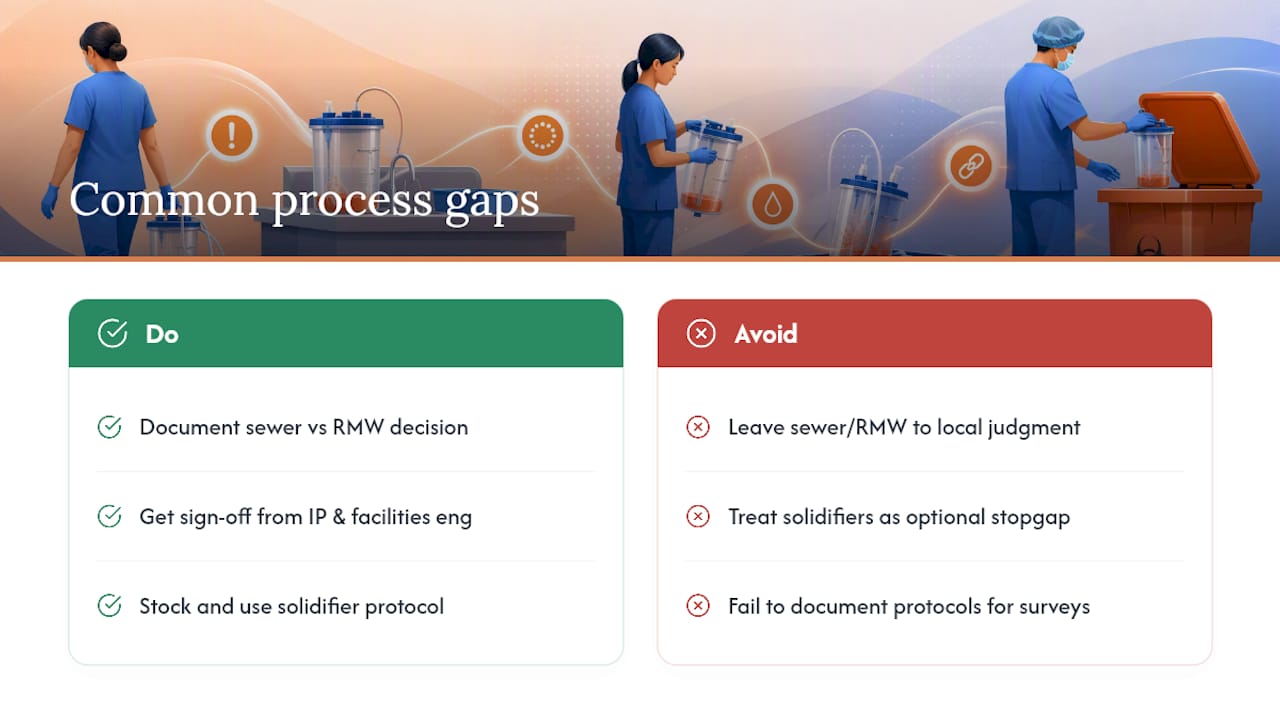
The second gap is underestimating solidifiers and liners as a “nice to have.” The evidence on closed systems is compelling, but not every unit has the budget or plumbing for a full closed-drain installation. A well-stocked solidifier protocol, used consistently, closes most of the exposure gap at a fraction of the cost. Facilities that treat solidifiers as a stopgap until they can afford something fancier are missing that they already have an effective tool in hand.
What should change first isn’t the equipment. It’s the paperwork. Get the sewer-versus-RMW decision documented and signed off by infection prevention and facilities engineering before the next survey asks the question for you.
— Opulent
Training Support for Safe Suction Waste Handling
Handling suction waste safely takes more than reading an IFU once during orientation. Opulentprivatecare places nurses and trains family caregivers specifically for children who depend on tracheostomy, ventilator, and G-tube support, where suction canister management is part of daily care, not an occasional task.

Every family matched through Opulentprivatecare’s 3 Thumbs Up Rule gets a caregiver who has been trained on the exact protocols this article covers, backed by published shift fill rates and nurse retention data the agency shares openly. If your family needs a consistent, trained nurse for trach, vent, or feeding tube care in Georgia, review Opulentprivatecare’s trach, vent, and G-tube services and request a care consultation to get matched with a nurse who already knows this checklist cold.
Recommended
Comments