
Home Care Nurse Retention: What Actually Keeps Nurses on the Job
- Opulent Private Care Services

- 7 days ago
- 13 min read
The single most effective fix for home care nurse retention is a combination of three things: data-driven early onboarding support, stable schedules, and frontline supervisors who actually pick up the phone. Agencies that treat retention as a prediction problem, not a personality problem, keep nurses longer and fill more shifts.
If you’re running a home health agency right now, do three things this quarter. First, build a 90-day onboarding runway with paid preceptor hours, because early tenure and job satisfaction are among the strongest predictors of retention in home healthcare nursing. Second, stabilize schedules before you touch pay, since schedule volatility is directly tied to turnover exceeding 30% among full-time RNs in home health settings. Third, put a real supervisor relationship in front of every new hire in week one, not week six.
Here’s the urgency: industry reporting puts median caregiver turnover near 79% in recent years, with a large share of departures happening inside the first 100 days. That’s not a hiring problem. That’s an onboarding and prediction problem, and it’s fixable with the right operational moves.
Key Takeaways
Retention improves fastest when agencies pair structured 90-day onboarding with schedule stability and weekly supervisor engagement, then measure results with hard KPIs instead of anecdote.
Point | Details |
Fix onboarding first | Guarantee paid preceptor hours in week one and week five to cut first-90-day attrition. |
Stabilize schedules before pay | Schedule volatility is tied to turnover exceeding 30% among full-time home health RNs. |
Treat pay as a floor, not a fix | Compensation prevents dissatisfaction but leadership and growth opportunities drive long-term retention. |
Track five KPIs weekly | Monitor turnover, first-90-day attrition, tenure, shift-fill rate, and vacancy days with named owners. |
Use family-fit checks like Opulentprivatecare’s model | The 3 Thumbs Up Rule and published KPIs show how transparency and three-way sign-off reduce early mismatches. |
Table of Contents
Why Home Care Nurse Turnover Happens and Which Causes You Can Fix
How Do You Build a First-90-Days Onboarding Plan That Sticks?
How Do Career Pathways Keep Experienced Nurses From Leaving?
What Do Supervisors Need to Do Differently to Retain Nurses?
How Opulent Private Care Puts These Principles Into Practice
Get Reliable, Continuity-Focused Pediatric Nursing With Opulent Private Care
Why Home Care Nurse Turnover Happens and Which Causes You Can Fix
Most agencies blame turnover on “the market” or “burnout” without breaking down which drivers are actually within their control. Some are. Some aren’t. The distinction matters because it determines where you spend your next budget dollar.
Burnout from isolation. Hospital nurses have a charge nurse down the hall. Home care nurses spend a 12-hour shift alone with one patient and one family, with no backup if something goes sideways. That isolation compounds faster than clinical burnout does.
Schedule volatility. Last-minute cancellations, inconsistent case assignments, and unpredictable hours push nurses toward employers who offer steadier work. This is one of the most modifiable causes on the list.
Weak onboarding. A nurse dropped into a tracheostomy case after a single shadow shift will either quit or make a preventable error. Neither outcome helps the family or the agency.
Supervision failures. When a nurse calls with a problem and gets voicemail, she remembers it. Repeated non-response from management is one of the fastest routes to resignation.
Family fit. A mismatch between a nurse’s working style and a family’s expectations creates daily friction that no amount of clinical skill fixes.
Pay treated as the whole answer. Underpaying drives people out fast, but overpaying alone doesn’t keep them if the other five factors are broken.
A cross-national review of home care nurse turnover found that job characteristics, workload structure, communication quality, and employment conditions together shape whether a nurse intends to remain employed far more than any single factor in isolation. Compare a hospital nurse who calls a supervisor down the hall during a bad shift to a home care nurse texting a manager who doesn’t answer until the next morning. Same clinical stress, wildly different support structure. Pediatric cases raise the stakes again: workforce research on children with medical complexity points to training gaps and family-fit friction as recurring, largely preventable causes of early exits.
What Does Nurse Turnover Actually Cost Your Agency?
Turnover isn’t a line item most agencies track well, which is exactly why it stays high. Once you calculate it, retention stops being a soft HR concern and becomes a budget conversation your CFO will pay attention to.
Three cost buckets drive the number up fast:
Recruiting and screening costs — job postings, background checks, and recruiter time for every replacement hire.
Training and onboarding hours — paid orientation, preceptor shifts, and competency sign-offs that produce zero billable revenue.
Lost billable hours and overtime — every open shift is either unbilled or covered at premium overtime rates by remaining staff, who then burn out faster themselves.
A workable formula: (recruiting cost + training hours × hourly rate + estimated lost billable hours × billing rate) per departure. Run this once per exiting nurse and multiply by your annual departure count. Most agencies find the number lands somewhere between several thousand and over ten thousand dollars per RN departure, depending on case complexity and how long the seat sits vacant.
The operational fallout compounds the dollar figure. Every unfilled shift either goes uncovered, meaning a family loses care hours, or gets covered by an overtime nurse pulled from another case. Shift-fill rate is the metric that shows this pain in real time. Track it weekly, not quarterly. An agency losing ground on retention will see shift-fill rate erode weeks before the turnover number itself shows up in a monthly report.
How Do You Build a First-90-Days Onboarding Plan That Sticks?
Turnover is heaviest in the first 90 days, which means your onboarding plan is your single highest-leverage retention tool. Nurses who feel confident and supported early stay; nurses who feel thrown into complexity without a safety net leave, often within weeks.
A structured first-90-day plan should include:
Week 1: supervised shifts only. No nurse works a complex case solo in week one, period. Pair every new hire with a preceptor for the full first week regardless of prior experience.
Week 2 to 4: competency sign-offs by task. Trach care, feeding tube management, seizure protocols, and ventilator checks each get a documented sign-off before independent work begins.
Week 5: a second protected mentor check-in. Guaranteed, paid mentor time at week five, not just week one, catches problems that surface once the nurse is flying mostly solo.
Day 30, 60, 90: structured family-fit confirmation. A short check-in with the family and nurse separately, not just together, surfaces friction before it becomes a resignation.
Practical evidence backs the two-touchpoint mentor model specifically: preceptor programs that guarantee paid mentor hours in week one and week five show measurably lower first-90-day attrition than programs that leave mentorship informal or ad hoc. That second touchpoint matters because week one confidence often erodes by week four, right when supervision typically fades.
Pro Tip: Schedule preceptor hours as a fixed weekly billing line, not an ad hoc favor from a senior nurse. If preceptor time isn’t budgeted, it gets skipped the first time staffing gets tight, and that’s exactly when new hires need it most.
Scheduling preceptor time without losing billable hours means building it into your rate structure upfront, either through a training differential billed to the case or a small overhead allocation per new hire. Treat it as a fixed cost of hiring, not a discretionary extra.

Does Higher Pay Actually Improve Nurse Retention?
Pay matters, but not the way most agencies think. A paired comparative study of home care nurses conducted before and during COVID-19 found that compensation satisfaction stayed essentially stable across that entire period, while perceptions of professional growth and leadership quality shifted far more. Compensation behaves like a hygiene factor: get it wrong and people leave fast, but getting it right doesn’t guarantee anyone stays.
That means pay-only retention strategies waste money. A one-time raise across the board moves the needle for a few months and then flattens out once nurses adjust their expectations upward. What actually works is targeted, not blanket:
Guaranteed minimum hours for nurses on stable long-term cases, removing the income unpredictability that drives people toward per diem shift apps.
Skill-based differentials for trach, vent, or G-tube certification, since those cases carry higher risk and deserve pay that reflects it.
Sign-on and 90-day retention bonuses structured to pay out at the exact point turnover risk peaks, not on day one.
Benefits packaging that includes real health coverage or PTO accrual for full-time home care nurses, an area many agencies still underbuild compared to hospital employers.
Check current pediatric private duty nursing pay benchmarks before setting differentials, since underpricing skill premiums undercuts the whole strategy.
How you communicate a compensation change matters almost as much as the change itself. Announcing a bonus tied explicitly to milestone dates, “this pays out at your 90-day mark,” reinforces the retention behavior you want rather than just handing over money with no framing at all.
How Do Career Pathways Keep Experienced Nurses From Leaving?
Once pay and onboarding are stable, the next lever is showing nurses a future inside your agency instead of a ceiling. A nurse who can see where she’ll be in two years stays; a nurse who feels stuck in the same role indefinitely starts scrolling job boards.
Build a visible ladder, even a simple one:
Entry to specialist track. Move nurses from general pediatric cases into trach/vent/G-tube specialization with formal certification support, not informal assignment.
Preceptor and mentor roles. Experienced nurses who train new hires get a title, a pay differential, and recognition, converting their tenure into a leadership function instead of a dead end.
Tuition and CE funding. Paid continuing education hours or partial tuition assistance for advanced certifications signal long-term investment rather than transactional employment.
Internal hiring for coordinator and supervisor roles. When a scheduling or clinical coordinator position opens, look at your own nurses first. Promoting from within tells every nurse on staff that tenure leads somewhere.
Recognition matters here too, not as a token gesture, but structurally. A nurse who trains three new hires and gets a note in a newsletter feels less valued than one who gets a documented preceptor pay bump and a resume line she can point to. Resources like a pediatric home health nursing resume guide are worth sharing internally when you’re building out these role descriptions, since nurses often don’t realize how much specialized pediatric experience is worth on paper.
Which Scheduling Models Actually Reduce Turnover?
Schedule volatility is one of the most measurable, most fixable drivers of home care nurse turnover. The PMC study on schedule volatility found turnover rates exceeding 30% among full-time RNs tied directly to unstable scheduling patterns, not clinical burnout alone. That’s a scheduling design problem, not a personnel problem.
Four models worth testing:
Self-scheduling within guardrails. Let nurses pick shifts inside pre-approved blocks tied to case continuity requirements, rather than assigning shifts top-down.
Float pools for backup coverage. A small pool of cross-trained nurses who can step into any case on short notice prevents last-minute scrambling that burns out your core staff.
Guaranteed minimum blocks. Offering a guaranteed weekly hour floor for nurses on long-term cases removes the income anxiety that drives people to pick up second jobs elsewhere.
Shared caseloads for high-acuity cases. Splitting a demanding case between two nurses on a fixed rotation prevents any single nurse from absorbing all the isolation and stress alone.
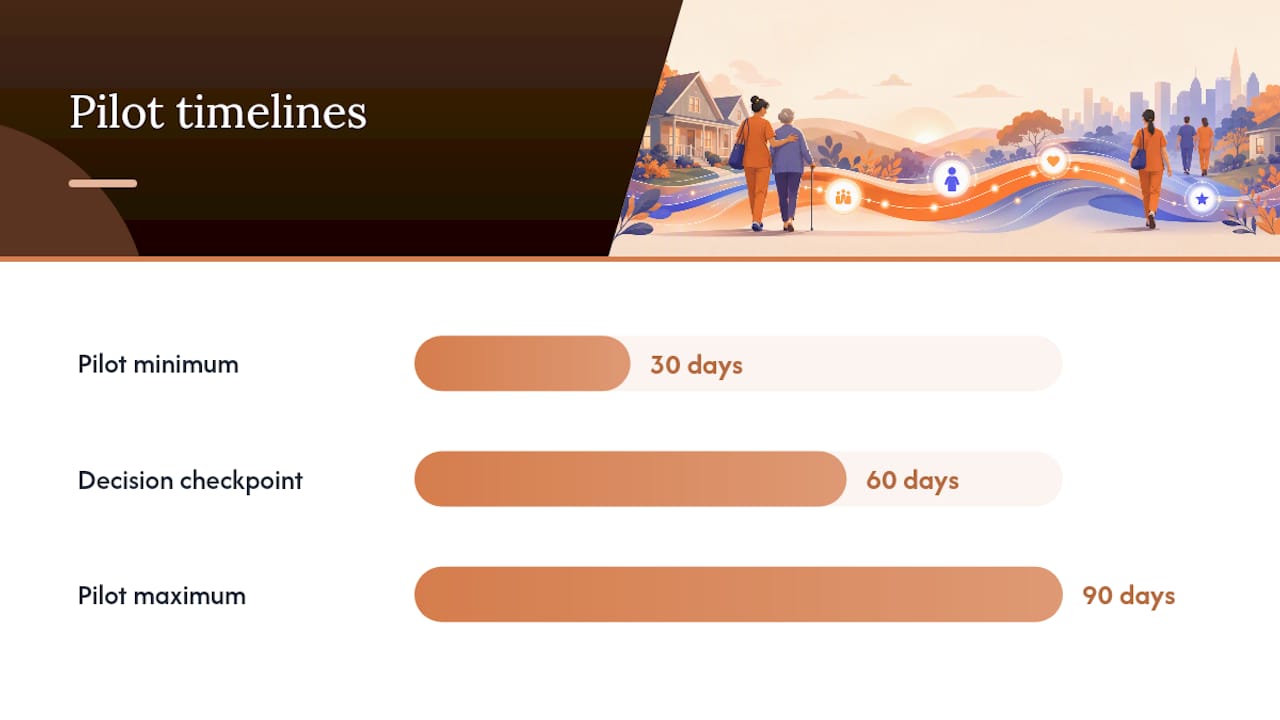
Run a 30 to 90 day pilot on one model at a time. Pick a control group of similar cases, apply the new scheduling structure to a test group, and track shift-fill rate and voluntary resignation rate weekly. If fill rate improves by a measurable margin and resignations drop inside 60 days, scale it agency-wide.
Pro Tip: Don’t pilot two scheduling changes at once. If you launch self-scheduling and a float pool simultaneously, you won’t know which one moved the needle when your numbers improve.
What Do Supervisors Need to Do Differently to Retain Nurses?
“Supportive leadership” sounds good in a mission statement and means nothing until you turn it into a weekly checklist a supervisor actually follows. Vague encouragement to “be more supportive” changes nothing. Specific, repeatable actions do.
Build these into every supervisor’s routine:
Weekly one-on-ones, not just crisis calls. A five-minute check-in when nothing is wrong builds the trust that makes a nurse call you first when something is.
A rapid escalation pathway with a real response time. If a nurse can’t reach anyone for four hours during a clinical concern, that’s your retention leak, not the nurse’s problem.
Active advocacy for schedule requests. When a nurse asks for a specific day off for a family event, a supervisor who fights for it earns loyalty that outlasts any bonus.
Structured career conversations twice a year. Not a performance review. A genuine “where do you want to be in a year” conversation that feeds directly into your career ladder.
Recognition that’s specific, not generic. “You handled that seizure protocol change flawlessly” lands harder than “great job this month.”
Train supervisors on these five behaviors explicitly. Most clinical managers were promoted for clinical skill, not people management, and they need the checklist spelled out rather than assumed.
How Can Agencies Support Nurse Mental Health in the Field?
Home care nurses work alone. That isolation is structurally different from hospital burnout, and it needs a different set of supports, ones that meet a nurse where she is instead of asking her to drive to an office.
Telehealth EAP access. An employee assistance program that requires an in-person appointment during business hours is functionally useless to a nurse working a 12-hour home shift. Telehealth access removes that barrier.
Scheduled peer debrief sessions. A monthly virtual call where nurses on similar caseloads talk through hard cases reduces the isolation that solo home care work creates.
Protected respite time after high-acuity cases. A nurse coming off a difficult pediatric case involving a medical crisis needs a guaranteed break before her next placement, not an immediate reassignment.
Manager check-ins after critical incidents. Any case involving a hospitalization, a code, or a death gets a mandatory follow-up call from a supervisor within 48 hours.
Measure uptake, not just availability. Track how many nurses actually use EAP services or attend peer debriefs each quarter. Low uptake despite availability is itself a signal: either the access isn’t as frictionless as you think, or trust in confidentiality is low.
Can You Predict Which Nurses Are About to Quit?
Most agencies find out a nurse is leaving when she hands in her notice. By then, it’s too late to intervene. Shifting from anecdote to predictive analytics means catching the warning signs weeks earlier, when a conversation can still change the outcome.
Watch for these signals, in order of predictive value:
Early no-shows or late cancellations. A nurse who never missed a shift and suddenly cancels twice in a month is telling you something before she says it out loud.
A drop in requested hours. Nurses planning to leave often quietly reduce their availability weeks before giving notice.
Declining response time to scheduling requests. Slower replies to texts or calls from coordinators is a soft but reliable disengagement signal.
Missed optional training or team events. Nurses checking out emotionally stop showing up for anything not mandatory.
A simple analytics workflow doesn’t require expensive software. Capture these four data points weekly, set threshold rules (two missed shifts in 30 days triggers a check-in call, for example), and build a short intervention playbook for each trigger.
Risk Signal | Threshold to Trigger Outreach | Suggested Action |
Shift cancellations | 2+ in a 30-day window | Supervisor check-in call within 48 hours |
Drop in requested hours | reduction month over month | Career and workload conversation |
Slow response to scheduling | 3+ delayed responses in a row | Informal one-on-one, no agenda framing |
Skipped optional events | Two consecutive misses | Peer outreach, not management outreach |
A spreadsheet dashboard updated weekly by a scheduling coordinator is enough to start. You don’t need predictive software to act on predictive thinking.
What KPIs Should You Track to Measure Retention Progress?
Retention improvement is invisible unless you’re measuring the right numbers on a fixed cadence, with someone specific accountable for each one.
KPI | Target Range | Reporting Cadence |
Overall turnover rate | Below industry median, tracked against your own baseline | Monthly |
First-90-day attrition | As close to zero as operationally realistic | Monthly |
Average nurse tenure | Trending upward quarter over quarter | Quarterly |
Shift-fill rate | 90% or higher for stable cases | Weekly |
Vacancy days per open case | Under 5 days average | Weekly |
Assign ownership clearly: scheduling coordinators own shift-fill rate and vacancy days, HR or clinical directors own turnover and tenure, and agency leadership reviews all five monthly. When shift-fill rate drops two weeks running, that’s the trigger to review scheduling models, not wait for the monthly turnover report to confirm what you already suspected. A dashboard doesn’t need to be complex: five numbers, five owners, one shared spreadsheet updated weekly, checked against targets every reporting cycle.
How Opulent Private Care Puts These Principles Into Practice
Opulent Private Care built its staffing model around one core insight: mismatches between nurse and family create most early exits, and transparency about performance builds the trust that keeps everyone honest about what’s working.
The 3 Thumbs Up Rule requires sign-off from the family, the nurse, and Opulentprivatecare before any case begins. That three-way check catches the family-fit friction that research on pediatric home care stability identifies as a major, modifiable driver of early nurse turnover, before a single shift is ever worked.
Opulentprivatecare also publishes its own shift fill rates and nurse retention percentages rather than treating them as internal-only metrics. That transparency does two things: it holds the agency accountable to families evaluating care options, and it gives every nurse on staff visible proof that continuity is a real operational priority, not a marketing line.
For agencies handling mixed caseloads, from routine private duty to high-acuity trach and ventilator care, the practical takeaway is straightforward:
Build a formal three-way approval step before any placement, not just a resume review.
Publish your own fill-rate and retention numbers internally first, then externally once you trust the data.
Reserve continuity commitments for cases where rotating staff does the most clinical and emotional damage, typically complex pediatric cases.
Common Retention Pilot Mistakes and How to Avoid Them
Most retention pilots fail for the same handful of reasons, and none of them are complicated to fix once you see the pattern.
The most common mistake is a one-off pay bump treated as a complete strategy. It buys three months of goodwill and then evaporates once nurses recalibrate their expectations. The second is underfunding training, budgeting for orientation but skipping paid preceptor hours past week one, right when new hires need support most. The third is ignoring family-nurse fit entirely and assuming clinical competence is the only variable that matters. The fourth, and most damaging over time, is launching a pilot without baseline metrics, so nobody can tell whether shift-fill rate or turnover actually moved.
Before launching your next pilot: set a 90-day measurement window, track shift-fill rate and voluntary resignations weekly, change one variable at a time, and assign a single owner accountable for reporting results. Skip any one of these and you’ll be guessing again in six months.
— Opulent
Get Reliable, Continuity-Focused Pediatric Nursing With Opulent Private Care
If your family or your agency’s clients are trying to solve the same problem this article covers from the inside, finding pediatric nurses who actually stay, Opulentprivatecare built its entire model around that exact gap. Families managing tracheostomy, ventilator, feeding tube, seizure, or neurological care don’t need another rotating roster of unfamiliar faces. They need one nurse who knows the child.

Opulentprivatecare matches nurses to families through the 3 Thumbs Up Rule, handles Medicaid and GAPP paperwork directly, and publishes its own retention and shift-fill numbers so families can see the continuity claim isn’t just marketing language. The service covers families across Georgia who qualify for Medicaid or GAPP funding and need statewide, in-home pediatric skilled nursing rather than short-term or occasional care.
If your child qualifies for GAPP-funded nursing and you’re tired of explaining the care plan to a new nurse every few weeks, visit Opulent Private Care to check eligibility and start the matching process, or explore the trach, vent, and G-tube program page for details specific to higher-acuity cases.
Sources
Recommended
Comments