
NICU to Home Transition: What Parents Must Do First


Your baby is ready to go home when the NICU team confirms three things: steady weight gain, a safe feeding plan, and the ability to maintain body temperature in an open crib without apnea or bradycardia events for a clinically determined period. That decision belongs to the medical team, guided by evidence-based criteria, but you have an active role in making the transition work. The National Perinatal Association frames this as a family-centered process that begins well before discharge day and continues after you walk through your front door.
Your first three actions once discharge planning begins:
Confirm with your baby’s primary nurse or neonatologist which specific clinical criteria still need to be met before discharge is possible.
Ask the discharge coordinator or social worker to schedule your baby’s first outpatient pediatric visit before you leave the hospital.
Contact your insurance plan to add your newborn and ask the social worker about Medicaid or CHIP eligibility if you need it.
Within a few days of a target discharge date, also confirm:
All durable medical equipment (DME) has been ordered and a delivery date is set.
You have completed or scheduled every required caregiver training (CPR, feeding, any equipment your baby will use at home).
You have a printed discharge summary, a medication list, and a follow-up schedule in hand.
The Agency for Healthcare Research and Quality (AHRQ) identifies the days immediately after discharge as a “high-vulnerability window,” and the March of Dimes notes that case managers can coordinate equipment, training, and home nursing for medically fragile newborns. If your baby has complex needs, Opulentprivatecare provides in-home pediatric skilled nursing in Georgia for families navigating exactly this moment.
Key Takeaways
A successful NICU to home transition requires confirmed clinical readiness, a printed discharge packet, scheduled outpatient follow-up, arranged home supports, and a clear plan for recognizing and responding to early warning signs.
Point | Details |
Confirm discharge criteria | Ask the team which specific milestones (weight, feeding, temperature, apnea-free period) remain before discharge is possible. |
Get a printed discharge packet | Request the discharge summary, medication list, equipment orders, and follow-up schedule before leaving the hospital. |
Schedule the first pediatric visit | Book the first-week outpatient visit before discharge day and give the pediatrician a copy of the discharge summary. |
Know the red-flag signs | Central cyanosis, unresponsive apnea, and seizures require 911; feeding refusal and fever require same-day pediatrician contact. |
Opulentprivatecare for complex babies | Georgia families with medically fragile NICU graduates can access in-home skilled nursing through Opulentprivatecare, including GAPP/Medicaid assistance and nurse matching. |
Table of Contents
1. What clinicians check before clearing your baby for discharge
4. Arranging equipment, supplies, and home nursing before discharge
5. Setting up follow-up care and establishing a medical home
7. Insurance and benefits steps to take before and after discharge
8. What to watch for in the first days home and when to call for help
10. Authoritative toolkits and checklists every NICU family should have
11. When your baby may need skilled in-home pediatric nursing
Skilled in-home pediatric nursing for NICU graduates in Georgia
1. What clinicians check before clearing your baby for discharge
Discharge readiness is not a single test. It is a cluster of physiologic milestones that clinicians track over days or weeks, and UW Medicine’s patient education resource lays out the core criteria clearly.
The four core physiologic criteria:
Consistent weight gain. Your baby should be gaining weight on a predictable trajectory, typically on full oral or enteral feeds without IV supplementation.
Safe feeding plan. Feeding must be coordinated with breathing. Babies who desat or brady during feeds are not yet ready.
Temperature regulation in an open crib. The baby must maintain a normal body temperature without an isolette for a defined period.
Apnea/bradycardia stability. Most programs require a set number of event-free days before discharge is considered. The exact window varies by institution and gestational age.
Pre-discharge tests and screens your team will complete:
Retinopathy of prematurity (ROP) exam for babies born before 30 weeks or under 1,500 grams, or as clinically indicated.
Hearing screen (BAER/ABR) before discharge, with a follow-up plan if the result is a “refer.”
Car-seat tolerance test (CSTT): your baby sits in the actual car seat for 90–120 minutes while oxygen saturation and heart rate are monitored. Failing this test means you need a car bed or a different seat configuration before going home.
Immunizations per the standard schedule, adjusted for chronological age.
RSV prophylaxis assessment during RSV season for high-risk infants.
The Journal of Perinatology interdisciplinary guidelines recommend that discharge preparation cover anticipatory guidance and a formal family and home needs assessment, not just the clinical checklist.
Pro Tip: Ask your primary nurse for a plain-language discharge summary and a printed readiness checklist. Specifically request one that lists each criterion with a checkbox and the date it was met. If the unit doesn’t have one, the AHRQ family information packet template is a solid starting point your team can customize.
2. How discharge planning works and when it starts
Planning for the NICU to home transition begins at admission, not the week before discharge. That is not an exaggeration. The discharge coordinator, case manager, primary nurse, and social worker are all tracking your baby’s trajectory from day one, and the earlier you engage with them, the smoother the handoff.
The key roles you will work with:
Discharge coordinator or case manager: manages the logistics, including equipment orders, insurance authorizations, and home nursing arrangements.
Primary nurse: your closest clinical contact, responsible for teaching you hands-on care skills and documenting your readiness.
Social worker: screens for social determinants of health, connects you to community resources, and helps navigate insurance and benefits.
Neonatologist or attending physician: sets and confirms the clinical discharge criteria.
The typical planning timeline looks like this:
Early in the NICU stay: family needs assessment, identification of equipment and home nursing requirements, insurance review.
Mid-stay: formal discharge planning meeting with the full team; begin caregiver training.
One to two weeks before target discharge: confirm equipment delivery dates, schedule rooming-in if the unit offers it, finalize follow-up appointments.
Final 48–72 hours: complete all training sign-offs, receive printed discharge packet, confirm first pediatric visit.
The AHRQ toolkit recommends that families receive a family information packet that includes medication lists, equipment instructions, follow-up schedules, and emergency contacts. Ask your discharge coordinator for this packet by name. If your unit uses a health coach model, that person will also follow up with you by phone within the first few days after discharge to catch problems early.
NPA’s discharge preparation guidelines show that structured education programs with a defined curriculum and family-driven assessments measurably improve caregiver confidence at discharge.
3. Practical skills you must learn before leaving the NICU
Confidence at discharge comes from repetition, not from watching once. Parents who room in overnight and practice hands-on care under nursing supervision consistently report feeling more prepared than those who observe from the bedside. PMC parent experience research confirms that structured education and consistent nursing assignments during the NICU stay increase caregiver confidence.
Skills to master before discharge:
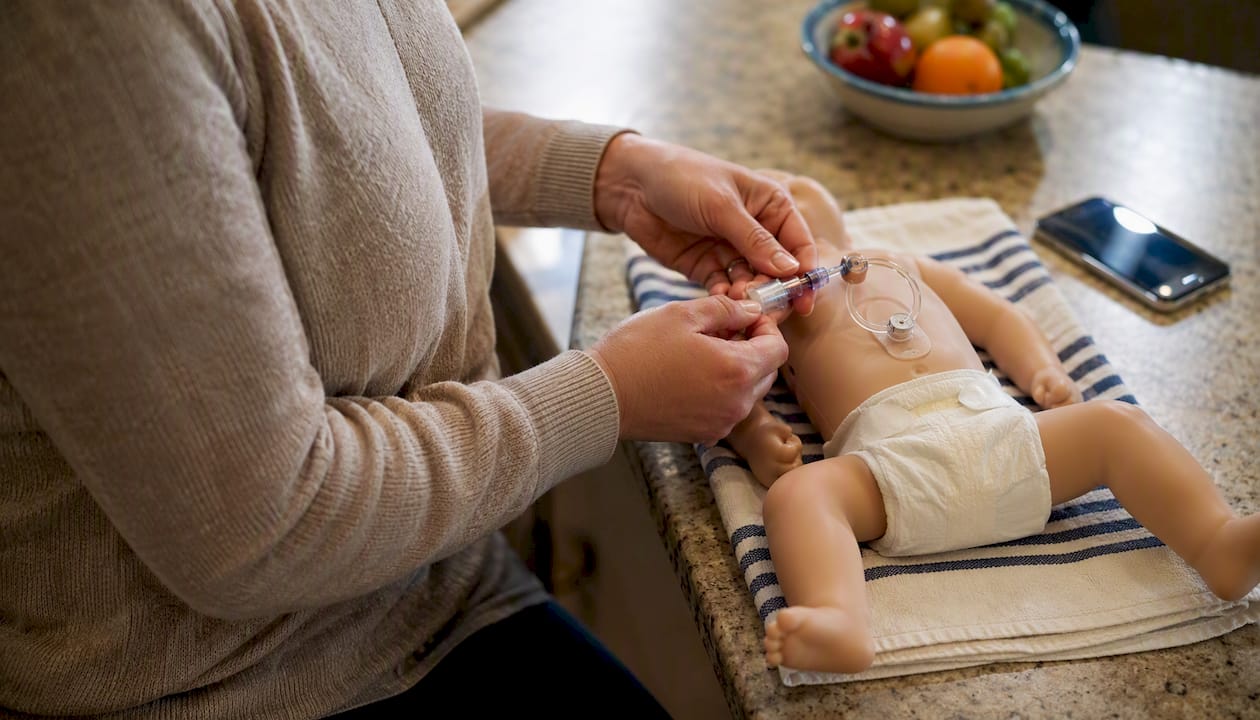
Feeding: breastfeeding latch and positioning for a premature or low-tone infant, paced bottle feeding, and if applicable, nasogastric or gastrostomy tube feeding including how to check placement and manage a clog.
Medication administration: oral syringes, correct dosing, what to do if a dose is missed or vomited, and how to store temperature-sensitive medications.
Wound and tube care: G-tube site cleaning, stoma care, and recognizing signs of infection or granulation tissue.
Oxygen and respiratory device management: setting up and troubleshooting a nasal cannula, reading a pulse oximeter, and knowing your baby’s target saturation range.
Infant CPR: complete a hands-on course, not just a video. Many NICUs offer this on-site. The American Heart Association’s Pediatric First Aid CPR AED course is widely available.
Apnea monitor use: how to apply leads correctly, what a true alarm sounds like versus artifact, and the response protocol your team gives you.
How mastery gets documented: Most units use a teach-back model. You explain or demonstrate the skill back to the nurse, who documents it in the chart. Some units require two or three supervised practice sessions before signing off. Rooming-in, where you spend one or more nights caring for your baby independently in a private room while nursing is available, is the closest simulation of being home.
Pro Tip: If a skill feels unclear after one demonstration, ask for a repeat. Bring a notebook or use your phone to record (with permission) the nurse walking through a procedure. Short video clips of tube feeding or G-tube care are far easier to reference at 2 AM than a printed handout.
4. Arranging equipment, supplies, and home nursing before discharge
Medical equipment does not appear at your door automatically. It requires a physician’s order, insurance authorization, a durable medical equipment supplier, and often a separate training session before you leave the hospital. Starting this process early is not optional for complex babies.
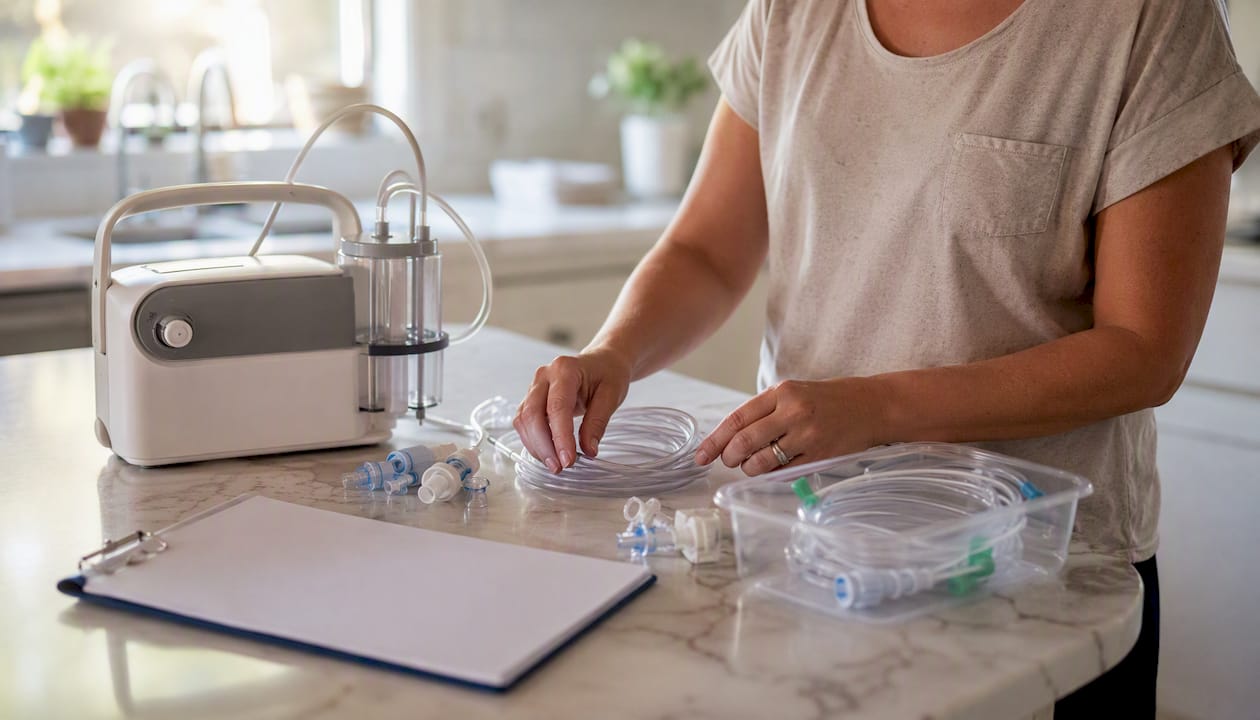
March of Dimes confirms that case managers coordinate equipment orders, caregiver training, and home nursing arrangements for medically fragile newborns.
Equipment | Who typically orders | Training needed | Where to keep documents |
Pulse oximeter | Physician/NP | Reading values, alarm response | Home binder, bedside |
Oxygen concentrator or tank | Physician/NP + DME supplier | Setup, flow rate, alarm response | Home binder, near equipment |
Apnea monitor | Physician/NP + DME supplier | Lead placement, alarm response, event download | Home binder, bedside |
Feeding pump | Physician/NP + dietitian | Programming rates, cleaning tubing | Home binder, near pump |
Trach/stoma supplies | Physician/NP + home nursing | Full trach care protocol | Home binder, supply cabinet |
Nasal cannula and tubing | DME supplier | Sizing, securing, skin checks | Home binder |
For home nursing specifically:
Your case manager initiates the referral and works with your insurer or Medicaid program to obtain authorization.
In Georgia, the GAPP program (Georgia Pediatric Program) funds in-home skilled nursing for eligible medically fragile children through Medicaid.
Training for home nursing staff should ideally begin while your baby is still in the NICU so the nurse assigned to your child can learn your baby’s specific needs and equipment before the first home shift.
Ask your case manager for a written authorization number and the start date for nursing coverage before you leave the hospital.
For a detailed look at coordinating ongoing skilled nursing and home health support, Opulentprivatecare’s resource on pediatric caregiver coordination covers the practical steps families navigate after discharge.
5. Setting up follow-up care and establishing a medical home
The discharge summary is a multi-purpose document. It bridges the NICU team and every outpatient provider your baby will see, and March of Dimes recommends keeping a printed copy in a dedicated binder for emergencies and visits. Do not leave the hospital without one.
What the first-week pediatric visit must include:
Weight check and feeding assessment.
Review of all medications and doses.
Confirmation that specialist referrals are in place (ophthalmology, pulmonology, neurology, cardiology, as applicable).
Review of equipment settings and any alarm events since discharge.
Schedule this visit before discharge day. If your pediatrician has not received the discharge summary by the time of the visit, bring your printed copy.
Specialists and therapies to schedule before leaving:
Ophthalmology follow-up if your baby had ROP or a “refer” on the eye exam.
Early intervention evaluation (Part C of IDEA, available in every state) for developmental therapy services. Referral can be made by the NICU team.
Pulmonology or cardiology if your baby goes home on oxygen or has a cardiac diagnosis.
Lactation consultant if breastfeeding is ongoing and your baby is still learning.
AHRQ’s transition toolkit is explicit: the transition is incomplete until outpatient follow-up is established, and a clear handoff to primary care reduces errors during the high-vulnerability window after discharge.
Pro Tip: Build a “handoff binder” before discharge day. Sections: discharge summary, current medication list, equipment orders and settings, follow-up appointment schedule, insurance cards and authorization numbers, and a one-page emergency contact sheet. Give a copy of the emergency contact page to every caregiver in your home. For the first week, plan a daily check-in with your home nurse or health coach to catch problems before they escalate.
6. Home safety and practical prep before bringing baby home
A safe home environment is something you can control completely, and getting it right before discharge day removes one major source of stress. Use this checklist as your baseline.
Safe sleep and sleeping environment:
Firm, flat mattress in a safety-approved crib or bassinet with no bumpers, pillows, or loose bedding.
Baby sleeps on their back unless the medical team has given a specific exception in writing (some babies with severe reflux or airway issues have documented exceptions).
Room temperature between 68°F and 72°F.
Car seat:
Have a certified Child Passenger Safety Technician (CPST) inspect the installation before discharge. Find one at Safekids. Many hospitals have a CPST on staff or can refer you.
Your baby must pass the car-seat tolerance test in the actual seat you plan to use. If your baby needs a car bed, order it before the test.
Home safety basics:
Working smoke detectors and carbon monoxide detectors on every level.
Emergency contact list posted in a visible location: pediatrician, specialist, home nursing agency, DME supplier, poison control (1-800-222-1222), and 911.
Medical supply storage: labeled, organized, and accessible. Keep a two-week buffer of critical supplies (feeding tube supplies, trach supplies, oxygen tubing).
Outings and public exposure:
Premature and medically fragile infants have immature immune systems. Limit crowded indoor spaces for the first several weeks, especially during RSV season (typically October through March in most US regions).
Ask your pediatrician before any air travel or long car trips.
Visitors at home: ask anyone with cold or flu symptoms to postpone their visit. Hand washing before holding the baby is non-negotiable.
Henderson County’s NICU-to-home checklist is a practical, printable example that covers car seat readiness, supplies, contact lists, and rooming-in practice suggestions you can mirror for your own preparation.
7. Insurance and benefits steps to take before and after discharge
Administrative tasks feel low-priority when your baby is in the NICU. They are not. Missing a 30-day enrollment window or failing to get a letter of medical necessity can delay equipment delivery by weeks.
Immediate actions:
Add your newborn to your health insurance within 30 days of birth (or within your plan’s qualifying event window). Contact HR or your insurer directly. Missing this window can leave your baby uninsured until the next open enrollment period.
Ask the social worker about Medicaid and CHIP eligibility. Even families with private insurance sometimes qualify for Medicaid as secondary coverage for a medically complex child. In Georgia, the GAPP program specifically funds in-home skilled nursing for eligible children.
Request letters of medical necessity (LMN) from the attending physician for every piece of durable medical equipment and for in-home nursing. Insurers and Medicaid programs require these before authorizing coverage.
What the case manager handles (and what you still need to track):
Case managers submit referrals and authorizations, but they manage dozens of families at once. Keep your own log: authorization number, date submitted, date approved, and the name of the person you spoke with at the insurer. When something stalls, you will have the information needed to follow up.
Families of medically fragile newborns frequently encounter delayed hospital billing that arrives weeks or months after discharge. Keep every Explanation of Benefits (EOB) your insurer sends, and do not pay a bill before comparing it to the EOB. Billing errors are common in complex NICU stays, and you have the right to request an itemized bill and dispute charges.
8. What to watch for in the first days home and when to call for help
The first week at home is the highest-risk period for NICU graduates. AHRQ’s toolkit calls this the “high-vulnerability window” and recommends health-coach follow-up within days of discharge to catch problems before they become emergencies.
Use this three-tier response guide:
Green (watch and monitor):
Baby is fussier than usual but feeding normally and gaining weight.
One loose stool without blood or mucus.
Mild nasal congestion without fever or breathing changes.
Equipment alarm that resolves immediately when you reposition the baby or check the lead placement.
Yellow (call your pediatrician or home nurse within the hour):
Feeding refusal for two consecutive feeds or significant drop in intake.
Fever of 100.4°F or higher (rectal) in a baby under two months corrected age.
Weight loss or failure to gain over two to three days.
Persistent equipment alarms that do not resolve with repositioning.
Increased work of breathing: nasal flaring, chest retractions, or grunting.
Apnea or bradycardia episode that requires stimulation to resolve.
Red (call 911 immediately):
Baby is not breathing and does not respond to stimulation. Begin CPR.
Lips or face turning blue (central cyanosis).
Seizure activity.
Apnea monitor alarm with no response from the baby despite stimulation.
Trach tube dislodgement if you are not trained for emergency replacement.
On equipment alarms: Know the difference between a true alarm and artifact before you leave the hospital. A pulse oximeter that alarms because the probe slipped off the foot reads differently than one alarming because saturation has genuinely dropped. Your DME supplier and home nursing team should walk you through each device’s alarm patterns before discharge.
9. Coping after discharge and where to find real support
Anxiety after a NICU stay is not a sign that something is wrong with you. PMC parent experience research documents that anxiety about discharge readiness and a perceived loss of in-hospital support are among the most consistent themes parents report. The NICU feels safe because help is always 30 seconds away. Home does not feel that way at first, and that gap is real.
Concrete supports to ask about before discharge:
Peer-to-peer programs: Ask your NICU social worker about parent mentor programs. Many children’s hospitals connect NICU families with trained parent mentors who have been through the same experience.
March of Dimes support groups: The March of Dimes offers NICU family support programs and connects families to local and online communities.
Hand to Hold: A national nonprofit offering free peer support, counseling referrals, and a helpline (1-855-424-6362) specifically for NICU families.
Online communities: Groups like Graham’s Foundation (for premature infant families) and the NICU Parent Network offer moderated peer support.
When to seek professional mental health support: If anxiety, intrusive thoughts, or hypervigilance are interfering with sleep, relationships, or your ability to care for your baby two or more weeks after discharge, ask your own physician for a referral. Postpartum anxiety and PTSD following a NICU stay are well-documented and treatable. Build this into your discharge planning conversation, not as an afterthought.
For families navigating long-term care needs, Opulentprivatecare’s resource for special needs families covers community connections and caregiver support that extend well beyond the first week home.
10. Authoritative toolkits and checklists every NICU family should have
You do not need to build your own system from scratch. These vetted resources cover the full arc of NICU discharge planning and post-discharge care.
AHRQ “Transitioning Newborns from NICU to Home” toolkit: The most comprehensive clinical and family-facing resource available. Includes a family information packet with medication lists, equipment instructions, follow-up schedules, and emergency contacts. Ask your discharge coordinator to provide this packet or customize it for your baby.
National Perinatal Association (NPA) discharge guidelines: Evidence-based interdisciplinary guidelines covering anticipatory guidance, family and home needs assessment, and care coordination. Available through nicutohome.org with family-facing summaries and clinician tools.
March of Dimes NICU family resources: Practical handouts on discharge readiness, what to expect at home, and how to access community support. Available at marchofdimes.org.
Henderson County NICU-to-home checklist: A printable checklist covering car seat readiness, home supplies, contact lists, and practice suggestions. A useful template to bring to your discharge planning meeting and customize with your team.
UW Medicine “When Can My Baby Come Home?” patient education sheet: Plain-language explanation of discharge criteria, pre-discharge tests, and what parents should expect. Ask your NICU to provide a similar handout, or download the UW Medicine version directly.
What makes a checklist actually useful:
Discharge criteria with checkboxes and dates.
Equipment list with supplier contact and authorization number.
Follow-up appointment schedule with dates, times, and addresses.
Emergency contact list with after-hours numbers.
Medication list with dose, frequency, and administration instructions.
11. When your baby may need skilled in-home pediatric nursing
Not every NICU graduate needs home nursing, but some babies clearly do, and identifying that need before discharge is part of good planning. The clinical scenarios that most commonly require skilled in-home nursing include:
Ongoing oxygen or ventilator support: babies who go home on supplemental oxygen or a home ventilator need a nurse who can manage equipment, recognize deterioration, and respond to alarms.
Feeding tube dependence: nasogastric or gastrostomy tube feeding requires skilled assessment of tolerance, tube placement verification, and management of complications.
Tracheostomy: trach care, suctioning, and emergency tube changes require a trained nurse present during high-risk periods.
Frequent apnea or bradycardia: babies with ongoing events need monitoring and a caregiver trained in response protocols.
Complex medication regimens: multiple medications, narrow therapeutic windows, or IV medications at home require skilled nursing oversight.
Neurological or cardiac conditions: seizure management, cardiac monitoring, and neurological assessments are beyond what most family caregivers can safely manage alone.
How to obtain skilled nursing authorization:
Your case manager initiates the referral. For Georgia families, the GAPP program through Medicaid is the primary funding pathway. The process involves a physician’s order, a letter of medical necessity, an assessment by the home nursing agency, and insurer or Medicaid authorization. This takes time, so start the conversation early.
What to ask any home nursing provider before committing:
What is your nurse turnover rate, and how do you handle continuity when a nurse calls out?
Are your nurses credentialed in pediatric care, and do they have experience with my baby’s specific conditions?
How do you match a nurse to our family, and what happens if the match is not a good fit?
How do you handle equipment troubleshooting after hours?
Do you assist with Medicaid or GAPP paperwork?
Pro Tip: Ask for the agency’s shift fill rate in writing. Nurse continuity, not just nurse availability, is what reduces your daily burden.
For a detailed look at in-home pediatric visit workflows and what families can expect from skilled nursing at home, Opulentprivatecare’s guide covers the practical questions families ask most.
What the NICU-to-home transition really demands of families
The hardest part of this transition is not the clinical complexity. It is the psychological shift from being a parent in a hospital where every alarm is answered in seconds to being the primary responder in your own home. Families who do best are the ones who treat discharge preparation as a skill-building process, not a paperwork exercise.
Structured discharge planning, rooming-in practice, and consistent nursing assignments during the NICU stay are not nice extras. They are the difference between a family that feels equipped and one that calls the ER at 3 AM because they did not know what a normal alarm response looked like. The evidence from parent experience research and the AHRQ toolkit both point in the same direction: preparation reduces readmissions and reduces parental distress, and the two outcomes are connected.
One thing most guides understate is the value of a consistent home nurse in the first weeks. A rotating roster of unfamiliar nurses does not give you the continuity you need when your baby’s baseline is still being established at home. The nurse who knows your baby’s normal saturation range, feeding tolerance, and typical alarm patterns is a clinical asset. That continuity is worth asking about explicitly when you evaluate any home nursing provider.
Skilled in-home pediatric nursing for NICU graduates in Georgia
Families leaving the NICU with a medically complex baby face a specific gap: the clinical support that surrounded them in the hospital does not automatically follow them home. Opulentprivatecare fills that gap with statewide in-home pediatric skilled nursing for Georgia families, covering tracheostomy care, ventilator management, feeding tube support, seizure monitoring, and neurological and cardiac conditions.

What sets Opulentprivatecare apart is the “3 Thumbs Up Rule”: care does not start until the family, the assigned nurse, and Opulentprivatecare all approve the match. That process produces a nurse who fits your baby’s clinical needs and your family’s communication style, not whoever was available that week. Opulentprivatecare also publishes shift fill rates and nurse retention metrics so families can evaluate reliability before committing, and the team assists with Medicaid and GAPP program paperwork from intake through authorization. To find out whether your baby qualifies for in-home nursing coverage and to start the matching process, contact Opulentprivatecare directly through the service page.
Sources
This article is general information, not a substitute for advice from a qualified doctor. Consult a qualified healthcare professional about your own circumstances before acting on anything here.
Recommended
Comments