
Families: Get the Same Nurse at Home and Cut Readmissions

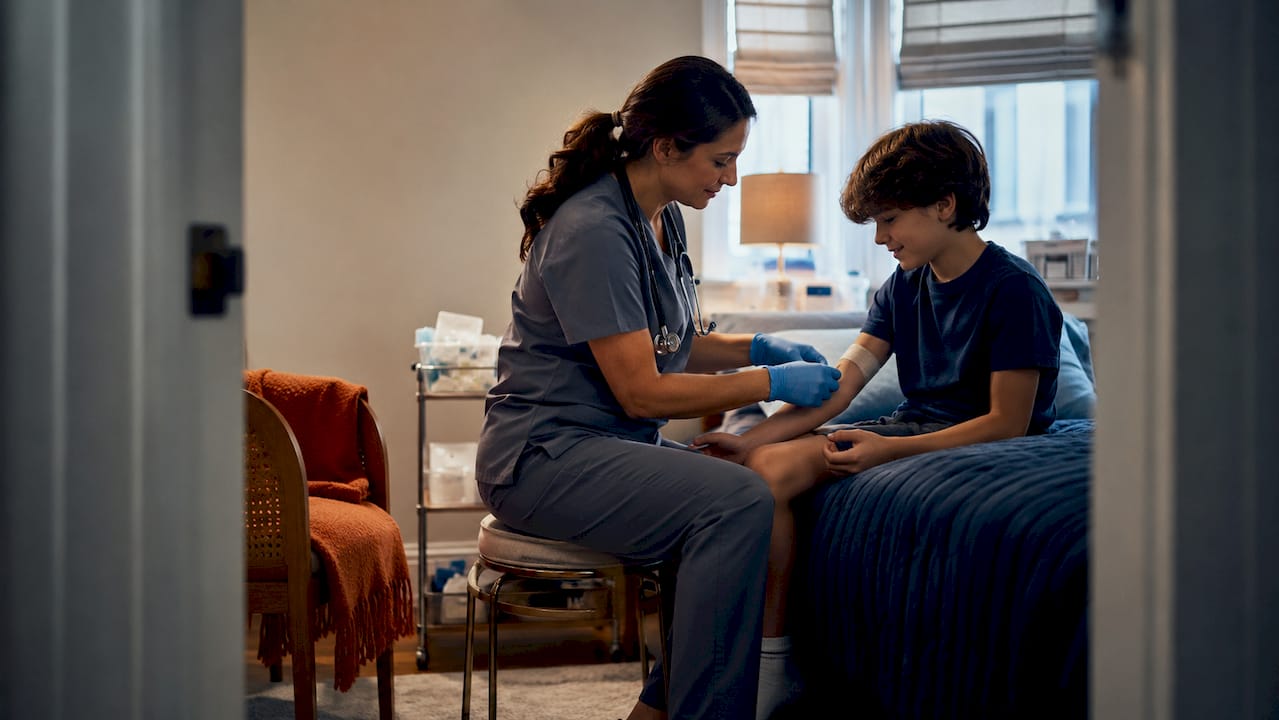
Yes, you can get the same nurse for home care, but which route gets you them matters. Private-duty and concierge nursing models give you the most control over consistent assignment, while Medicare-certified home health often rotates staff due to intermittent-visit rules. Start with an RN assessment, then request an introductory meeting with your candidate nurse before care begins.
TL;DR:
Continuity of care reduces hospital readmissions from 16% to 12.9% within the first month by enabling nurses to recognize subtle health shifts more effectively.
Private-duty and concierge nursing models are the best options for securing a consistent nurse, as they prioritize scheduling control over staff rotation.
Agencies that track nurse retention and use structured matching tools are more likely to assign the same nurse consistently over time.
A formal trial period, clear contractual language, and a written hand-off protocol are critical steps to securing and maintaining nurse continuity.
Families should actively participate by maintaining logs, providing feedback early, and thoroughly vetting nursing agencies’ staffing metrics for genuine continuity commitments.
Table of Contents
Why Having the Same Nurse Improves Outcomes and Daily Life
A nurse who already knows your loved one’s baseline catches problems a stranger would miss. That is not a comfort argument. It is a clinical one.
Continuity interventions are tied to measurably fewer hospital readmissions. One meta-analysis found readmission rates fell from 16% to 12.9% within a single month when patients kept the same care provider instead of rotating through different clinicians. That gap represents real hospital stays avoided, not a rounding error in a spreadsheet.
Continuity by the numbers: Readmissions dropped from 16% to 12.9% in one month among patients with consistent caregiver assignment, according to a PubMed meta-analysis.
The mechanism is simple. A nurse who sees the same patient shift after shift builds an internal map of what “normal” looks like, so a subtle shift in skin color, breathing pattern, or mood registers immediately instead of getting dismissed as unremarkable. Research on care continuity describes this as an early-warning function that rotating staff structurally cannot replicate, since each new nurse has to relearn the baseline from scratch.
There is an emotional layer too. Children with tracheostomies, feeding tubes, or seizure disorders often struggle with what caregivers call stranger fatigue. A consistent routine with a familiar face reduces anxiety and behavioral resistance during care tasks that already feel invasive. The same holds for cognitively impaired adults, where a new face at the door can trigger confusion that a familiar nurse simply does not.
Which Care Models Can Actually Deliver a Consistent Nurse?
Not every home nursing arrangement is built for continuity, and knowing the difference before you sign anything saves months of frustration.
Medicare-certified home health operates under physician orders for intermittent, medically necessary visits. It is not designed around a single assigned nurse. Staffing depends on who is available on a given day, coverage areas, and visit frequency set by the care plan, not by family preference. You may see the same nurse occasionally, but the model does not guarantee it.
Private-duty or concierge nursing, by contrast, is built for scheduling control. Because the family or a private agency sets the terms, a single primary nurse can be assigned to recurring shifts as a standard practice rather than an exception.
Family hire (employing a nurse directly) gives you full control but shifts payroll, scheduling, and backup coverage entirely onto you.
Quick comparison of what each model can realistically promise:
Medicare-certified home health: rotating staff likely, physician-order driven, no continuity guarantee
Private-duty/concierge nursing: primary-nurse assignment standard, family controls scheduling, higher likelihood of a single consistent caregiver
Family hire: full control, but no agency backup network if your nurse is unavailable
Medicaid/GAPP programs (where eligible): can fund continuity-focused pediatric nursing in participating states, worth asking about directly
Private-pay and concierge arrangements consistently allow more scheduling control than Medicare home health, largely because they are not bound by the same intermittent-visit restrictions.
How to Secure the Same Nurse: Step-by-Step
Getting a primary nurse assigned to your case is not automatic. It takes deliberate steps and, honestly, a willingness to ask pointed questions before you sign anything.
Start with an RN-led clinical assessment. This produces a written care plan documenting diagnoses, equipment (trach, vent, G-tube), and daily routines.
Request a formal introductory meeting with the candidate nurse before care starts, not after.
Ask what matching criteria the agency uses. Reliable agencies weigh clinical competencies alongside temperament and family communication style, not just credentials on paper.
Negotiate a trial period, typically one to four weeks, with a scheduling agreement that names the primary nurse explicitly.
Put continuity language in the contract: primary assignment terms, shift-fill expectations, a written hand-off protocol for backups, and a commitment to disclose retention metrics on request.
Pro Tip: Ask the agency for its current shift-fill rate and nurse retention percentage before you sign. A provider that hesitates to share those numbers is telling you something about its staffing capacity.
Agencies that use structured matching and scheduling tools tend to prioritize prior successful placements when assigning shifts, which works in your favor if you have already had one good match.
Interview and Vetting Checklist for the Right Fit
Clinical credentials get a nurse in the door. Temperament keeps them in the role for the long haul, and families routinely underweight that second factor.
Confirm these basics before anything else:
Active nursing license in good standing
Specialty competencies matching your case: trach, vent, G-tube, pediatric experience specifically
Current CPR certification and any condition-specific training
Then move to fit. Ask how the nurse handles a shift when a routine gets disrupted, how they document for a substitute, and what their longest tenure with one family has been. A thorough background check covers licensing and history, but a short conversation about routine-building often reveals more about long-term fit than the resume does.
Set expectations up front: a trial period, defined performance check-ins, and a clear path for corrective action if something is not working. Families who skip this step often end up renegotiating fit issues months in, after trust has already frayed.
Preparing Your Home and Requiring a Hand-Off Protocol
Continuity does not mean your primary nurse never takes a day off. It means backups do not undo months of built-up knowledge when they step in.
Build a one-page care brief covering baseline vitals, feeding and medication routines, and one designated contact reachable through two channels (call and text, for instance). Some providers use a one-contact, two-channel model to keep communication simple during transitions.
Require a written hand-off protocol in writing, not a verbal promise:
Who briefs the backup nurse and when
A standardized checklist covering baseline behavioral cues, respiratory or feeding parameters, and the recent problem list
An explicit sign-off from the primary nurse confirming the hand-off happened
Pro Tip: Keep your own running log of routines and incidents. It becomes the fastest way to brief a backup nurse when your primary is out sick or on leave.
A documented hand-off process protects patient-specific knowledge even when the person delivering care changes for a shift.
Patient and Family Roles in Maintaining Continuity of Care
Continuity is not something an agency delivers to you passively. Families play an active role in whether it holds up over months, not just weeks.
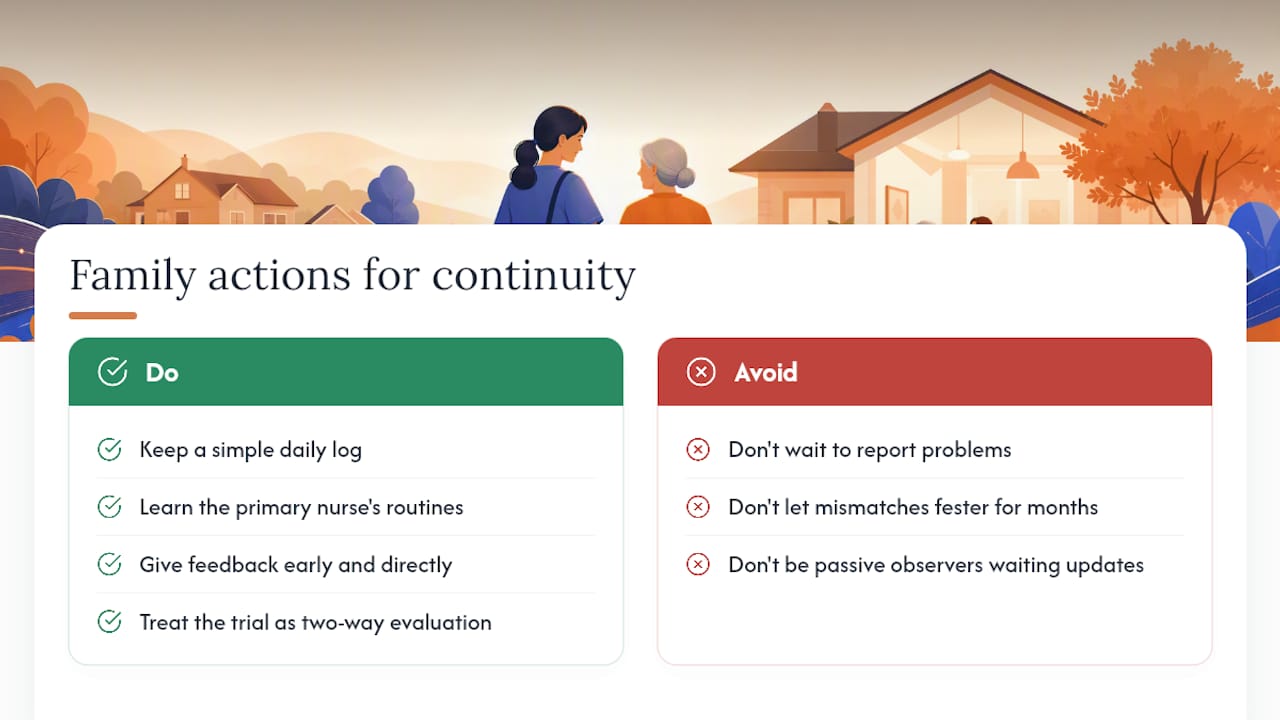
Keep a simple daily log of routines, medication timing, and anything unusual. It sounds tedious until the day a backup nurse walks in and that log saves twenty minutes of confused explanation while your child or loved one is uncomfortable. Parent and caregiver training matters here too. When family members understand the same clinical routines the primary nurse follows, they become a second layer of consistency rather than passive observers waiting for updates.
Feedback speed matters as much as feedback content. If something about the nursing relationship is not working, whether it is a scheduling friction point or a personality mismatch, say so early and directly to the agency rather than waiting to see if it resolves on its own. Small mismatches caught during a trial period are easy to correct. The same mismatches left to fester for three months often end in a nurse leaving the case entirely, which is exactly the disruption continuity-focused care is meant to prevent.
Families should also treat the introductory meeting and trial period as genuinely two-way. You are evaluating the nurse’s fit with your household’s routines and communication style, not just their clinical resume. A nurse who is technically excellent but consistently talks past your questions during the trial is a fit problem worth flagging before signing a long-term arrangement, not after.
Potential Challenges in Securing the Same Nurse Consistently
Continuity is achievable, but it is not automatic, and pretending otherwise sets families up for disappointment.
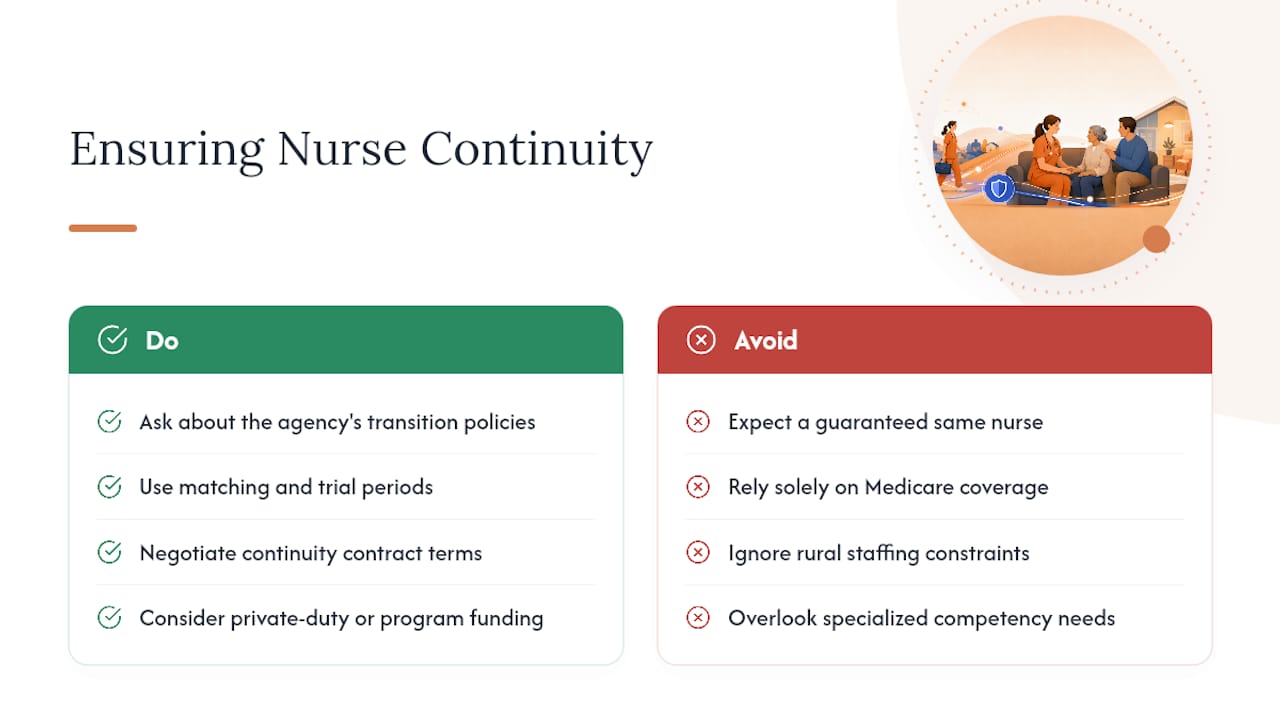
Nurse turnover across home care and home health remains high industry-wide, according to caregiver-matching research, and no agency can promise a nurse will never leave. Illness, relocation, and career changes happen regardless of how good the initial match was. What separates a strong agency from a weak one is not the absence of turnover but how well it handles the transition when turnover occurs.
Geography is a real constraint too. Rural areas or regions with nursing shortages simply have fewer candidates to match against, which can mean longer waits for a primary assignment or a smaller pool of backup nurses when needed.
Complex cases (multiple diagnoses, specialized equipment like ventilators, unpredictable seizure activity) narrow the pool of qualified nurses further, since not every candidate has the specific competencies required. And insurance structure can work against you: Medicare’s intermittent-visit model was never built around a single dedicated nurse, so families relying solely on that coverage should expect more staff rotation than those using private-duty or program-funded models.
The honest answer is that continuity is a target you build toward through matching, contract terms, and trial periods, not a guarantee any provider can make on day one.
Legal and Regulatory Considerations for Continuity
Home nursing sits inside a regulatory framework that shapes what continuity promises actually mean in practice.
Nurses must hold active state licensure and practice within their scope, which affects who can legally perform certain tasks (ventilator management versus basic personal care, for example). Medicare’s coverage rules are federal and require intermittent, physician-ordered skilled visits, which is precisely why guaranteed same-nurse assignment is harder to secure under that coverage alone.
State Medicaid programs, including Georgia’s GAPP for medically fragile children, operate under their own eligibility and authorization rules separate from Medicare. Families should confirm eligibility and authorized hours directly with the program rather than assuming coverage mirrors Medicare’s structure.
Contracts matter legally, not just operationally. Any written agreement specifying primary nurse assignment, shift-fill commitments, or hand-off protocols becomes the enforceable record if a dispute arises later. Verbal assurances about “always getting the same nurse” carry no weight if the signed agreement does not reflect that commitment. Ask that continuity terms appear in writing, and read the cancellation and staffing-substitution clauses closely before signing.
Technology Tools That Support Continuity Between Visits
The right tools do not replace a good nurse, but they close the information gaps that break continuity when a backup steps in.
Agencies increasingly rely on caregiver-matching and scheduling software that tracks prior successful placements, so a family’s preferred nurse gets prioritized for future shifts instead of being reassigned at random. This kind of matching technology also flags scheduling conflicts before they turn into last-minute staffing scrambles.
On the communication side, a shared digital care log, even something as simple as a messaging thread through one designated contact, keeps everyone (primary nurse, backups, and family) working from the same information instead of relying on memory or a notebook that gets left in the wrong room. Secure messaging platforms and shared electronic care plans reduce the odds that a critical detail, like a recent medication change, gets lost between shifts.
None of this technology substitutes for a written hand-off protocol or a trial period built around real feedback. It supports continuity; it does not manufacture it.
Why Continuity Deserves to Be a Non-Starter, Not a Nice-to-Have
Families adjusting to a new home nurse every few weeks live in a low-grade state of vigilance that rarely gets named directly. Every shift becomes a re-briefing. Every subtle change in a child’s breathing or a parent’s memory gets second-guessed because the person watching does not yet know what “normal” looks like for that patient.
That is the gap continuity closes, and it is why Opulentprivatecare built its intake process around the 3 Thumbs Up Rule: family, nurse, and agency all sign off before care starts. Combine that with published shift-fill and retention metrics and a one-contact, two-channel communication model, and continuity stops being an aspiration and becomes something you can actually measure.
If you take one thing from this guide, ask any provider you are evaluating for their current retention numbers before you ask about pricing. The answer tells you whether continuity is a genuine operational commitment or just a phrase in their marketing.
— Opulent
Opulent Private Care: Continuity-First Pediatric Nursing in Georgia
Some providers offer statewide, in-home pediatric skilled nursing for medically fragile children, including tracheostomy, ventilator, feeding tube, seizure, cardiac, and neurological care. Matching may consider both clinical competency and family fit, sometimes using processes like the 3 Thumbs Up Rule, and provide information about shift-fill and retention metrics upon request.
Unlike Medicare home health, which rotates staff by design, Opulentprivatecare structures care around a single primary nurse from the start, with Medicaid and GAPP paperwork assistance handled as part of the intake process. For families managing complex equipment, the trach, vent, and G-tube service line covers the specialized competencies continuity-focused matching depends on.
If your family is navigating a hospital discharge or simply tired of explaining your child’s care plan to a new face every week, start with an assessment and ask what a same-nurse arrangement would look like for your case.
This article is general information, not a substitute for advice from a qualified doctor. Consult a qualified healthcare professional about your own circumstances before acting on anything here.
Sources
Cost depends on hours needed, the nurse’s skill level, whether coverage is live-in or hourly, and whether you are working through agency payroll or hiring privately. Live-in arrangements and higher-acuity skill requirements (ventilator management, for instance) push costs up regardless of the model you choose.
Medicare covers only intermittent skilled nursing tied to physician orders, so families wanting guaranteed same-nurse coverage often need private pay or a program-based path. For eligible pediatric families in Georgia, Medicaid’s GAPP program can fund continuity-focused in-home nursing without the intermittent-visit restrictions that limit standard Medicare home health.
A realistic timeline looks like this:
That day 3 and day 14 check-in structure is not arbitrary. It reflects a pattern agencies rely on because early formal feedback catches most mismatches before they become entrenched problems.
Recommended
Comments