
Avoid GAPP Denials: Medical Necessity Letter Checklist for GA Parents


Yes, a GAPP medical necessity letter is required, and the fastest first step is asking your child’s pediatrician to complete a physician plan of treatment, known as the PPOT, that spells out specific skilled nursing tasks and hours. Georgia Pediatric Program (GAPP) reviewers need that document plus the Appendix Ia form before they can authorize in-home nursing. Ask the physician’s office for a PPOT and a recent office note today. If you already work with an agency, loop it in immediately so they can start assembling the rest of the packet while the doctor’s office prepares the clinical paperwork.
TL;DR:
A detailed physician plan of treatment and supporting clinical records are essential for GAPP approval, with specific hours and tasks clearly documented.
Submitting legible, signed documents such as office notes, discharge summaries, and test results reduces review delays and increases approval chances.
Only a physician can sign the medical necessity order, but agencies like Opulentprivatecare assist in preparing, coordinating, and submitting the complete packet.
In case of denial, providing targeted objective evidence and requesting clarifications or peer reviews can improve chances of approval on resubmission.
GAPP authorizations are not permanent and require annual updates with recent documentation to maintain coverage.
Table of Contents
What Is a GAPP Medical Necessity Letter and When Do You Need One?
GAPP serves children under age 21 who are enrolled in Georgia Medicaid and have a documented medical need for skilled nursing or personal care support at home. The Georgia Pediatric Program presentation confirms the program has operated since August 2002 and covers children up to just before their 21st birthday.
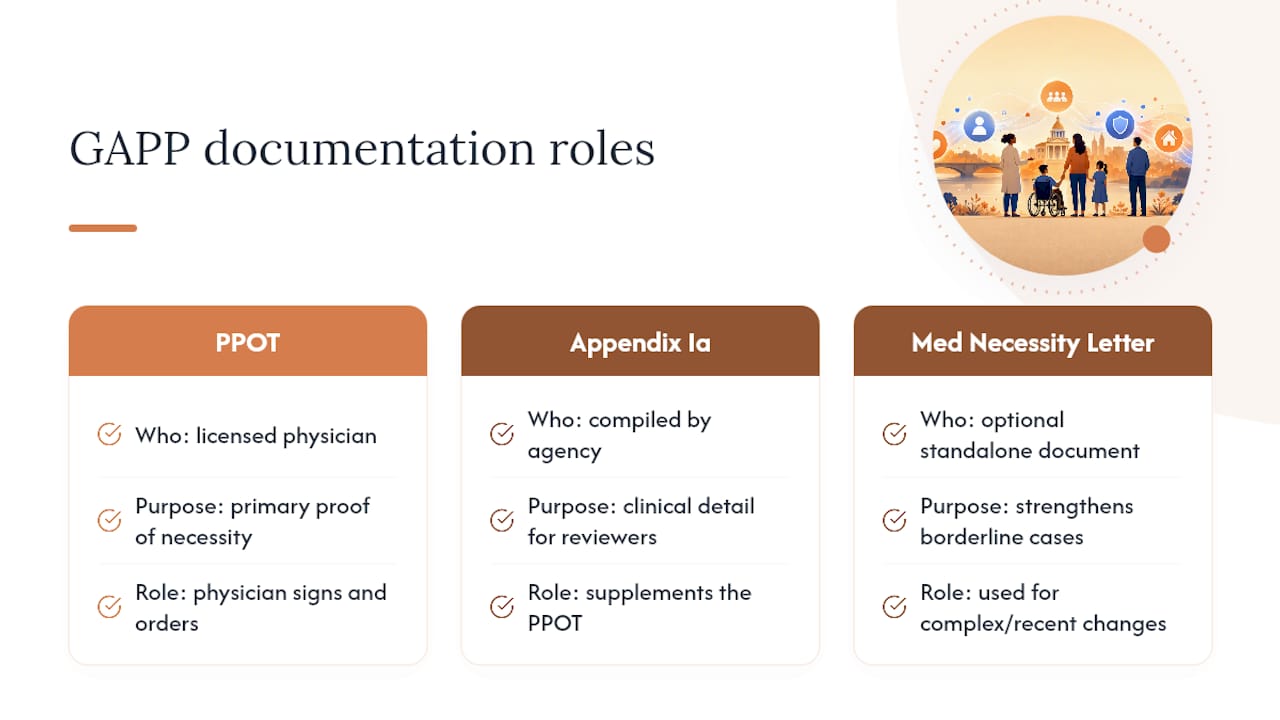
The physician order, called the PPOT, functions as your primary proof of medical necessity. Appendix Ia supplements it with clinical detail reviewers use to confirm the request. A standalone Letter of Medical Necessity isn’t always mandatory, but it strengthens a borderline case, especially when a child’s condition is complex or recently changed.
Physicians write and sign the PPOT because only a licensed provider can attest to medical necessity. Agencies typically handle Appendix Ia, coordinate with the physician’s office, and compile everything into one submission. Confusingly, searching “GAPP” online sometimes surfaces unrelated products like auto GAP insurance, which has nothing to do with Medicaid pediatric nursing.
What Should the Medical Necessity Letter Actually Say?
Reviewers deny requests most often because the clinical rationale is vague or missing, not because a form is the wrong brand; see this medical necessity documentation examples guide for helpful phrasing and checklist ideas. A strong letter or PPOT addendum covers these elements:
Diagnosis and objective findings: the exact medical diagnosis, plus recent vitals, lab results, or imaging that back it up.
Specific skilled nursing tasks: name the actual task, such as “tracheostomy suctioning every 2 hours” or “ventilator setting checks each shift,” not a general phrase like “nursing supervision.”
Equipment settings: ventilator mode, oxygen liter flow, or feeding pump rate and schedule, if applicable.
Requested hours with a daily schedule: state the number of nursing hours per day and per week, tied to when the tasks actually occur.
Duration and recertification timeline: note whether the need is ongoing and when the next review should happen.
A cost-effectiveness statement, when relevant, comparing in-home nursing to a hospital or facility stay.
A physician might write: “Patient requires tracheostomy care and ventilator monitoring 16 hours daily due to chronic respiratory failure; skilled nursing assessment is medically necessary to prevent hospitalization.” That single sentence hits diagnosis, task, and hours at once.
Pro Tip: Legibility trips up more submissions than people expect. Clinical necessity guidelines cited by eviCore stress that unreadable or vague notes can stall a review before anyone even evaluates the clinical facts. Ask the physician’s office for a typed note instead of handwritten scrawl.
What Supporting Documents Do You Need to Attach?
The medical necessity letter rarely stands alone. GAPP’s manual lists a specific set of forms and records reviewers expect to see together:
Recent physician office notes, showing the clinical trajectory over the past few months.
Hospital discharge summaries, if your child was recently admitted.
PPOT (DMA-80), the core physician order.
Appendix Ia, the supplemental clinical information form.
Letter of Understanding (Appendix J), which confirms the family understands program responsibilities.
Freedom of Choice (Appendix G), documenting the family’s choice of provider.
Test results and current medication list, and therapy notes if occupational, speech, or physical therapy is involved.
Each document serves a distinct purpose. Office notes show reviewers the condition is active and being managed, not historical. Ventilator or feeding settings demonstrate daily complexity that justifies skilled hours rather than unskilled caregiving. When you request records, ask specifically for legible copies with clinician signatures and visit dates. A missing signature or an undated note is one of the more common reasons a packet bounces back for correction.
Who Signs and Submits the Letter, and How Agencies Help
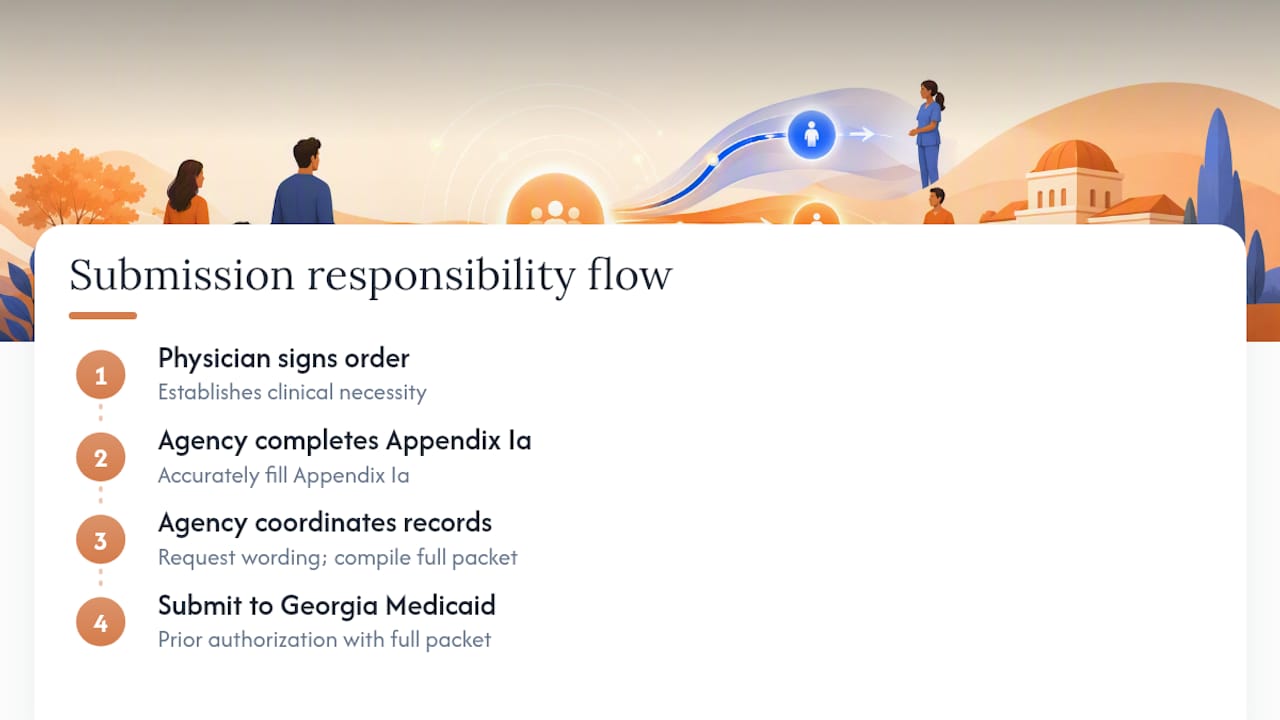
Only a physician can sign the medical order that establishes clinical necessity. That responsibility never shifts to an agency, no matter how experienced the staff. What agencies can do is fill out Appendix Ia accurately, coordinate directly with the physician’s office to request the right wording, and compile the full packet before it goes to Georgia Medicaid for prior authorization.
This is where working with an established provider pays off. Opulentprivatecare follows a documented process for coaching physicians’ offices on required phrasing and tracking down missing records before submission. The agency’s “3 Thumbs Up Rule,” requiring sign-off from the family, the caregiver, and the agency before care starts, reflects the same attention to detail that keeps a paperwork submission from stalling.
How Do You Submit the Packet and What Happens Next?
Once the clinical documentation is ready, submission follows a fairly predictable path:
The physician completes and signs the PPOT, including diagnosis, tasks, and requested hours.
The agency finishes Appendix Ia and gathers office notes, discharge summaries, and other supporting records.
The complete packet goes to Georgia Medicaid as a prior authorization request.
A medical review team evaluates the submission against documented necessity.
Approved requests generate a Determination Letter, sometimes called the LON, and services can begin.
Complete files move faster. Dated, signed office notes and specific hourly requests shorten review time; vague or incomplete submissions get sent back for clarification, which adds weeks. GAPP authorizations aren’t permanent. Expect annual recertification, which typically means a fresh Appendix Ia, an updated Letter of Understanding, and a renewed Freedom of Choice form to keep the case active.
What If GAPP Denies Your Request?
A denial letter states a reason, and reading it carefully matters more than reacting quickly. The most common causes are incomplete or unclear medical rationale, a lapse in active Medicaid status, or missing signatures on the PPOT or Appendix Ia.
Once you know the reason, the path forward usually looks like this:
Gather the specific missing records the denial cites, such as a recent office note or lab result.
Ask the physician to issue a clarifying addendum, or request a peer-to-peer review if the denial hinges on clinical judgment.
Have your agency resubmit the corrected packet rather than starting from scratch.
File a formal appeal within the timeframe stated on the denial letter itself.
Pro Tip: Tie every requested skilled task directly to an objective finding already in the chart. A reviewer who denied “24-hour nursing” for lacking justification is far more likely to approve “16 hours daily tracheostomy care” backed by a note documenting frequent suctioning. For a deeper walkthrough of appeal timing and documentation, see this GAPP denial appeal guide.
Why the Paperwork Burden Is Heavier Than It Should Be
Parents rarely fail at GAPP applications because they misunderstand their child’s needs. They fail because the forms demand a level of administrative precision that has nothing to do with clinical skill. An agency that has moved dozens of PPOTs through the same review process knows which phrases trigger a second look and which physician’s office needs a nudge to include vent settings. That institutional memory matters more than any template. When evaluating agency fit, ask direct questions: how many active GAPP cases do they manage, how do they communicate delays, and will the same nurse show up consistently once care starts.
— Opulent
How Opulentprivatecare Helps Georgia Families Get Through the Paperwork
Filling out a GAPP packet correctly the first time saves weeks, and that’s exactly where Opulentprivatecare’s day to day experience with Georgia families pays off. Rather than leaving parents to interpret PPOT wording alone, the team works directly with your child’s physician to make sure the order reflects the specific tasks and hours reviewers expect to see.
Here’s what that support actually looks like:
Coaching physicians’ offices on the exact clinical language GAPP reviewers require.
Completing Appendix Ia and collecting office notes, discharge summaries, and test results on your behalf.
Assembling and submitting the full prior authorization packet to Georgia Medicaid.
Matching your child with a consistent nurse once authorization comes through, so you’re not managing rotating staff on top of managing paperwork.
If your family is starting a GAPP application or has hit a wall with a denial, visit Opulentprivatecare’s Georgia pediatric nursing page to talk through your child’s specific needs and get help moving the packet forward.
Sources
This article is general information, not a substitute for advice from a qualified doctor. Consult a qualified healthcare professional about your own circumstances before acting on anything here.
FAQ
Is a Medical Necessity Letter Always Required for GAPP?
A physician-signed PPOT documenting skilled nursing needs is required for every GAPP case, and a supplemental Letter of Medical Necessity strengthens the file when the clinical picture is complex.
Who Writes the GAPP Medical Necessity Letter?
The child’s physician must write and sign the clinical order, though an agency like Opulentprivatecare can help draft supporting documentation and coordinate with the physician’s office.
What’s the Most Common Reason GAPP Denies a Request?
Vague or incomplete clinical rationale is the leading cause, followed by missing signatures and outdated or illegible office notes.
How Long Does GAPP Take to Approve a Submission?
Timing varies by case, but complete packets with dated office notes and specific hourly requests move through review faster than submissions missing required records.
Does GAPP Require Annual Recertification?
Yes, GAPP authorizations require yearly renewal, including an updated Appendix Ia, a renewed Letter of Understanding, and a current Freedom of Choice form.
Recommended
Comments